Who is afforded a non-politicized death?
All My Dead Cats and Other Losses by s.e. smith

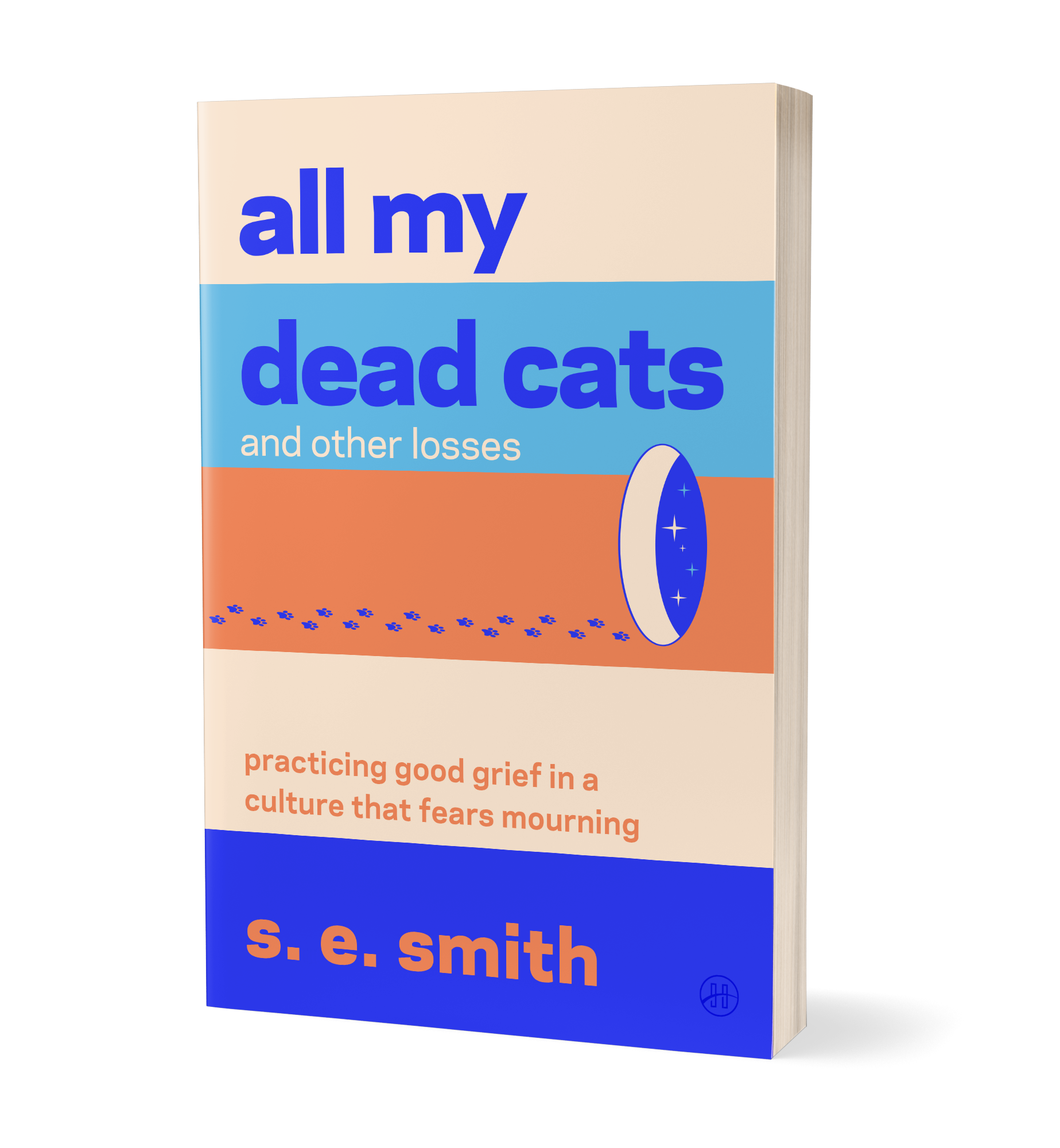
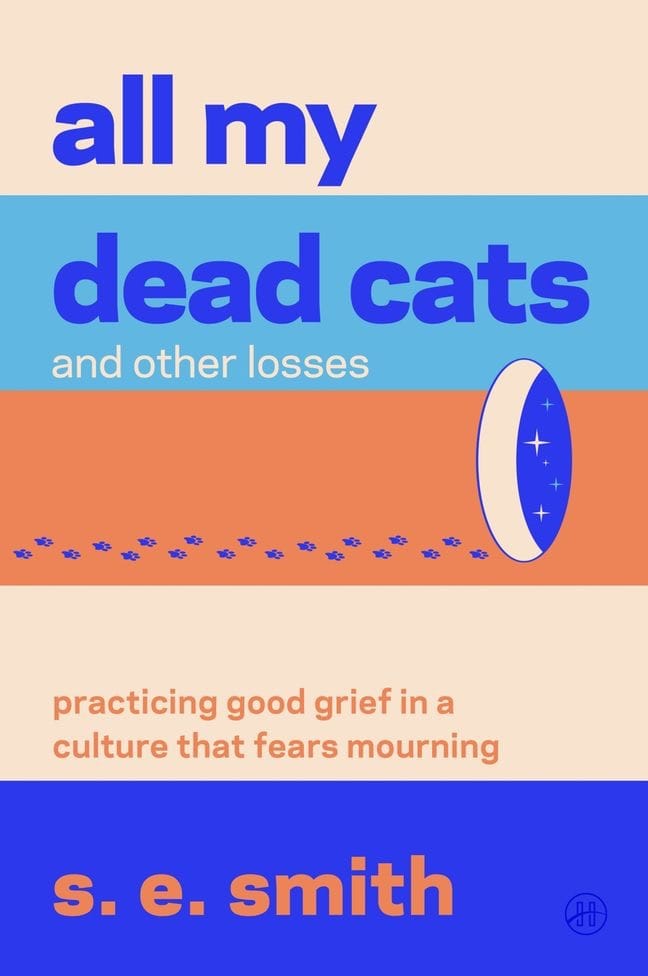
Today I'm happy to share an excerpt from the forthcoming book All My Dead Cats and Other Losses by s.e. smith, a National Magazine Award-winning journalist and cofounder of the worker-owned feminist media collective The Flytrap.
I know I'm very subtle about it but longtime Hell World readers may have picked up on a certain preoccupation and/or obsession with death in basically every single thing I've ever written. (The working title for my next book by the way is I'm never going to die lol). My own personal style of dealing with death and loss and the looming prospect of both is uh – not healthy. I'm not unlike many Americans in that regard. But there are other ways to mourn. Grief need not be so isolating and individualistic and shameful and commercialized as we have come to understand it. Throughout the book smith weaves touching stories of personal loss with discussions from professionals in the death business – funeral home directors and death doulas and so on – and tries to help us all try to, not answer, but better reckon with the most unsolvable puzzle we have going.
I'll turn it over to smith to introduce the chapter this selection is taken from and then the excerpt itself. Sign up for free or with a paid subscription to support our work here. Thank you for reading.
I started All My Dead Cats and Other Losses in early 2020—right before covid hit U.S. shores, and when I was thinking a lot about "complicated grief," now known as "prolonged grief disorder." How, I asked myself, did the way we mourn in America get so fucked up that having feelings about death that last more than six months is a literal pathology? Why are we sending people to the doctor for carrying their dead with them rather than putting them on a shelf somewhere? You can post a little annual memorial comment—nothing too uncomfortable about how you feel broken apart and adrift still—on social media for a couple years about how you miss someone who was essential to your world but no more than that?
I knew we were trapped in capitalism, bootstrapping, and fear of any kind of emotional expression, but the deeper I got, the more furious I became, especially as I watched a pandemic kill millions of people worldwide while Americans were more fixated than ever on pretending that you should go back to work the day after someone dies as though nothing had gone wrong. We were a country clogged with grief and no one was talking about it, or if they were, it was about how to move on as though this thing didn't shatter our entire world.
I also started thinking about who is allowed to mourn and how, why some forms of grief are considered normal and acceptable while others are rejected, and why some deaths simply do not matter. How is it that the White House is posting RIP Harambe memes while casually killing hundreds of people in boat strikes in the Caribbean; sending our neighbors to concentration camps; and killing protesters in the street? Why is collective rage, grief as a political project, shutting down a freeway or grinding a city to a halt, doing too much?
I wrote this book because it was the one I wanted to read as a person who is tired of pretending and mad as hell: It is cultural criticism and a conversation about mourning and the urgency of making grief a social and collective activity, not a self-help how-to guide promising a solution to grief. It is grief as in fuck you, because loss is not something you can fix with the right cheat code, so let's be mad together—and hopefully, you'll find something here that resonates with you, puts a name to something you've been trying to articulate, and makes you want to text a friend late at night.
– s.e. smith
Grief associated with politicized losses, which can carry a double weight of anger and sorrow about the loss itself, but also grief about the way the loss played out and was treated by society, are often not understood as a form of disenfranchised grief. People in this situation are unable to mourn the very real and immediate loss of loved ones because those deaths have become wrapped in something larger that doesn’t belong to them anymore. These kinds of deaths are all around us, and sometimes it is hard for us to remember that a prominent, widely discussed death also involves very real people who were close to the decedent in a culture that projects a variety of things onto these deaths.
When I visited the Emmett Till Memorial at the National Museum of African American History and Culture, it highlighted these tensions for me. Till was just fourteen in 1955, a child, when he was kidnapped and lynched in a violent punishment for talking to a white woman. Mamie Till lost a son, but his funeral turned into a political commentary, one that resonated for me standing in front of his recovered and refurbished coffin, displayed at the request of the family just as his mangled body was prominently featured in the media at the time of his death as a sobering illustration of the impacts of racism in Jim Crow America.
In a mingled room of predominantly Black and white visitors, we related to this visual representation of profound grief very differently, drawing upon our own distinct cultural backgrounds. Seeing images of the anguished Mamie Till at the coffin and her son’s funeral blown up to larger-than-life size on the walls, I thought of her dual losses: of her son, and of the ability to mourn on her own terms, grieving in such a public way and under pressure to relate her son’s death to the larger civil rights movement, after a killing that ultimately had a profound impact on American history precisely because it was politicized, its shocking nature a rebuke. As the attendant reminded us not to take pictures at the request of the family, I was struck by their attempt to exert some control, taking back a narrative that had been wrenched from them when Emmett became a symbol.
Populations experiencing sustained mass traumas are also reckoning with politicized disenfranchised grief and the feeling of being abandoned by society—because if society recognized and cared about their trauma, there would be a bigger push to put an end to these cycles. Black communities face an epidemic of deaths caused by social inequalities within the frame of a white supremacist culture that expresses outrage and distaste for their expressions of grief. Nearly a thousand people died trying to cross the harsh U.S.-Mexico border in 2022, but the families of people from Latin America and elsewhere risking everything in the arid landscapes of the Southwest may not even have bodies to mourn, and they are grieving people the U.S. government has dehumanized for decades. Thousands of Indigenous people are missing and murdered across the United States, their relatives fighting for recognition and investigative resources. Disabled people face a steady mass drip of deaths caused by violence within the medical complex and are told that these deaths are inevitable. This experience of death and loss as a social and political identity is explored in Achille Mbembe’s Necropolitics, which probes “the capacity to define who matters and who does not, who is disposable and who is not.”
Decisions about how to respond to these kinds of deaths can be heartbreaking and stressful. Making decisions about how to leverage the political weight of a death while the body is still warm can feel crass, unseemly.
“It was necessary to take to the streets, to become not just mourners but militants. How else could one honor the dead, and prevent further deaths?” wrote Hannah Gold in an essay exploring what we owe both mourners and the dead for The Baffler. For some people and bodies, existence is inherently political, and the fight to stay alive is an act of resistance, which turns death into something larger than themselves and the experiences of the people grieving them.
“Who is afforded a non-politicized death? Who is afforded a non-politicized life?” she asked.
These questions haunt some disenfranchised grievers facing pressing decisions about how, and if, to integrate a loss into a larger social and cultural conversation. “It feels dirty to plot like this,” Gold continued, “to utilize the real and present grief of others. But in this moment of urgency, it seems we are not above it. Maybe in a generation, I think, these dead will be able to rest.” She was speaking to the realities of a world where the dead cannot rest because they are political symbols too, and their mourners share their losses with the world in a way that feels like losing autonomy and control.
Death comes with sharp edges. Who deserves, as Judith Butler has asked, to be mourned, and how? If we acknowledge that disenfranchised grief is real and complex, and that people should be able to mourn the things they experience as losses, there’s still a secondary question of how and whether they can mark those losses, what kinds of rituals and ceremonies are considered appropriate, and how much space they can take up in their grief. Under this framing, conversations about grief cannot be taken literally as conversations about death, and death cannot be interpreted as an individual issue, not least because everyone who dies knew numerous people, touched their lives in different ways. Loss affects us all, deeply, and some of us are feeling disenfranchised grief without even being aware of it.
Expanding our understanding of loss and subsequent grief to realms beyond death and understanding that disenfranchisement often plays a role in non-death losses alongside stigmatized and politicized deaths are both key elements of better grief. Acknowledging disenfranchised grief may bring us a step closer to creating space for mourners to express themselves and work through and with their grief in a way that suits their individual circumstances, but that also requires engaging as a society with the reasons why some people (and animals), mourners, events, and deaths are devalued. It is not enough to put up a #BlackLivesMatter sign.
In a harsh helix, people experience disenfranchised grief because society minimizes their losses, sometimes by telling them to be silent, sometimes by thrusting them unwillingly into a spotlight that deprives them of their grief as a personal event.
Those who cannot mourn because they are supposed to remain in silence or perform for society at large get stuck. We are all of us waiting for the real memorial, the funeral, the gathering, frozen in amber that is freezing and fracturing as it becomes apparent that these validations will never come, for an end to the ongoing trauma that dogs the heels of some grievers: The loss is not over. We see each other in passing, something about the eyes that is familiar, and we nod.
s.e. smith is a National Magazine Award-winning journalist and cultural critic whose work has appeared in Esquire, The Guardian, Rolling Stone, Bitch Magazine, and numerous other publications in addition to anthologies such as Body Language and Disability Intimacy. Smith is also a cofounder of The Flytrap, a worker-owned feminist media collective.
This excerpt, adapted from All My Dead Cats and Other Losses: Practicing Good Grief in a Culture That Fears Mourning by s.e. smith (HarperOne, 2026), appears by permission of the publisher.
A selection of related reading in Hell World:
 Luke O’Neil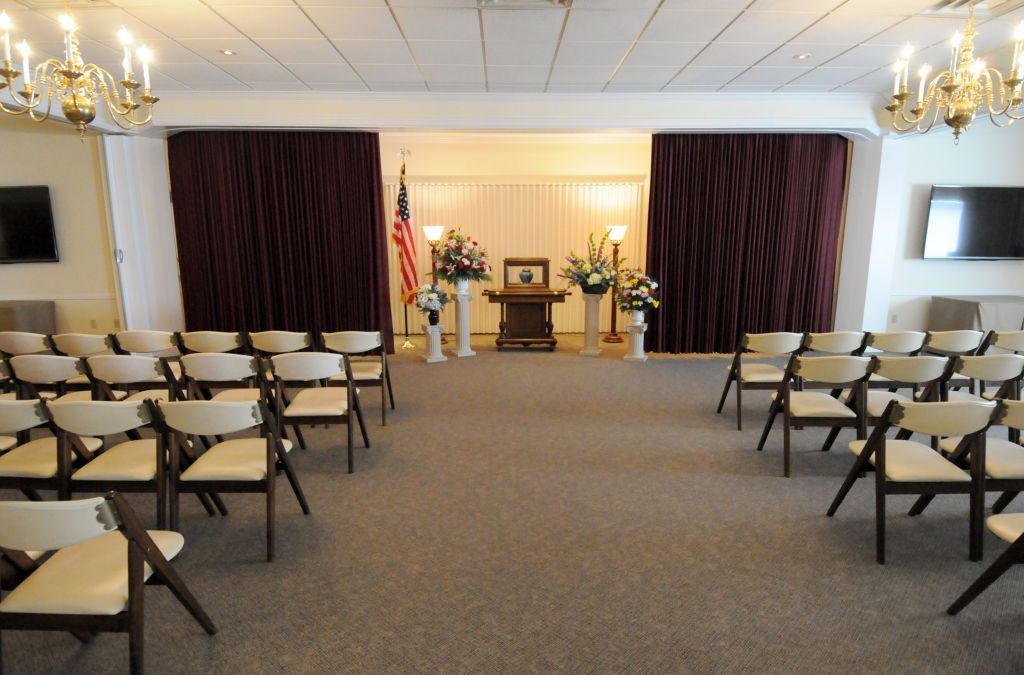
My first experience with death was sitting in the morgue inside my dad’s house in Northwest Indiana—the funeral home—on one of the Saturdays he had custody. Because I was probably in kindergarten, he didn’t trust me to be alone, so instead he had me sit in a rickety, old, wooden chair that had an armrest affixed to it with duct tape—we were Polish, after all—and let me watch as he and his embalmer guy sucked the fluids out of a person and replaced them with a batch of chemicals. I think I was four or five years old. I’m not sure this was better than whatever I would have gotten up to on my own, but I think it says a lot about our familial dynamic.
In my dad’s minivan there was a cot with a gray cloth cover that was always there, just in case, while we were out, we had to stop and pick up a body, either from the local morgue or on a house call. Once after a Little League game my dad gave another kid a ride home and he absolutely freaked out that a dead body had once been reclining on the cot in our van. I remember not being able to understand why this was such an alien concept to him. While I can appreciate that not every eight-year-old has watched people be embalmed on a regular basis, the fact that death was so abjectly terrifying even in this most tangential context has always stuck with me.
 Luke O’Neil
It’s really unpredictable how somebody is going to react to the news. Largely people immediately have regrets. I hate to say that. It’s human nature to not expect yourself to die. As the protagonist of reality you don’t expect that you’re ever going to die or not be around. I think a lot of people, it’s trite, but they go through those stages of grief. There's gotta be something else you can do, or what did I do wrong or what can I change. There has to be something. I think grief and regret comes early on in the process of digesting the news.
Then a lot of times it’s pretty inspiring. People try to make amends with themselves. A lot of times you see healing, or they’ll say I need to talk to my son. There are people I need to apologize to. A lot of times people deal with the news well. When that happens I sit down with them and say tell me about your life. Tell me what you did. A common thread I’ve seen is that if somebody felt loved during their life they have an easier time accepting the end of their life. It’s not a matter of success or accomplishment but if someone just feels like there was another person who cared for them when they were alive… The tragedy is that I’m not going to see my wife again, but at least I had that person caring for me the whole time.
It’s when people have unresolved fights in personal relationships, or that they’re processing that all the wealth they accumulated is not going to help extend their life…. Those are the people I would say where there’s not acceptance. There’s no peace. There’s not a good scientific analysis of this type of thing, but I think it’s 50/50 where people have a very sudden peace.
 Luke O’Neil
A dozen or so of us have been texting a lot again the past couple months since our friend has been sick in the way you do when this happens. It brings the living together. Death. One of its most peculiar tricks. We've been sharing old stories. Making each other laugh. Remembering ways in which our friend specifically made us all laugh. He had the kind of laugh that you coveted. That made you feel like a million fucking dollars if you could get it out. Not that he was stingy with it. The opposite in fact.
You have to laugh through shit like this. I don't know why that is. I didn't invent this fact I inherited it like we all did. You have to laugh because it's a cruel fucking joke. The entire thing start to finish.
When you aren't crying that is. It's a strange thing I've often felt. When an old friend dies. That I don't cry until a second old friend calls to ask if I've heard. A kind of triangle has to be formed. There's a geometry to it.
 Luke O’Neil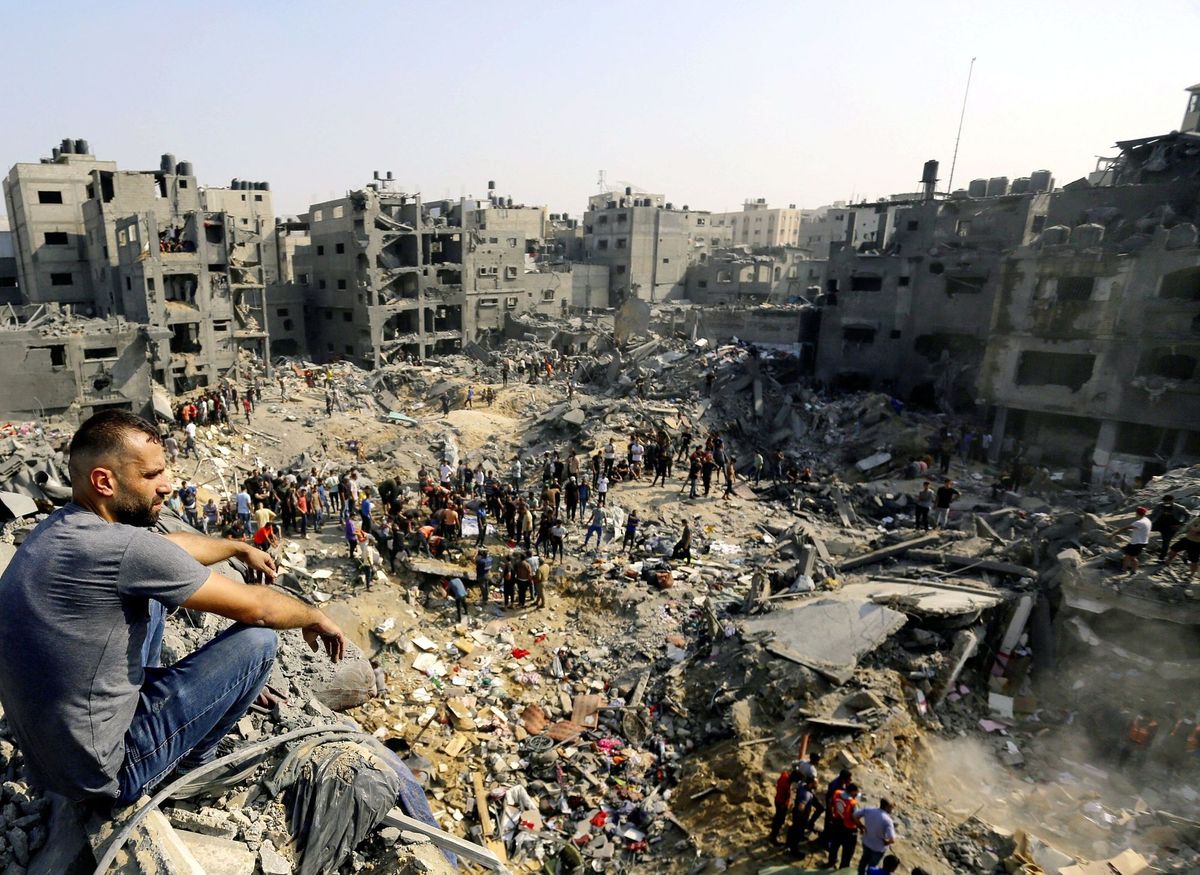
This is all before we even mention the outward reaching and outward reaching tentacles of suffering involved in a war like this.
You lived! But a hundred or more people you know or love did not.
They don’t post those statistics on the news. They don’t say 200,000 driven mad by a grief that they will never recover from. We don't have a way to tabulate that sort of thing.
 Luke O’Neil
While numbers vary state by state, whether you’re insured or not, and on how complicated the delivery itself is, the average cost of having a baby in America ranges into the multiple thousands of dollars if not into the tens of thousands of dollars.
The cost of the other main thing besides being born we’re put here on earth to do — die — isn’t much different.
Setting aside the ridiculous costs of healthcare before we even get to the dying part, what happens after we pass ends up costing the people we leave behind exorbitant amounts as well. Again, depending on the state, the cost of a funeral averages somewhere in the vicinity of $7-$12,000. Swipe the fucking credit card on the way in and on the way out. Toss in the other typical major milestones in a fortunate human’s life — buying a home, getting married and going to school — and the moment of conception starts to look like nothing but a decades long process of accumulating debt merely to exist and function in society.
As Harvey Day writes below “We die as we live, buried in debt.”
And we’re buried in that debt even as we’re literally being buried in dirt.
 Luke O’Neil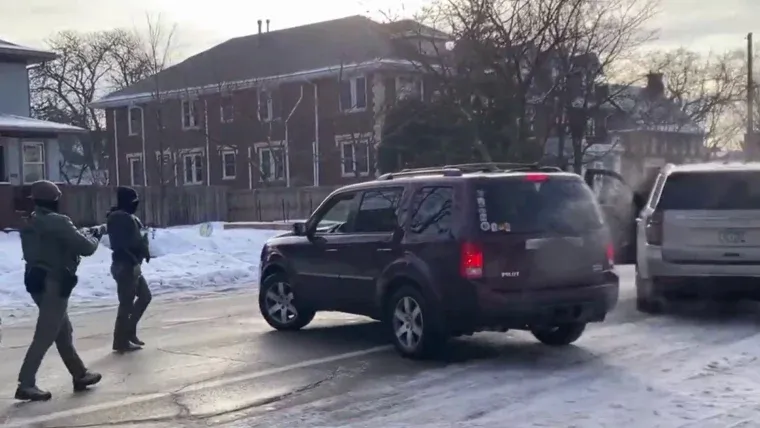
Her family will have to endure incursions by that warped, false version of reality as they mourn their wife, mother, and friend against a backdrop of cruelty and repression—just as Heyer’s mother, Susan Bro, had to see her daughter’s corpse splashed all over social media by neo-Nazi trolls as she grieved. To die a politicized death in America is to be forever denied peace. Emmett Till's memorial sign has been repeatedly shot up and defaced; so has Black Panther Fred Hampton’s. Much of the media has refused to even acknowledge the murders of Palestinian journalists or the continuing genocide in Gaza, let alone memorialize the unfathomable loss. ICE has shot eight other people in the past four months, and killed four. A memorial to Heather Heyer in Charlottesville, VA was also vandalized in 2019, and community members must remain constantly vigilant to protect it. Even the dead aren’t safe, and preparations should be made to ensure that this latest martyr is protected in her eternal sleep.
 Luke O’Neil
There’s no wrong way to grieve. Over and over, they tell us this. It’s true, I guess, in the sense that no central grief regulatory body is going to sanction me for how I’m going about it. No poster will go up bearing my face and the words “DO NOT ALLOW THIS MAN TO GRIEVE.” (Where would they even put it?) But in another sense, there’s no right way to grieve, if we understand grief as a primal scream to the heavens of “Where did you go? Why aren’t you here?” There isn’t a way to scream that so loudly it will result in a reply, and it’s so hard to grapple with that ice-cold fact and not wonder on some level what the point of any of it is.
It makes me feel ashamed of my emotional immaturity sometimes, this failure to accept the fact of her absence. Death is the great, looming fact, wholly indifferent to our objections. The men who seek to overcome it are embarrassing freaks, fish-faced zillionaire oligarchs who think mortality is for the little people. Is there any way to cry skyward that I want my friend back without throwing in my lot with their worldview? Are these questions without answers all just part of the bargaining stage? Because if I’m still there a decade in, the depression stage is going to be a mother.