It’s the price we pay for love

Zack Budryk returns today with a lovely meditation on grief and how it changes over time.
"One of these inexpressible phenomena tied to loss...is the way the person you’ve lost is fixed in amber for all time the way they were when they died, but the ghost in their place is changing every second of every day."
More from me after that.
A thousand ghosts
by Zack Budryk
The bravest friend I ever made was tall for a woman, with long brown hair that tangled easily but that she’d never cut short, and most days, a red lip that a Golden Age Hollywood actress would envy. She was born and raised in King, North Carolina, a town northwest of Winston-Salem with fewer than 10,000 people, and made many (and there were many) of the friends she’d cherish for the rest of her life at Salem College, the oldest women’s college in the US.
She had an incredible, infectious laugh and she loved good whiskey, karaoke, Ramshackle Glory and her chocolate lab Bella. Somehow or other she and another friend of ours acquired a pack of little plastic novelty hands that you could stick on the ends of your fingers and I have an oddly specific memory of her fucking around with those things and leaving them around the office all the time in her final weeks.
Caroline Elizabeth Wall died unexpectedly some time on the morning of June 21, 2016, a few months into her twenty-fifth year. I remember the moment of awful confirmation after a couple hours of frantic attempts at contact, and clapping my hand to my mouth in a way I am not normally given to do, but what really sticks in my memory are the physical sensations. It was the second full day of summer in Washington DC, one of those summer days that alternated between pissing rain and hateful, moisture-pregnant heat. On a sensory level, it all added to the sense that the pain of this day would surely kill me too. It was like all the earth was sobbing.
Grief has a way of going from all you can think about, all you can feel or taste, to a companion so constant its presence can give you a jump scare, like a cat that’s grown old with you (I should know, as a keeper of both). It doesn’t check with you before making this transition. It doesn’t check with you for anything. No matter how you cope or process it, grieving for ten years will make you a different person than you ever would have been in another life. My friend Charlie calls us “grief scholars,” ordinary people with a terrible expertise thrust upon us by circumstance, the only way to gain it in the first place.
I didn’t spend much of my twenties thinking about my thirties. Few of us do, I suspect. But when I did, I certainly didn’t think I’d be someone with a friend who’d been dead for ten years as part of them. I entered adulthood with the charmed oblivion of one who did not meet loss young. No one really prepared me for it because no one really can prepare anyone else for it. To try to articulate grief to someone who hasn’t known it is like trying to describe the color green to someone who’s never seen it.
One of these inexpressible phenomena tied to loss (and there are hundreds that no one person could hope to coherently catalogue) is the way the person you’ve lost is fixed in amber for all time the way they were when they died, but the ghost in their place is changing every second of every day. There are a thousand different Carolines who have lived by my side and given me counsel in the last ten years, all of them as true and real as every other and all of them ungraspable even by other people who loved her, much as their own thousand Carolines could never be understood or felt by me.
The need to hold onto a person from beyond the veil is one of the oldest recorded human longings. We’ve been doing it practically since we realized we could lose people, and one of the seemingly clearest signs that other animals have some consciousness at least adjacent to our own is their own approximations of the same behavior. I knew Caroline, and lost her, in a time when I was something of the historian of every friend group I found myself in, taking pictures to commemorate every night out, copying a funny exchange into a Facebook status, remembering with autistic precision the origin of every running inside joke. In the years following Caroline’s death, this left me feeling like it was my job to curate those memories for the sake of everyone who loved her. But how vital a function is that ten years in, long past the point that any new memories are being made? Is it rank narcissism to worry about that in the first place? Or is it a debt I owe her to find new ways to fulfill?
There’s no wrong way to grieve. Over and over, they tell us this. It’s true, I guess, in the sense that no central grief regulatory body is going to sanction me for how I’m going about it. No poster will go up bearing my face and the words “DO NOT ALLOW THIS MAN TO GRIEVE.” (Where would they even put it?) But in another sense, there’s no right way to grieve, if we understand grief as a primal scream to the heavens of “Where did you go? Why aren’t you here?” There isn’t a way to scream that so loudly it will result in a reply, and it’s so hard to grapple with that ice-cold fact and not wonder on some level what the point of any of it is.
It makes me feel ashamed of my emotional immaturity sometimes, this failure to accept the fact of her absence. Death is the great, looming fact, wholly indifferent to our objections. The men who seek to overcome it are embarrassing freaks, fish-faced zillionaire oligarchs who think mortality is for the little people. Is there any way to cry skyward that I want my friend back without throwing in my lot with their worldview? Are these questions without answers all just part of the bargaining stage? Because if I’m still there a decade in, the depression stage is going to be a mother.
Another of the things you have to learn for yourself is that even though you’re not making new memories, you and the person who’s gone, you, on your own, are creating new understandings of both the person and their ghosts, in ways you’d never expect.
Last August, Aubrey Plaza told Amy Poehler on her podcast that she’d found an unlikely frame of reference for navigating the death of her husband, Jeff Baena, earlier that year. Plaza referenced the corny streaming sci-fi movie The Gorge, saying “there’s a cliff on one side and there’s a cliff on the other side, then there’s a gorge in between and it’s filled with all these monster people that are trying to get them … I swear when I watched it, I was like, that feels like what my grief is like…or what grief could be like.”
Plaza is self-effacing about her insight, blanking on the title of the movie and calling it a “really dumb analogy.” But far from being dumb, what she’s describing is one of the most consistent emotional sensations I’ve experienced since Caroline died, one that can be as sharp and sudden as her death itself, the beautiful, terrible presence of her in a world where, when she was alive, she could only occupy a single space. It could be a movie or a song she loved, or hell, it could be a song she wasn’t even alive for. Caroline hated Neil Diamond’s Sweet Caroline but I’ll be damned if I can ever hear it again without first and foremost thinking of her, which is saying something coming from a family of Red Sox fans.
There will, ultimately, be other people I lose. There already have been. It’s the price we pay for love. And perhaps I could avoid that by never knowing people like Caroline in the first place, but that’s no choice at all. Maybe that’s what I still have to learn from her and her thousand ghosts, long after they’ve made any new memories. Maybe they’re all still making me brave enough to continue to love enough to fear losing it.
The day Caroline died, those of us who knew her left work early to lean on each other and try to process this big, cruel new reality at one of our apartments.
“Caroline never, ever left any room for doubt that she loved her friends,” my wife said through tears. It was a pure truth, one indisputably supported by the dry facts of history, like Washington being the first president. Caroline told us she loved us like she breathed, and in spite of the repetition, it did nothing to cheapen it. It felt just as sincere and earned and sacred every single time. If the random, infuriating death of a young, vibrant woman just beginning to live can mean anything ten years later, let it mean that. Let those thousand Carolines all her loved ones have known since then, and the thousand new ones they will know in the coming years, remind us all that we are loved and worthy of love in a time when hate often seems to be running the table.
As we dispersed, my wife brought up one of her favorite quotes, by Anna Cumins: “Do not save your loving speeches for your friends till they are dead. Do not write them on their tombstones, speak them rather now instead.”
Zack Budryk is a DC-area journalist and writer. His reporting and commentary have appeared in The Hill, The Washington Post, Teen Vogue and The Nation and his fiction has been published in Rock and a Hard Place Magazine.
He's written for Hell World on Amy Madigan and the politics of the Oscars ceremony, The Testament of Ann Lee, Venezuela and the gangster capitalism of Trumpism, The Knives Out film Wake Up Dead Man, and what it means to be a man, the impulse to take action during times like these and vigilante justice.
I shared this piece about my favorite band the other day. Watch this new video of a performance since then. It's one of the best of them I've ever seen. Letterman voice: Now that's the stuff boys!
 Luke O’Neil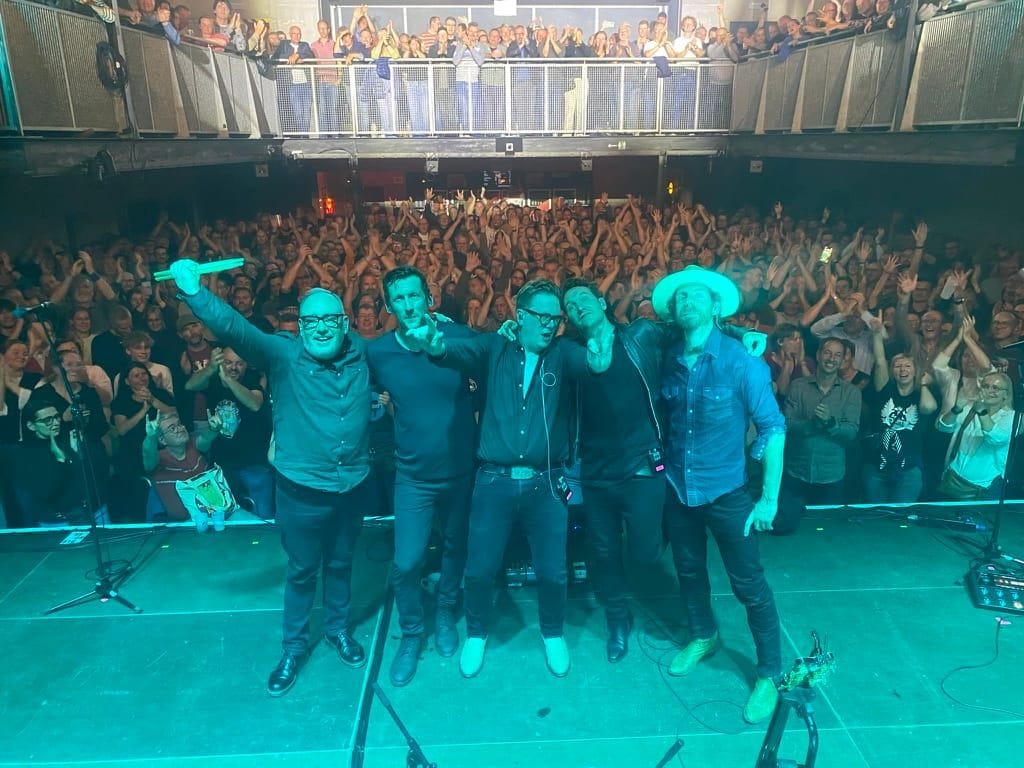
An old one from ACWF I had cause to remember recently.
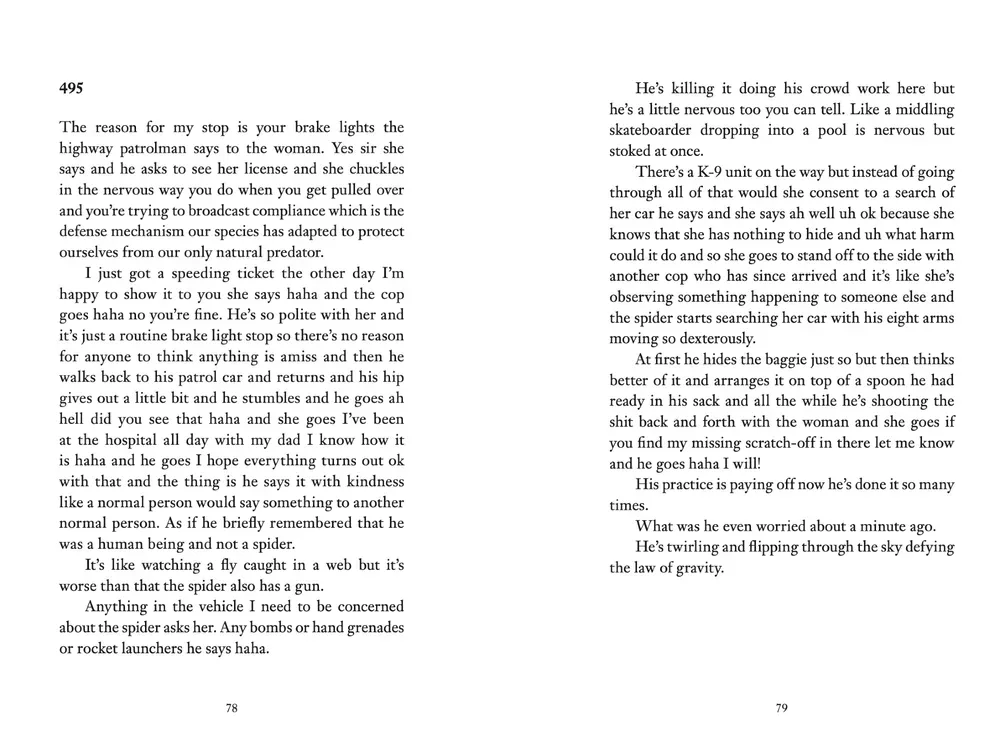
This one was unfortunately "ripped from the headlines" as they say.
Wester the friendly cop was eventually caught up on his bullshit in July of this year after a nine month investigation and he was charged with multiple counts of racketeering, false imprisonment, fabricating evidence and possession of controlled substances and other shit leading to officials in Florida reviewing three hundred of his arrests and dropping charges in 120 of them according to the Tallahassee Democrat and it’s good news that a lot of the people he arrested have been released but that sense of relief you might be feeling at the system finally correcting itself doesn’t account for the trauma many of them experienced or the very serious consequences they faced for even being arrested in the first place. ...
Sometimes Wester would have been able to arrest people he pulled over for legitimate reasons but he still planted meth on them anyway.
Paid subscribers stick around for a new poem, some TV and music recommendations, and the best articles and posts I read this week. That sort of thing. Whatever it is I do.