Justification for our own murder
Are you not as sick as I am of being lied to?
Every single day is like the parable of the man on the deserted island refusing to be saved by boat or helicopter because he's waiting for God's help to arrive but instead it's about any Democrat with a backbone and an iota of charisma refusing to take the opportunity to become the next president by simply describing reality as it is.
Are you not as sick as I am of being lied to every hour of your life?
What a small ask that is right? I'm not even talking about The Truth – although that would be nice – but merely the truth.
And how grateful we would be for the pittance. To have someone in a position of power accurately observe and then accurately explain what has happened and why it is wrong. What has long been wrong. Hell I'd settle for a news outlet capable of and willing to do that.
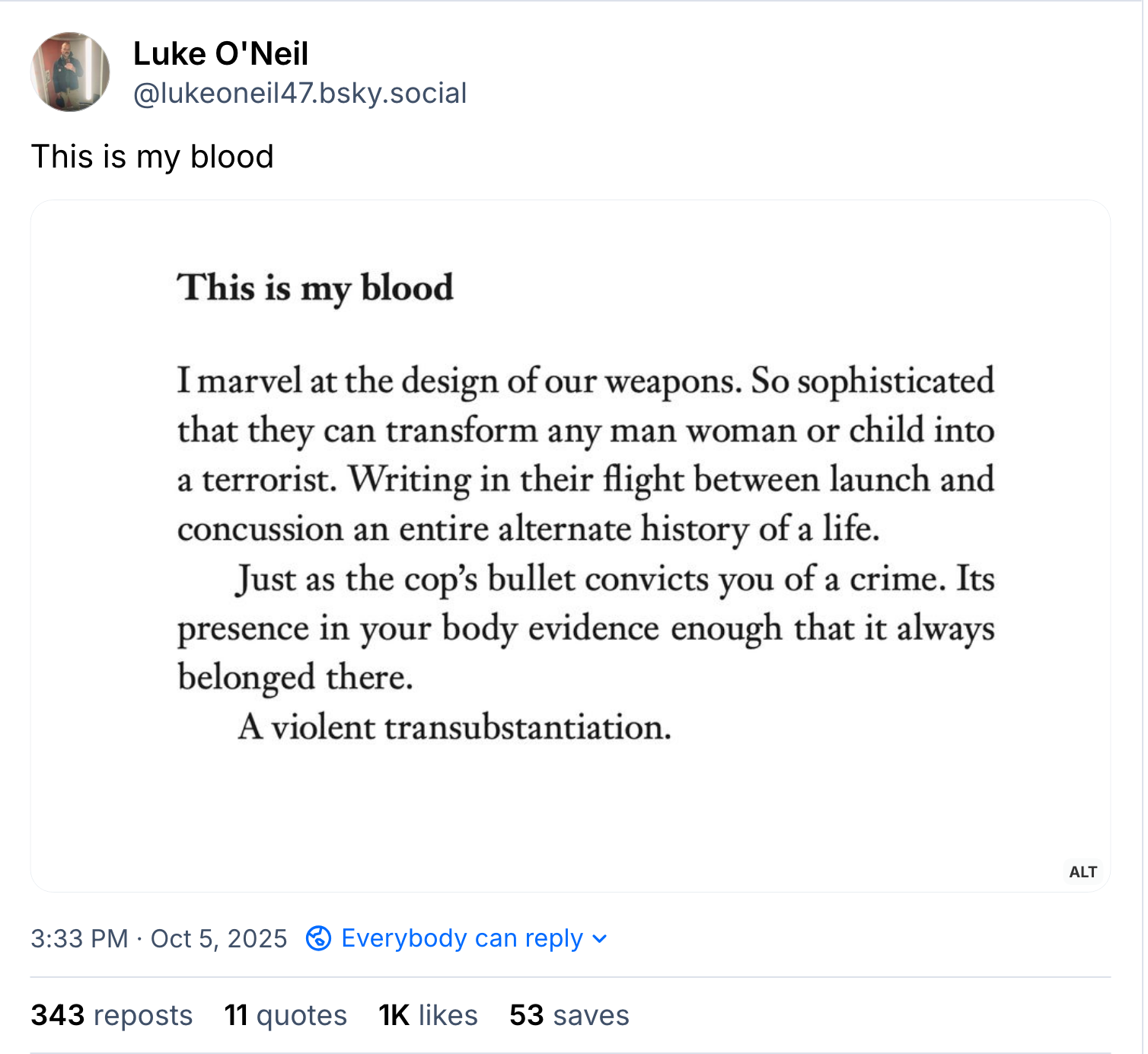
One of those corrupted things is the longstanding double standard applied to cops of any kind in this country. How fucking convenient it is that they get to "fear for their lives" anytime they want to absolve themselves of anything they might do and yet when we actually fear for our own lives specifically because of them and do anything a scared person would reasonably do it's used as a justification for our killing.
How I would love for a week to go by where I didn't feel the impulse to share this one again.
There is a category of people in this country that are supposed to be composed in high stress situations. They train for them in fact and get paid well for it and are given very broad leeway on how they react. Still they shit their pants constantly and cry about how scared they are all the time. And we're supposed to venerate them as our sainted warrior class.
Cowards to a man. As I've written in here before they're "barbarians and martyrs at once. ... Crying and hitting you and crying and hitting you and crying and hitting you."
There have been countless examples of police summarily executing the scared and helpless over the years but the one I keep thinking about today is the 2016 killing of Daniel Shaver. He was shot to death by a police officer at a hotel in Arizona after being commanded to perform a series of confusing physical tasks. Weeping on his knees and stomach. It's an excruciating thing to watch never mind be forced to do yourself.
 Luke O’Neil
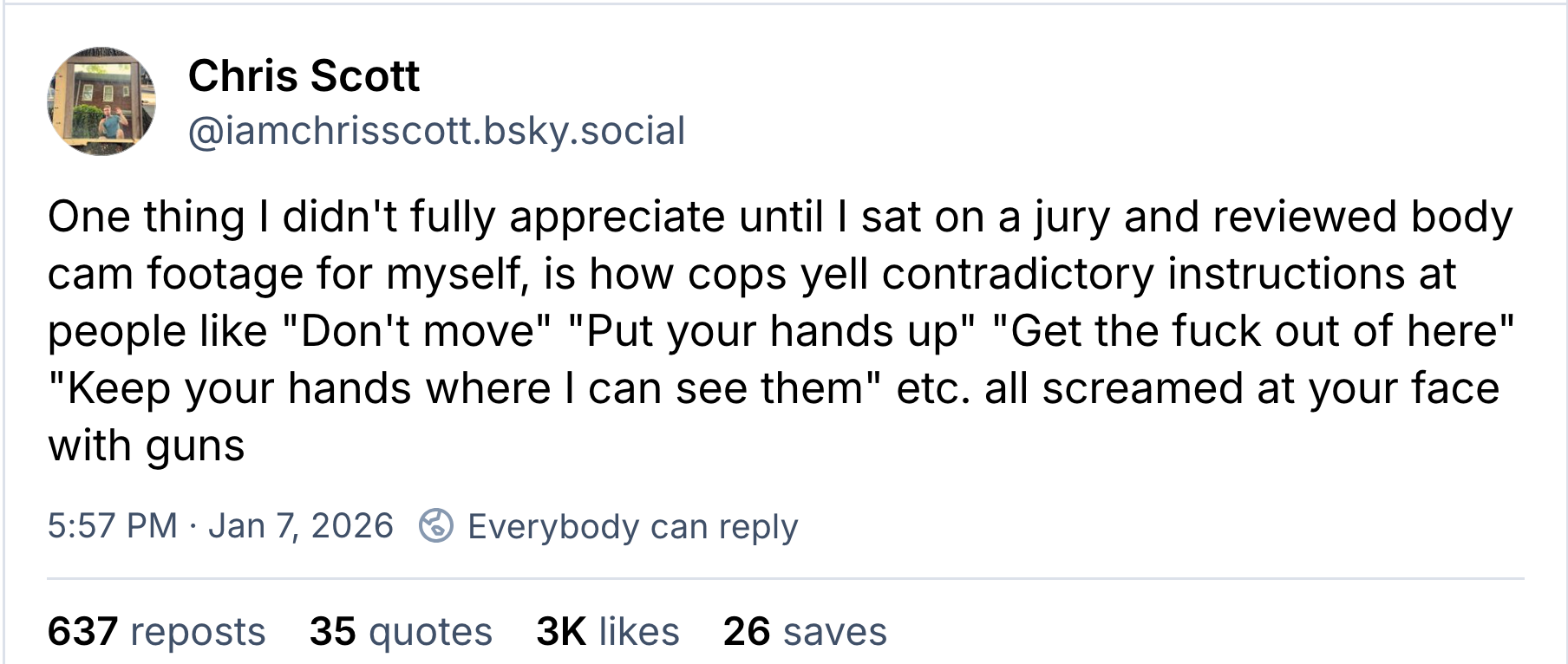
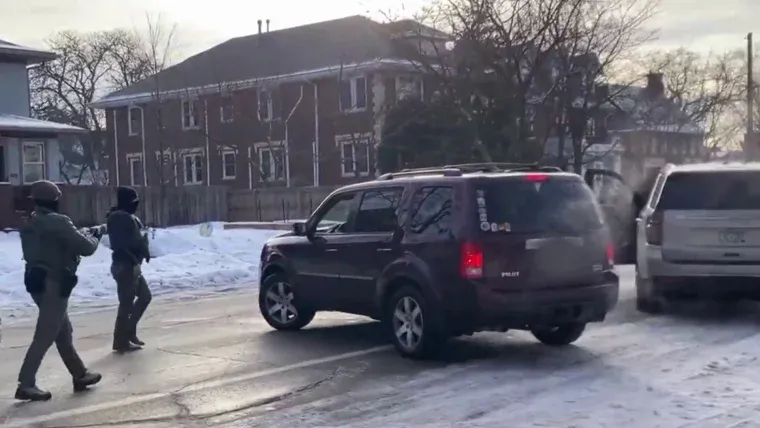
Don't you drive a little tightly and perhaps poorly when there's just a normal cop standing there as you go by? Tense up. Imagine a bunch of them with guns pointed at you? You would of course not be calm and collected.
Renee Nicole Good, a 37 year old mother, who was executed by an ICE agent in Minneapolis yesterday – and by all of ICE and by Kristi Noem and by Donald Trump – was a poet among many other beautiful things. She won a prize for a piece of hers while in college. I'll share it in here down below.
I just went back to look at something I wrote five years ago yesterday. In the aftermath of the assault on the Capitol.
 Luke O’Neil
I don’t want the police to shoot them like they shoot us, I want the police to not shoot us like they don’t shoot them...
I don’t want new laws protecting legislators from protests and confrontation I just want them to not drag disability activists out of their wheelchairs and to not brutalize anti-war and clean water and medical care protestors like they don’t do to their natural right wing ideological allies.
I guess I didn't get that wish.
And now schools are closed throughout Minneapolis for the rest of the week. To protect the children from the government.
I'm going to turn it over to Kim Kelly now. She writes about the parallels between the killings of Good and Heather Heyer in Charlottesville in 2017.
Help pay our writers please and thank you. They are good and decent and do not lie.
To die a politicized death in America is to be forever denied peace
by Kim Kelly
A woman died yesterday. Women die every day in America, in all kinds of ways: from illness or accidents, in childbirth, from neglect, at the hands of a lover or a stranger, or if they’re extraordinarily lucky, of old age. This woman was not lucky. She was shot four times in the face by a masked government agent and left for dead. Her murder was caught on video by bystanders, including her own wife, who cried out as they heard the gunshots, saw her body slump forward, and heard the ICE agents yell angrily at a doctor who tried to help the dying woman. Photos of the bloodied airbag and stuffed animals spilling out of her car’s glovebox hit social media within an hour of her death. The President of the United States and a bevy of his federal lackeys began smearing her publicly as a “violent rioter” and a “domestic terrorist.” Dueling narratives struggled for primacy. Videos of the shooting circulated. The governor talked about activating the National Guard. Her poetry went viral.
Meanwhile, her wife wept. The woman’s three children had to be told that Mom wasn’t coming home. One of them had already lost a father. The woman’s name was Renee Nicole Gold, and she was trying to help her neighbors when ICE blocked the road and then her car as she was trying to leave. They killed her for it, then lied about why.
Nine years ago another woman much like Gold was murdered in much the same way: in broad daylight, among people she loved and cared for, by an evil man who looked at her coldly through a prism of hatred and decided she was an obstacle that needed removing. It was another time of crackling political tension; Donald Trump was, somehow, the President, and it wasn’t going well. Neo-Nazis were organizing publicly on a frightening scale, and the government’s response was to stand back and let them. Not everyone was content to allow this to happen.
On August 12, 2017 in Charlottesville, VA, a 32-year-old woman named Heather Heyer was marching down Fourth Street with a crowd of antifascists and local activists. It was a hot, sunny summer day, and thousands of protestors had turned out to counter the neo-Nazi “Unite the Right” rally that had invaded the city that day. By the time the sun hit its highest point, most of the action had fizzled; that march was a last hurrah of sorts, a reclamation of the streets that had been soiled by jackboots but retaken by the people. When a grey Dodge Challenger came speeding down the middle of the street, it took a moment to register what was happening. It seemed to transpire almost in slow motion—the flying bodies, people leaping out of the way, the car revving faster as it plowed into us then screeched backwards down the block. I can still see the way Heather Heyer’s body hit its windshield, her blonde hair streaming, her turquoise shirt a flash in the sun. She did not move after that. As the sirens began to blare and the screaming broke through, I started to run.
If James Fields had only had the patience to wait a few more years, that day could’ve turned out so much differently. He could have held onto his bubbling hatred for a little longer, then cashed in on that sweet ICE signing bonus. Instead of serving a federal life sentence for murder and hate crimes, he could have been handed a badge, a gun, and ample opportunities to act out his neo-Nazi fantasies with the full support of the U.S. government. The Army had shown Fields the door a scant three months after he enlisted, citing substandard performance, but ICE is far less discerning about the composition of its ranks now. Thanks to a frantic new recruitment push, the agency’s standards have sunk ever lower; a mentally unstable man with a documented history of showing white supremacist sentiments, neo-Nazi political views, antisocial behavior, and violence against his own mother would fit right in. Instead of being shunned, Fields would have found a cozy home within the gang of masked men terrorizing our neighborhoods. Hell, he'd probably run into some of his old “alt-right” pals at the office.
Instead, he’s become just another ugly footnote in the long and bloody history of American white supremacist terrorism. I was surprised to see so few references to Heyer as I doomscrolled yesterday; she was the first person I thought of once I saw the footage of the car and the protestors and the armed goons, and will be back in my nightmares like usual tonight. For those who weren’t around then, believe me when I tell you that the murder of Heather Heyer caused the kind of massive outcry that’s difficult to imagine happening now. Trump referred to her as “a beautiful… incredible… special young woman” and tweeted his condolences to those injured in the attack (really!). His Klan-friendly Attorney General, Jeff Sessions, opened a civil rights investigation into the case and stated “The violence and deaths in Charlottesville strike at the heart of American law and justice… When such actions arise from racial bigotry and hatred, they betray our core values and cannot be tolerated.” (Wow, woke much?)
It was also during a press conference following the attack that Trump let fly his infamous "very fine people” comment. At the time, that was genuinely viewed as quite shocking. He was roundly condemned for it; of course that didn’t have any real effect, but his administration was still interested enough in respectability theater to make him walk it back and explicitly (albeit pissily) condemn the Nazi violence. That all almost seems quaint now, when naked racism, open bigotry, and gleeful violence are a dedicated feature of the second Trump regime. Can you even imagine him bothering to pretend to give a miniscule flyspeck of a shit about Heather Heyer’s death now? He’d probably be retweeting Nazi conspiracists downplaying her murder and calling her an MS-13 antifa queenpin. Back then we thought a Trump presidency would be the end of the world but we were wrong. It’s the second one that’s probably going to get us there.
Of course the same hateful far-right propaganda machine that delighted in smearing Heyer has already rushed to do the same to Good, desperately searching for a way to spin the cold-blooded murder of a Midwestern mom to fit their poisonous agenda. So far the regime’s lies have provided the meat of their attacks, but racist gargoyles like Laura Loomer and various FOX News banshees have been A-B testing tweets about “pronouns” and shrieking about her identity as a queer woman. Meanwhile, Vice Presidential lapdog J.D. Vance deployed his trademark charmless sneer to paint her as a criminal, and ICE’s chief degenerate mouthpiece, Kristi Noem has repeatedly called her a “domestic terrorist.” The facts of the case do not matter, and will continue not to matter, as the story progresses; the same filthy pigs who insisted that Heather Heyer died of a weight-related “heart attack” have decided that Good was a crazed maniac hellbent on running down a federal agent, and they will not waver.
Her family will have to endure incursions by that warped, false version of reality as they mourn their wife, mother, and friend against a backdrop of cruelty and repression—just as Heyer’s mother, Susan Bro, had to see her daughter’s corpse splashed all over social media by neo-Nazi trolls as she grieved. To die a politicized death in America is to be forever denied peace. Emmett Till's memorial sign has been repeatedly shot up and defaced; so has Black Panther Fred Hampton’s. Much of the media has refused to even acknowledge the murders of Palestinian journalists or the continuing genocide in Gaza, let alone memorialize the unfathomable loss. ICE has shot eight other people in the past four months, and killed four. A memorial to Heather Heyer in Charlottesville, VA was also vandalized in 2019, and community members must remain constantly vigilant to protect it. Even the dead aren’t safe, and preparations should be made to ensure that this latest martyr is protected in her eternal sleep.
Kim Kelly is a freelance labor journalist and author of two books on radical labor history, Fight Like Hell: The Untold History of American Labor and the young readers version, Fight to Win! Heroes of American Labor, which is now available for preorder.
Back in March Kelly interviewed Eric Blanc for Hell World about his book We Are the Union: How Worker-to-Worker Organizing is Revitalizing Labor and Winning Big. It went in part like so:
 Luke O’Neil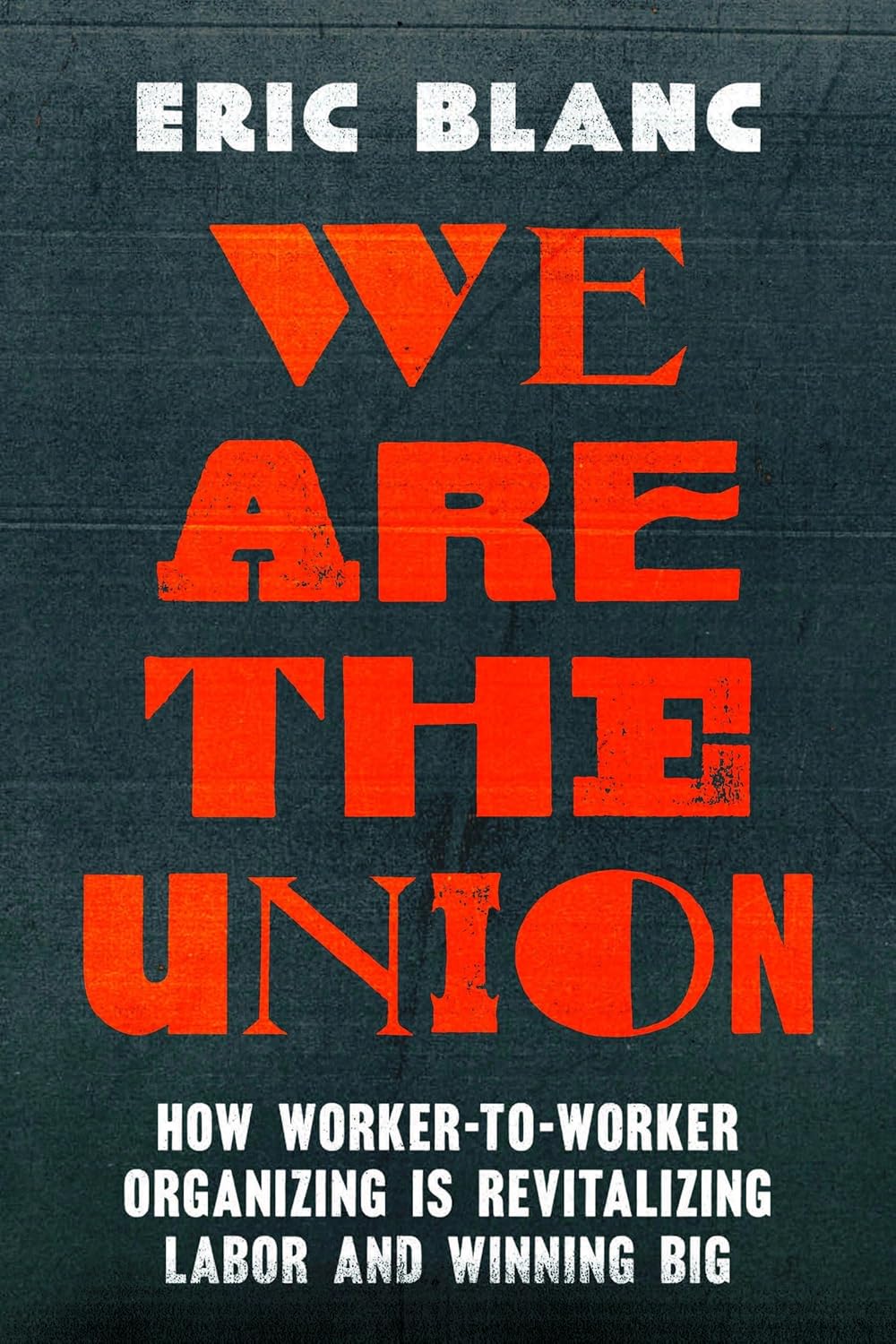
One of the things I like about your book is that it really provides a grounded-but-hopeful message. And since the times we’re in are pretty bleak, I was hoping you could end by saying what gives you political hope at this moment?
I take solace in the fact that things can change very quickly. Oftentimes they change for the worse, of course, but if you look throughout history it's just always the case that almost everybody is surprised when you have eruptions of worker militancy. And we’re starting to see that again today. If you had asked me a couple of months ago I wouldn't necessarily have expected this amount of federal worker organizing against Trump to have emerged already.
It’s bad that so many people on our side are doom-pilled, although I get it. Like everybody else, I’ve had moments of horrible despair at the state of things. But it becomes a self-fulfilling prophecy if you think nothing can be done, because if that’s your assumption then you're not ever going to organize and fight back and then truly nothing gets better. In turn if you do maintain some sort of grounded hope, that tends to help spur you to fight back.
And I think it’s worth remembering, you know, people have fought back and won in a lot harder circumstances than we’re in today. You know as bad as things are right now, I think about what it was like organizing under Jim Crow. That was, by any measure, an authoritarian regime. People were getting murdered for fighting for just basic democratic rights. Similarly, hundreds and hundreds of workers literally lost their lives fighting the bosses before union rights were accepted in the 1930s. So we have a responsibility I think to rise to this moment. And I’d just say on a personal note, that I also feel less depressed when I'm organizing. I’ve been working round the clock these past two months to support the federal workers and it turns out that when you’re organizing all day, you don’t have much time to worry. And when you’re surrounded by comrades you don't have to absorb all of the horrors of the world individually.
In 2020 Renée Nicole Good (then Macklin) won an Academy of American Poets University & College Poetry Prize while studying at Old Dominion University in Virginia. Here is her poem.
On Learning to Dissect Fetal Pigs
by Renée Nicole Macklin
i want back my rocking chairs,
solipsist sunsets,
& coastal jungle sounds that are tercets from cicadas and pentameter from the hairy legs of cockroaches.
i’ve donated bibles to thrift stores
(mashed them in plastic trash bags with an acidic himalayan salt lamp—
the post-baptism bibles, the ones plucked from street corners from the meaty hands of zealots, the dumbed-down, easy-to-read, parasitic kind):
remember more the slick rubber smell of high gloss biology textbook pictures; they burned the hairs inside my nostrils,
& salt & ink that rubbed off on my palms.
under clippings of the moon at two forty five AM I study&repeat
ribosome
endoplasmic—
lactic acid
stamen
at the IHOP on the corner of powers and stetson hills—
i repeated & scribbled until it picked its way & stagnated somewhere i can’t point to anymore, maybe my gut—
maybe there in-between my pancreas & large intestine is the piddly brook of my soul.
it’s the ruler by which i reduce all things now; hard-edged & splintering from knowledge that used to sit, a cloth against fevered forehead.
can i let them both be? this fickle faith and this college science that heckles from the back of the classroom
now i can’t believe—
that the bible and qur’an and bhagavad gita are sliding long hairs behind my ear like mom used to & exhaling from their mouths “make room for wonder”—
all my understanding dribbles down the chin onto the chest & is summarized as:
life is merely
to ovum and sperm
and where those two meet
and how often and how well
and what dies there.
I saw quite a bit of "let's wait for the facts to come in" posting yesterday.
I wrote about waiting for the facts to come in for Esquire back in 2014 after the killing by police of Eric Brown in Ferguson. Ben Collins, who edited it, reminded me of it yesterday. Sadly a lot of the work he and I and others did over the years is largely gone from the website. It's not like you can expect a small outfit like Hearst to keep the archives live. That costs money.
Seriously, read this: "'Waiting for the facts' means waiting to develop a cover story. It means waiting for story to blow over. It means waiting until 'But that was seven months ago! Get over it!' becomes a legitimate excuse." web.archive.org/web/20140901...
— Tim Onion (@bencollins.bsky.social) 2026-01-07T20:19:55.412Z
Here it is if you'd like to read it. It's all still true.
If You Are "Waiting for the Facts" from the Police, You Will Be Waiting for the Rest of Your Life
By now you've likely had the misfortune of wading knee-deep into the overflowing septic tank that passes for dialogue surrounding the Michael Brown story. Predictably, on one side of the argument, there are those who see this as yet another example of violence perpetrated against black men by an institutionally racist law enforcement complex. On the other extreme, you have those who think that Brown, simply because he was even in a position to run afoul of the police, must have done something to provoke his own killing, aggression being the natural state of the animalistic black man.
Somewhere in that spectrum there are those who are still waiting for all the facts to come in.
They're going to be waiting a long time.
“Waiting for all the facts to come in” is a common trope whenever there's a racially charged, or politically tendentious story in the news that captures all of our attention. In theory, it's an appeal to some unreachable, platonic model of journalistic balance, the type of “some say, others say” equivocating that comprises most of the work done by our milquetoast national media. This myth presumes that the truth in any story must fall in the exact center of some probability distribution equation between either extreme. It assumes that both extremes hold equal validity, when that is almost never true.
There's a more pernicious application of this line of thinking in stories like this, and it sounds like this:
“So, why didn't everyone wait until the facts came in before they went crazy?” one arbiter of universal factual equilibrium, in response to a previous Ferguson story on Esquire, wants to know. “Everyone just believed Dorian Johnson's 'story' from the get go. Then every day or so the facts started rolling in—he had robbed a store, an autopsy showed no shots in the back, other witness accounts of the story detailing that he tried to jump through the cop's window to get the gun, etc.”
It could have been lifted from the Trayvon Martin aftermath, or in the comments on reports about Eric Garner's killing by the NYPD, or any of a hundred other stories about the dispatching of black men by authority figures. “Just the facts, ma'am,” says a nation of Joe Fridays, each a dispassionate observer here to sort through the emotional responses from the fool-hearty left.
Here's a fact: Mike Brown, an unarmed teenager, was shot six times by an officer of the law.
Here are some other facts: “One of the bullets shattered Mr. Brown’s right eye, traveled through his face, exited his jaw and re-entered his collarbone," the New York Times writes of the autopsy results. "The last two shots in the head would have stopped him in his tracks and were likely the last fired.”
The “waiting for the facts” refrain is most often bellowed from the wrongest people imaginable: 9/11-truthers, vaccine-deniers, climate-change skeptics, police-abuse apologists, homophobes, “race-realists.” It's as if in every conceivable argument the truth will eventually come out if we just hold on a little while longer, and see how things shake out.
Of course, it doesn't actually mean they want a thorough accounting of the details. Instead it means to wait for a preferred version of the facts to arrive, which are due presently. Like, say, in this willfully distorted piece, which conflates irrelevant statistics—"children will see 16,000 murders on television before they have the right to vote," which is so many more than the police commit!—to prove that, well, I don't know what. Being a cop is hard.
In the case of the Darren Wilson supporters, waiting for the facts means forestalling judgment until enough exculpatory evidence can be ginned-up. It means holding out long enough for the police to get their stories straight, to concoct a narrative in which people like Brown are violent criminals. It means laying down covering fire long enough that the character assassins can get the target in their sights. It means anticipating phoney injury reports being disseminated, for the likes of Wilson, and George Zimmerman to get their ducks in order, to bolster their defense. It means leaving the story's carcass out in the sun long enough for the vultures to pick it clean.
"Waiting for the facts" means, after arresting a black man for sitting on a public bench and waiting to pick up his children by himself, keeping his phone as evidence for six months.
"Waiting for the facts" means waiting to develop a cover story. It means waiting for the story to blow over. It means waiting until "But that was seven months ago! Get over it!" becomes a legitimate excuse.
Here's another group of facts, via the St. Louis Post-Dispatch:
“Last year, blacks, who make up a little less than two-thirds of the driving-age population in [Ferguson] accounted for 86 percent of all stops. When stopped, they were almost twice as likely to be searched as whites and twice as likely to be arrested, though police were less likely to find contraband on them.”
Here are some national facts:
“While people of color make up about 30 percent of the United States’ population, they account for 60 percent of those imprisoned.”
“According to the Bureau of Justice Statistics, one in three black men can expect to go to prison in their lifetime.”
I do not know exactly what happened between Mike Brown and Officer Darren Wilson. It's entirely possible that Brown decided that August 9 would be the day that he would attack a police officer—that he was so enraged for being asked to step out of the street by Wilson that he lunged into a police car, attempted to steal the officer's weapon, and, failing to do so, began attacking Wilson with his fists, smashing his eye socket with his mighty blows. It's possible that he then turned and ran, but, thinking better of it, decided to come back for more. It's possible that he was impervious to Wilson's first flurry of bullets, charging ever onward, like the goddamn Wolverine in berserker mode, desperate to enact his revenge, before ultimately succumbing to two head shots that would kill him.
This is all possible. The facts may bear this out in time. We just have to wait and see. If, in the waiting, we dig up some unsavory facts about Brown's past they may aid in dragging his name through the mud, well, that's just responsible journalism.
Here are some facts:
Only around 750 of the 17,000 law enforcement agencies contribute data on how many citizens they shoot per year. They are not required by federal law to do so.
In the seven year period leading up to 2012, a black man was killed by a white police officer almost two times a week.
The problem with waiting and seeing is it's a form of control, of maintaining the populaces' passivity in the face of curdling fury and well-earned anger. It's similar to the type of reasoning you hear from the right whenever there's a school shooting or a mass-killing. “Let's not politicize this,” they say. “This is not the right time.”
It's a means of punting, of forestalling the discussion that needs to happen—not later, but right now.
The facts aren't coming in, they're already here. Many of us just don't like what they're telling us.