I felt cleaner and more contented working at the landfill


It's the 8th anniversary of Hell World this week! What a run (?) I sincerely couldn't have done it without all of you. Thank you so much. Consider a paid subscription if you can to help us keep paying great writers.
Today Cole Nowicki writes from Canada on the tech industry's rightward shift and explicit cooperation with ICE, the indignities of working in the digital content dump (and the literal garbage dump), and how "A.I." is making everyone's job prospects somehow even worse. I liked this one a lot and I hope you do too.
Stick around for some new writing from me after.
Did you miss these recent pieces?
 Luke O’Neil
I interviewed Dave Wedge about his new book the other night and it went great. The book also just debuted on the best-seller list which was obviously because of the coveted Hell World bump.
 Luke O’Neil
People also seem to really have loved this one by Sandy Ernest Allen.

OH YOU DON'T FUCKING SAY?
 Luke O’Neil
It squeezes and squeezes until you submit
by Cole Nowicki
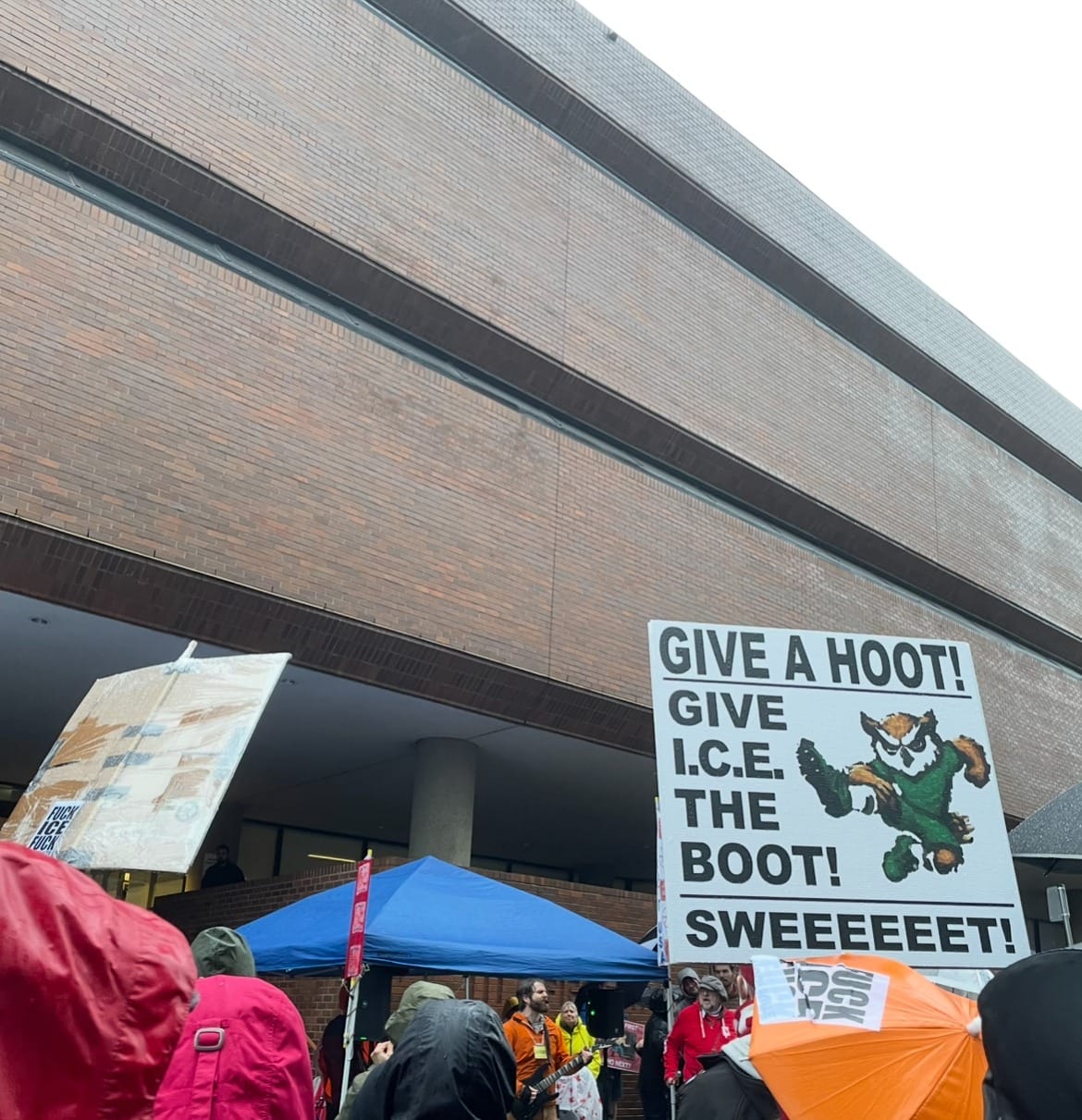
There were babies and the elderly and a bearded man under a small pop-up canopy absolutely shredding the guitar as the rain came down. The crowd was large, stretching almost the entire block. The Vancouver Police Department had closed off the street at both ends, presumably for our safety. Homemade signs protruded from the throng, some decorated with clever-ish slogans like “GIVE A HOOT! GIVE I.C.E. THE BOOT! SWEEEEEET!”
Others were more direct:
“FUCK ICE.”
It was January 30, and we had gathered to protest outside the offices of Hootsuite, a former darling of Canada’s tech scene that produces social media management and marketing tools. “HootSuite for President, Obama that is,” a headline from the Vancouver Sun read in 2009 after news broke that the Obama administration had begun using Hootsuite to schedule tweets on the @WhiteHouse Twitter account. This was seen as a public relations victory and a legitimization of Hootsuite’s product and its mission. The company would later return to the well of America's federal government.
On January 15, in the weeks between the murders of Renée Good and Alex Pretti by ICE and CBP agents in Minneapolis, Business in Vancouver reported that Hootsuite had signed a million-dollar deal with the agencies to provide access to its “social listening” technology. The company claims the tool is used to track online sentiment, not people. Others disagree or simply believe that no one should be doing business with jackbooted thugs of the state.
This was not the first time Hootsuite had been involved with ICE. In 2020, employees learned of a prospective deal with the agency and protested. The revolt led to the firing of a whistleblower and the company scuttling the deal.
A lot has changed in six years. In response to the news and the protests this time around, Hootsuite’s CEO resigned after bumbling through the first weeks of the scandal, but the company stood by its contracts with DHS. Why? The Globe and Mail reported in January that “The deals with ICE and CBP could prove to be lucrative at a time when revenue growth is challenging for Hootsuite.”
The person who helped facilitate those deals, Bill Cynecki, lists himself on LinkedIn as a former U.S. Army Reservist, “Military Intelligence Officer,” and “Public Affairs… Commanding Officer.” He also handles “U.S. Federal Accounts - Department of War and NatSec” for Hootsuite. According to emails seen by The Globe, a sales rep described the pilot with ICE as a “Trojan Horse deal” that could turn into a seven-figure contract and mentioned traveling to Washington… to brief ICE on how Hootsuite “can support their mission.”
I worked at Hootsuite, briefly, in 2018. At the time, I was also a freelancer covering sports and culture and whatever else I could convince an outlet to assign me, but the writing that kept me afloat and paid my bills came from marketing. Copywriting. Scriptwriting. Product descriptions. Blog posts. Email blasts. Social media chum. The work was generally mind-numbing, but it allowed me the privilege of handing my landlord a check each month as I focused on the writing I wanted to do in my free time, which generally paid little and often arrived late.
By then the digital media boom was waning and opportunities were increasingly scarce, especially in Canada. Every piece filed was a welcome supplement to my entry-level salary. After a few months on the job, Hootsuite reduced its marketing staff by 30%. Worthless instructional blogs on the Hootsuite site carried my byline for years after I got laid off, and they still live on, regurgitated by soulless content farms.
Following a few desperate weeks, I nabbed a contract at a major athleisure company where the email blasts and social media slop continued. I was tasked with providing pithy, compelling headlines for an upcoming Black Friday sale campaign that could not use the word “sale” or anything implying price reductions, as that might suggest a less-than-premium product. On Black Friday, we huddled into an office and watched a laptop screen as a sales dashboard jumped and flashed, showing thousands of leggings sold per second. We were breaking records. Chalk it up to our rhetorical workarounds. The head of the copy department popped a bottle of champagne; the cork landed with a plunk in the miniature zen garden sitting on a stanchion in the middle of the room.
It’s easy to become disillusioned as a marketer. You’re more often than not selling something you could care less about in your civilian life. Of course pretending, or better yet, enduring, is a requisite of most any job. At 19, I worked at the landfill in Castlegar, BC, where I was paid to sift through a sea of residential and commercial recycling, scooping up blue plastic bags full of cardboard and containers to tear apart in C-Cans that had been converted into sorting stations. It was miserable work, but our crew often reveled in its absurdity. A standard day might include playing catch with an accidentally recycled pair of dentures or wearing around the most fetching pieces of trash we could find.


Sometimes it was even creatively inspiring. I took photos on the job and wrote garbage poems, both in subject matter and quality, while on lunch break. A decade later, I was employed by a direct-to-consumer furniture company and paid to write thousands upon thousands of words of voice-y, disposable product copy. By then I had sharpened the particular skills required to endlessly produce new, and most importantly, elevated ways to sell the purchasing public on the benefits of rattan.
These email jobs were significantly easier on the body than the patchwork of general labour gigs I had done in the years previous — from the dump to landscaping, dishwashing to swamping for trucks moving rigs to remote leases up in the Albertan oil patch. I now closed my laptop each day with time and energy to pitch stories and put together manuscripts and book proposals. I was writing to support my writing, a fortunate existence even if it wasn't the ideal I had always pictured in my mind. That’s the reality for most freelance writers.
As I progressed in my marketing career, moving into senior positions, that familiar 9-5 pang of being a cog in the cruel and lumbering ouroboros of capitalism continued. However, around 2023, that feeling began to take a more urgent turn in my relatively cushy white-collar world.
This isn’t to say that the tech and brand behemoths were benevolent forces before, but there was a whiff of something different, if short-lived, in the early days of the COVID-19 pandemic. Widespread work-from-home policies allowed the worker more freedom. Many moved closer to their families, far away from their offices. An awareness grew that many of the previous norms placed on workforces were both unnecessary and restrictive, and even inhibiting the work they were being asked to do.
“Our employees aren’t children. Spotify will continue to work remotely.” A billboard campaign from the music streaming giant would later boast. You do not, under any circumstance, have to hand it to Spotify; they were just scoring easy points on the CEOs inspired by Elon Musk’s purchase and ruthless routing of Twitter in 2022. That byproduct of “Muskism,” as Quinn Slobodian and Ben Tarnoff coined it in their 2025 book of the same name, demanded fealty of the worker. They could not be given an inch. They needed to be reliant. They had to be punished, like children. The layoffs commenced.
Work-from-home policies began to be rescinded, and soon came a “soft layoff” for those who had moved too far from the office. “Restructuring” and “market conditions” became the excuses du jour for rank mismanagement. As did the ham-fisted proliferation of A.I. Marc Benioff of Salesforce axed 4,000 customer service roles in September of last year, saying that due to AI, “I need less heads.” Oracle cut 30,000. Meta has continued to hack and slash its workforce.
In 2025 the large video game publisher I worked for began to mandate ChatGPT training sessions. They started to populate my calendar. New invitations arrived soon after I declined them. When a company VP came up to our Vancouver office on a “listening tour” following growing unrest in the rank and file, I had the opportunity to share my concerns about large language models being forced into our workflow. The 500-word screed, which I read off of my computer, and in retrospect is quite embarrassing in an Aaron Sorkin-monologue sort of way, ended with genuine, shaking anger that as a writer and author I was “being asked to do my work with something that has stolen my work and the work of countless others,” which I found “upsetting and frankly, insulting.” Colleagues in the room clapped, Sorkin-like. The VP was unfazed.
Soon after the company announced its acquisition by a consortium of investors, including the Kingdom of Saudi Arabia’s Public Investment Fund and Jared Kushner’s private equity firm Affinity Partners. I began planning my exit, figuring I could ride it out until the deal was finalized. Then our team was tasked with promoting a last-minute addition to the mixed martial arts game I worked on. A new level based on the venue for an upcoming real-world event: the White House. Rumors circulated that people on the development team were refusing to touch it. In meetings and over email, I explained the obvious to whoever would listen: this would lend our brand to the explicit whitewashing of a fascist regime. Many were sympathetic, but the C-Suite was bullish on the marketing opportunity. It would go ahead. I resigned.
Two months later, during the broadcast of the MMA event on the South Lawn of the White House, shortly after a fighter called Michelle Obama “a man” in his post-fight speech, the game’s ad spot ran. It reused parts of a script I’d written for a separate trailer.
In the months since, I’ve been back to freelancing with an eye on the job market. The latter is not looking great. If a copywriting or “content marketing” role happens to advertise a living wage in prohibitively expensive Vancouver, it’s a rarity for it not to demand “fluency in AI,” whatever the fuck that actually means. I’ve clicked on dozens of “writer” roles at legitimate businesses that were actually gigs to handhold LLMs toward some semblance of humanity.
It’s not just the baffling job postings; the leaders of some of the largest tech companies in Canada are giddily rushing to the right, Muskism, and its most exploitative tendencies. Shopify CEO Tobias Lütke recently mused about disenfranchising the poor, calling it a “good system” that a greater share of the vote goes to the wealthy. Wealthsimple, a fintech company with an award-winning financial newsletter whose team I once fired off a resume to, just successfully lobbied the Canadian government to approve their own prediction market. A few weeks back I scrolled past a “technical writer” job at Raytheon on LinkedIn and found it refreshing to come across a straightforwardly evil company, one upfront in its designs.
Things aren’t faring much better on the media side. Postmedia, the dominant newspaper chain in the country, which is often hiring, is owned by Chatham Asset Management, an American hedge fund with close ties to the Trump Administration that pushes those papers ever further to the right. That’s while left-leaning outlets like PressProgress and The Grind are facing potentially destructive million-dollar SLAPP-style lawsuits from a disgraced conservative political candidate and a former IDF reservist soldier, respectively.
I’ve been fortunate to spend the last decade writing to support my writing, but that once stable-ish reality seems to be slipping away — at least when it comes to the roles I would be comfortable taking. Ones that don’t feel like they require my soul along with my social insurance number. I felt cleaner and more contented working at the landfill than I have scouring marketing job boards these last few months.
I also realize that it’s a privilege to be able to continue on with this Sorkin-esque moral grandstanding. As the months go on and my savings dip, that job at Raytheon and its six-figure salary will start to look pretty good. That’s the endgame of whatever you want to call this era and system we’re living under — end-stage capitalism, Muskism, Technofeudalism — it squeezes and squeezes until you submit. Fealty doesn’t guarantee survival.
Hootsuite’s now-former headquarters, the one I worked in and protested outside of in January, is slated to be turned into an AI data centre. The protests against its development keep growing.
Cole Nowicki is a writer living in Vancouver, BC. He’s the author of a couple of books and his commentary and reporting have appeared in The Tyee, The Walrus, and Thrasher Magazine. He writes Simple Magic, a newsletter about skateboarding, the internet, and other means of escape.
 Luke O’Neil
I've shared this one a hundred times but I don't care. It was seven years ago today we lost him. DCB forever.
Read this one too if you never did.
 Luke O’Neil
You have to imagine the last guy he ever drank margaritas at the mall with was like what hell Dave? Whole time I thought we were having a few laughs there. Talked mostly about the game. I didn’t know you were thinking all that.
We're just about to start shopping around my next collection – I am never going to die – and I am very excited about it. Here's a brand new one. Get in touch if you are a publisher and you want to make thousands of dollars off of it.
The party
On my first day in office they took me into the upper level of the capitol building and gave me a tour of the equipment. It’s all rather archaic my colleague said. Relics you might call them. No one has voted to spend the money on an upgrade. Too wasteful. But it all still does the trick. How exactly does it work I asked. Well there are a few different options. It’s really more a matter of stylistic preference. This one is fairly straightforward he said holding up the tail end of what looked like a lengthy fuse. There were hundreds of them tangled together like messy computer cables. You light this part then walk away. You can even do it in slow motion if you want. Then? Then what. Then go to the gym. Go for lunch drinks. Hell some of us do both. I meant what happens on the other side of it? Well there’s an explosion obviously. Does anyone get hurt? No one I’ve ever seen. And besides we don’t call it that. We don’t think about it like that. And if they or whoever you mean are harmed it doesn’t count for some reason. We looked into it and it doesn’t count. Look here next a second colleague said taking me by the crook of the arm to stand before a blinking array of brightly lit holes in the wall. You take one of these silver balls from the tray here and insert it like so. They zip along a sort of rollercoaster track before knocking over the first in a lineup of dominoes. It’s a bit more complicated than the fuse option but I prefer it because it’s even less direct. Almost completely untraceable back to us. And bipartisan for that matter. Long story short there’s a big boot on a hinge at the end that kicks whoever is standing in front of it right in the balls. Taking them out instantly. Look on the monitor there she said. It’s actually pretty funny. Why are they all lining up to get kicked in the balls I said. Well we don’t know. And it’s frankly none of our concern. Tradition I suppose. Some of them seem to even like it. What else are they gonna do? On the screen there were a few people standing off to the side looking directly into the surveillance camera. As if they could sense me. See directly into the chamber. Do they know about all of this I asked. Some of them do the first colleague said. That’s what this contraption over here is for he said guiding me toward an open window. This right here is a really long gun.
Paid subscribers stick around for another one. I showed it to a few people and they said "fuck man" and "goddamnit dude." Plus some more nice pictures of Maine and some reading recommendations and music and some other delightful stuff one can only assume