We don’t want them feeling at home and comfortable we want them removed
People who have the audacity to exist as poor in public

In May of 2024 people in Pittsburgh began seeing large piles of rocks being spread out on sites around the city that had been used for tent encampments. Curious about who was responsible for the displacement tactic, and how officials were talking about such efforts, Jordana Rosenfeld, a reporter who regularly covers issues around homelessness for the Pittsburgh City Paper, Pittsburgh's Public Source and elsewhere put in a public records request to the city and county. She received thousands of emails and documents, which she has spent the past couple years reviewing and reporting on, although in an apparent mistake, many of them were sent unredacted.
"I’m pleased to have the unredacted versions, though, because they narrate the push to clean up Downtown succinctly and honestly, spelling out the true drivers of policy: the unbridled revulsion of much of the propertied class for people who have the audacity to exist as poor in public," she writes.
Help pay for independent reporting like this with a subscription if you are able to.
"Homelessness is not just a problem for those without homes"
by Jordana Rosenfeld
Last month the dreams of Pittsburgh’s most aggressive pro-business boosters came true. The city hosted the 2026 NFL Draft, breaking all-time attendance records. How far we’ve come. A mere three years ago many of these leaders were complaining that Downtown Pittsburgh looked like a “war zone” beset by the homeless, emailing the mayor’s office, Pittsburgh Police, the Department of Public Safety and the county Department of Human Services photos of things like a makeshift toilet ingeniously erected in an alley to remedy the near-total absence of public restrooms. One archly suggested the city rename itself Pissburgh. Eventually the city cleared away all such debris, human and otherwise, in order to draw more than 800,000 sports fans to attend what Fox News called “one of the biggest football parties in human history.” Thank god we have our civic priorities in the right place and I am alive to see it.
How did this happen? Did we solve homelessness? No (although Zohran Mamdani’s new head of human services, our county’s former social services chief, might have you believe we did).
Official strategies included a systematic sweep of homeless encampments coupled with the thorough relocation of social services, including shelter beds, to locations that were less desirable and more far-flung. There was a modest investment in “street outreach” and case management ostensibly intended to help people get into housing (whether or not that worked is a different story) and an indeterminate, hotly disputed number of affordable units were added to the market (the only thing clear about how many new units got added is that it wasn’t near enough).
More interestingly, however, with some Downtown stakeholders desperate to “do something” about homelessness, others desperate to appear to be doing something, and everyone willing to settle for the homeless people simply going somewhere else, unofficial strategies to clean up Downtown were quietly executed without any public acknowledgement. City and county officials, business leaders, and major nonprofits created parallel and overlapping systems of surveillance, obsessively tracking the presence of unhoused people and tents and maximizing police engagement to harass, arrest, and otherwise induce those people to go elsewhere.
I put together the pieces of this unofficial response by reviewing thousands of emails and other documents I obtained through records requests to the city and county, starting in May 2024 after the appearance of large rocks covering the former sites of tent encampments. I wanted to figure out who put them there and whether the public had paid for them (it turned out to be a business-boosting nonprofit that had advocated to remove the encampments and features prominently in this story and probably cost more than $100,000.)
In the midst of the dozen encampment sweeps that happened in this period, I had friends who were working with the folks getting swept to find new places to live, and we wanted to see how government officials were talking about the tents and the people in them.
As public hysteria over the post-pandemic prevalence of unhoused people living and hanging out in Downtown Pittsburgh spiraled, the inboxes of city officials became inundated with some of the most rude and entitled characters in northern Appalachia. Like the North Side resident who begged city and business leaders in April 2024 to consider that “homelessness is not just a problem for those without homes.”
There was the hotel employee who persistently put scare quotes around the word “living” when discussing the unhoused people near her hotel. “We have lost numerous weddings estimating $20,000 each due to the people that are ‘living’ around the hotel,” she complained to the city. She demanded to know whether the city would pay her salary when her hotel inevitably closed “because of the encouragement [the city] give[s] to the homeless people.”
In breathless daily emails with an ever-growing subject line: “RE: Assault on Our Valet / Re: Lawlessness Abound / Action is Needed - Re: Disgraceful and Daily Occurrences / Re: Todays Daily Incident / Re:Another Dangerous Situation / Re: Growing Trash Issue Re: Today"s Attack…”, an exec at a hospitality company with Downtown properties lamented that “police presence is available only ‘on call.’”
A guy whose LinkedIn says he is a “private equity CFO,” typified the legion of property owners who spouted off in city officials’ inboxes. He insisted that he cares about the “genuinely unhoused (people who want and need help)” yet somehow not a single person he sees living in a tent or shitting in the alley or waiting outside a church for a meal falls into the mythical category of those deserving his compassion.
“Where my empathy ends is with the “voluntarily homeless” – those who could to defoul our city and insist upon living on the streets [sic].” He singled out a particular couple living in a tent – “cave dwellers” he called them – near his property as an example of the latter.
“We, as residents, don’t want them feeling at home and comfortable,” the CFO wrote. “Rather, we want them removed from places near our actual neighborhoods.”
In a follow-up email not including the CFO, the city’s homeless outreach chief explained to the deputy mayor that that particular couple was evicted by their landlord who chose to stop offering subsidized housing in order to sell his building to a developer.
I don’t think I was supposed to get these emails in full. The city had just gotten a new public records officer, and the folder I received in response to my right to know request had both redacted and unredacted copies. I’m pleased to have the unredacted versions, though, because they narrate the push to clean up Downtown succinctly and honestly, spelling out the true drivers of policy: the unbridled revulsion of much of the propertied class for people who have the audacity to exist as poor in public.
Widely seen as the face of homelessness, city officials in these emails did their best to pass the buck, instructing complainants to call the police if they “felt unsafe” and insisting that housing people was mainly the purview of the county. But facing escalating pressure from business and property owners, the city couldn’t just wait around for the county to house people. (Everyone involved agrees housing people is a painfully slow process. I spoke with multiple people living outside at this time who reported having been on the county housing waitlist for more than a year). At the end of 2022, the city swept its first tent encampment in roughly 20 years and had quietly begun developing a policy and deliberative committee that would establish the framework for systematic sweeps.
In early 2023 everyone became obsessed with counting and tracking anyone Downtown who looked homeless. The county published weekly internal “encampment updates” with the number of tents and encampments spotted near the city center. The city counted Downtown tents twice a week, and their outreach workers constantly received reports of tents from parks and maintenance workers and city council staffers, who forwarded complaints from their constituents. NGOs also got into the mix, with one business-boosting nonprofit launching their own daily “unhoused audit,” using data collected by their “outreach specialist” who, based on his emails to his boss, was clearly calling the police on the people to whom he was supposed to be reaching out. The boss, for his part, circulated lists of bus stops, blocks, and corners that were either “active” or “potential” locations for such dubious activities as “gathering,” “hovering,” and “sleeping.” Granted, someone literally hovering might be cause for alarm but I don’t think that’s what he meant.
At the government level, tracking of unhoused individuals persisted until they accepted an “offer” of “housing,” after which point (according to people living outside and advocates I spoke to and city employees themselves in meeting minutes) no one followed up with them to see if the place to stay met their needs or if they would be able to remain there long-term.
In lieu of being able to hire more police, who had been whining about “dangerously low” staffing levels for years, these groups hired more people responsible for imitating and calling the police. In the emails I saw an arts nonprofit expanded their private security service and tasked them with calling the police immediately should they see more than two individuals loitering at any time. The business-booster group launched both their own hotline to field reports of homeless people and a roving corps of “ambassadors” to be eyes on the street. They also paid for patrols of off-duty cops who they took care to ensure were able to actually arrest people. Both the business-booster and the arts nonprofit had mostly eschewed emailing city officials at this point, corresponding directly with Downtown police leadership.
This seemed to get the desired results. By May 2023, the arts nonprofit security head was noticing increased police presence and arrests, which he heralded as evidence things were moving in the right direction. Around this time he announced internally that they would begin 24/7 monitoring of their security cameras with a zero tolerance policy for “problematic behavior.” That summer a Downtown police lieutenant reiterated to the security head his commitment to “get results,” opining that “charg[ing] someone with a crime is the only way to make a difference.” “Don’t take your foot off the gas,” the head of security implored. In September the arts nonprofit added armed guards to their retinue.
And what were all these private guards doing? According to hundreds of incident reports the security chief forwarded to the police, and that the city released to me, they were mostly just calling the police. Per these reports, doing any of these things in one of Downtown’s many privately owned plazas masquerading as public space or in front of the wrong building will get the cops called on you:
- loitering (standing in one place without spending money);
- being a known loiterer (having a favorite place to stand without spending money);
- sleeping;
- possessing multiple paper bags and laying for 20 minutes in a hammock the arts org put there in the first place;
- sitting in a chair too close to a shrub;
- hanging out in the vicinity of “what looked like a lot of cigarettes”;
- and in the case of one Black man in January 2024, getting into and out of a car, going into a smoke shop, and then talking to someone.
Should the police ever decline to disperse a group of people the arts nonprofit security had asked them to disperse, the security chief would go over the head of his usual lieutenant contact to complain to the commander about the “apathetic” or “lackluster” response he was forced to contend with.
And that’s how they did it. The slow, grinding death-by-a-thousand-cuts that was apparently preferable to putting everyone in a house. Perhaps because it was crueler. All that expense and effort to not reduce the number of homeless people at all but to just move them around to wherever is not here. I don’t think the average Pittsburgher has any idea how closely they are being watched Downtown. I guess as long as you look like you have a house or at least somewhere better to be, you’re safe for now.
In February 2025, city and county officials issued a self-congratulatory press release touting that there were no more tents in Downtown Pittsburgh. The media dutifully parroted their line that everyone had “transitioned to more stable housing.” But the point-in-time count (admittedly a flawed metric, if there ever was one, and almost certainly an undercount, but one of the only standardized metrics the government uses to quantify homelessness) from the month prior to that announcement showed a 66% increase in people living outside from the previous year. “These increases did not align with DHS’s real-time data collection (from street outreach and weekly monitoring of tents), which indicated stable or even downward trends in unsheltered homelessness,” the county wrote. So they counted again and got a result they liked better. And then hired a Bloomberg-funded “philanthropic consultancy” to help them revise their methodology, presumably to make sure the data continued to trend in their preferred direction.
A few months later, Ed Gainey, our first Black mayor, who, like most supposed progressive mayors around the country was actually rather aggressive on homeless sweeps, lost the Democratic primary to Corey O'Connor, a center-right challenger who capitalized on perceptions that the incumbent was soft on homelessness and crime. “Public safety is not a statistic,” O’Connor said at his inauguration. “It is a feeling that you have as you walk down the street."
And then we threw the biggest football party in human history.
Jordana Rosenfeld is a reporter and editor living in Pittsburgh. She has reported on local responses to rising homelessness, including advocates’ attempts to protest aggressive sweeps, the pro-business nonprofits behind fields of boulders that quietly covered over the sites of cleared encampments, how everybody wants public restrooms but no one wants to pay for them, and profiled people living outside.
For more on homelessness in Hell World:
 Luke O’Neil
It works like this: The adults teach the youth to worship wealth as a sign of intelligence and goodness. Parents talk about people with no housing as a terrifying plague to be dealt with, not as loved ones, neighbors and friends to be helped, all in the name of “protecting children.” Local news runs article after article reporting on homelessness as a threat to public health and safety, implicitly and explicitly blaming them for everything. (In stories like these a person’s lack of housing is always announced in bold before any alleged crime.) And to top if all off, mayors, and even the governor, the champion fighter of the Democratic cause, use their bully pulpit to further harm those that don’t have a place to live. On Newsom’s official website he proudly shares pictures of himself front and center personally throwing away the belongings of people during a sweep in Los Angeles as part of his announcement of almost $200 million dollars to directly fund more sweeps.
 Luke O’Neil
I work on telling the story now because I’m not the only one who felt like he didn’t deserve a home or a bed because he was victimized in his own bed in his own home; and I’m not the only one who ended up on the streets high on hand sanitizer, methamphetamine and fentanyl, telling people that nobody had ever loved me and that I wished I could actually summon up courage enough to shoot myself in the face; and I was not the only one who’d made bad decisions when I knew better and told myself that I didn’t have to take responsibility for my own life because I was the biggest victim in the world; and I was not the only one who thought it didn’t matter what I said or did anyway because I was essentially invisible; and I was not the only one who passed out on the sidewalk as people walked over me and wondered what might have happened in my life that had led to such a moment; and I was not the only one who’d been kicked out of place after place and been beaten up by cops and criminals both; and I’m not the only one who became a violent criminal and victimized others myself; and I’m not the only one who got arrested over and over again and got to the point where I liked it because at least someone was interested in what I did; and I’m not the only one who’s woken up on a gurney in an emergency room out of an alcoholic blackout before signing in and suddenly feeling like I might have found a way out; and I’m not the only one who actually started to find joy in life and see the beauty in small things and take delight in the presence of other people even when they were giant pains in my ass; and I’m not the only one who wants to tell the story without leaving any of the bad parts out just so that I can make the point that life is still beautiful and worth living and that the world and other people are far more beautiful than I used to think.
 Luke O’Neil
But despite the false promise of services, freedom, and care, the stark reality underlying this fantasy is the forced removal of the unwanted from society. We the civilized (housed), stay here while the uncivilized (unhoused) go over there. Somewhere we don’t have to think or look at them, and where they can learn some respect for the Rule of Law. It’s forced separation of those people whose visible destitution spurs unavoidable cognitive dissonance for passersby who instinctively recognize the injustice that some should have so much, while others suffer and die in the streets of the wealthiest nation in history.
The dissonance is the issue being solved mind you. Not the suffering.
 Luke O’Neil
NIMBY is too cute a term for these people by the way. Sounds like a fluffy little magical creature instead of a demon who eats pain for their supper.
The thing these people always crying about the homeless are mad about is a result of a very simple thing: there are people without homes. But the real issue is that they think not having a home for some time is an immutable characteristic of the person and not simply a current lack of a home. Giving them a home will solve your big problem which is noticing them existing within the temporary condition of not having a home.
People get weird about the effectiveness of shifting terminology but the idea behind “homeless” versus “an unhoused person” is solid and I wish more people understood it. What we are talking about is a human being no different than you or I who – again – currently does not have a home. It is not an enduring and invariable characteristic like the color of one's eyes or blood type or whatever it means they have no home at this time. Once they have a home they are no longer "a homeless person" and therefore cannot "harm" you. That sounds really obvious right but so many people do not believe this. They think it is a stain that will follow a person around forever.
Oh but they're addicts and so forth? I promise I have done as much drugs and drank as much as many of the "degenerate homeless" that are "tearing your cities apart." So have many of you and many of your friends! The difference is we did it inside of a house.
Usually.
Do these people want to solve the problem they're twisting themselves up over (seeing homeless people on the street sometimes) or do they want to adhere to their carceral puritanical punishment brains?
Don't answer that. It's rhetorical.
Meanwhile in other countries the radical idea of giving people without a place to live a home seems to be working very well. Who would've thought?
 Luke O’Neil
I told you before that I know it can be uncomfortable to encounter an unhoused person in distress but that is because it is an up close and personal look at How It Actually Is. A peek under the hood of this country. The churning gears and foul combustion. It's no wonder then that so many of us want these humans simply disappeared. And they are humans in case you need reminding.
They aren't a threat so much as they are an indictment.
Look at what we allow.
It's the hideous beating of the tell-tale heart.
Much like with the existence of any billionaire the inverse here is that so many systemic mechanisms that should have been in operation had to have failed for any individual unhoused person to exist in the first place. It’s shameful to see and so of course we all feel uneasy about it.
It's not so much seeing how the sausage is made it's seeing the sausage after it’s been digested.
 Luke O’Neil
Every person out there is a symptom of our cultural and systemic rot. They’ve chipped away at collectivism so much that this is exactly what happens. People are seen as individual failures. And the numbers increase year after year. There’s no sign of it slowing down. Other than when the government put its foot down, during Covid, when they said you’re not allowed to evict people. It’s almost like we know what works: keeping people in their homes and preventing landlords from evicting them. It’s really that simple. You prevent these deaths of despair, which is what being unhoused is, by simply reigning in the landlord class. They’re not dying, they’re just making slightly less profits. But being unhoused is deadly.
 Luke O’Neil
“There are probably ‘liberals’ who were involved with writing that [Fremont] law, who are at the same time horrified by several aspects of these atrocious ICE raids that have been happening all over the country,” Amber Whitson, who lives in an RV in Berkeley told me. “And, I bet most of them still wouldn't see the irony in their actions and their words if you were to tattoo a detailed explanation on the insides of their eyelids.”
Such is the epic Predator handshake between conservatives and liberals. The core issue of homelessness is not the rising price of housing or the misallocation of affordable places to live, but personal failings by those on the streets. The idea is that their drug problem has led them there, never mind the housed multitudes with similar addictions; or that it's a result of bad investment decisions, never mind the many examples of well-to-do Americans falling into bankruptcy multiple times but never finding themselves in a tent on the side of the highway; or that they’re too lazy to work, never mind how many unhoused folks I’ve interviewed over the years who work one or more jobs.
 Luke O’Neil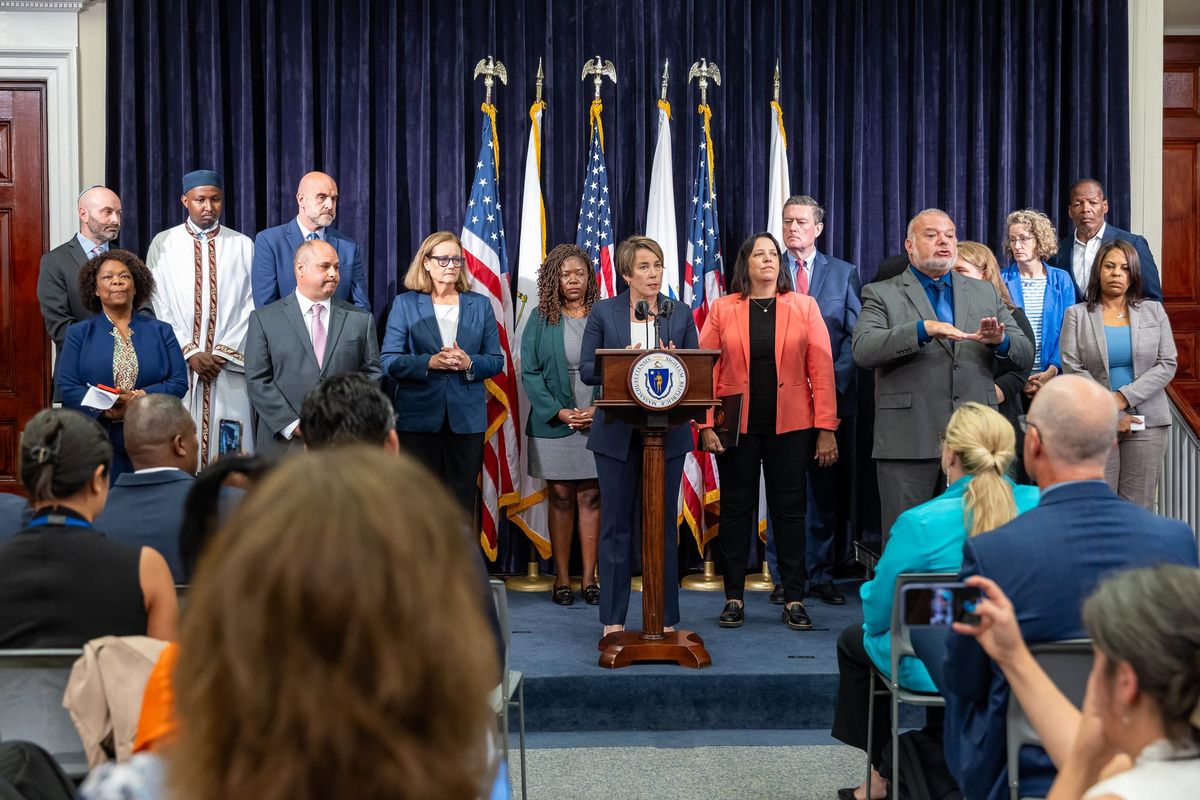
There’s another villain Healey could have chosen here: housing developers, real estate speculators, private equity firms, and landlords profiting off of the housing crisis. At the end of the day homelessness is a housing problem. Most experts agree on this. Andrea Park, who works on homeless policy at the Massachusetts Law Reform Institute, said the shelter system has been ripe to fail for a long time. Before the recent wave of Haitian immigrants, there were already 3,500 families in the state’s shelter system. “Why is that an okay number?” said Park.
“We average about 40,000 evictions a year in Massachusetts. Why is that okay?” she said.
 Luke O’Neil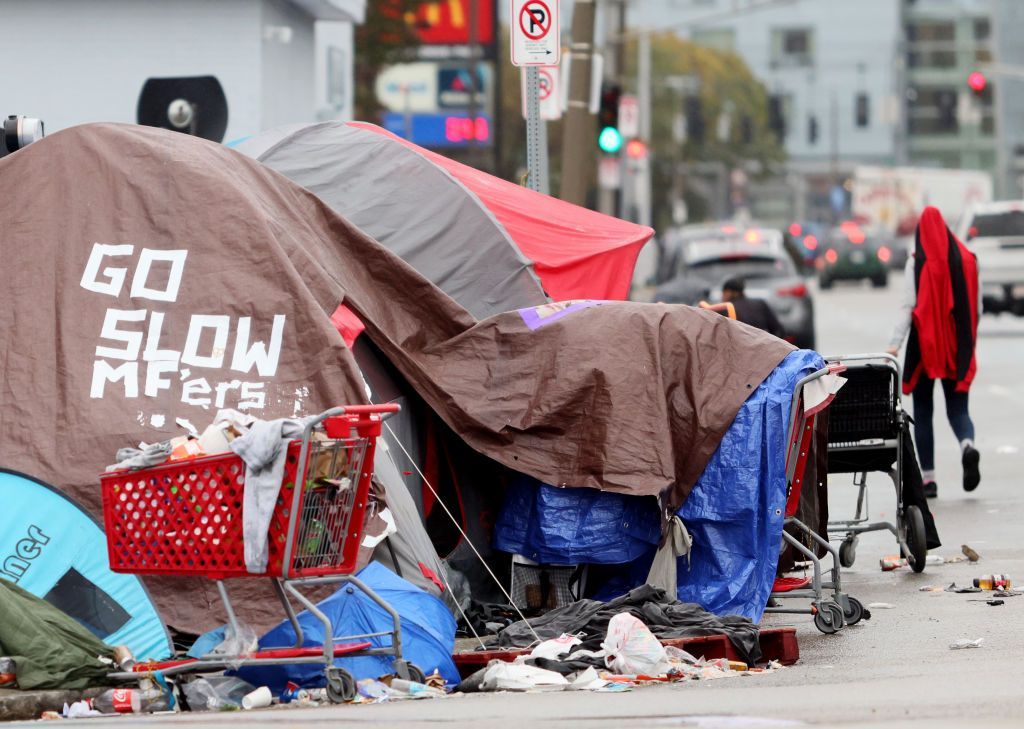
But Boston, the expensive liberal city, can’t seem to find that will. The policymakers, the home owners, and the business leaders of Boston—the people who arguably have the most political power here—still haven’t found it within themselves to call for investments in the infrastructure and social services that unhoused people need. The deficit of housing in Boston neighborhoods remains, as does the opposition to building more housing: a paranoia that adding more housing will jeopardize the “character” of these neighborhoods, where property owners call the shots and bend politicians to their will. So when Leung compliments Janey for removing the tents on Mass and Cass, the “courage” she seems to be alluding to is the message Janey has sent to the unhoused. We do not want you here, and if you don’t go away, we will put you away.
 Luke O’Neil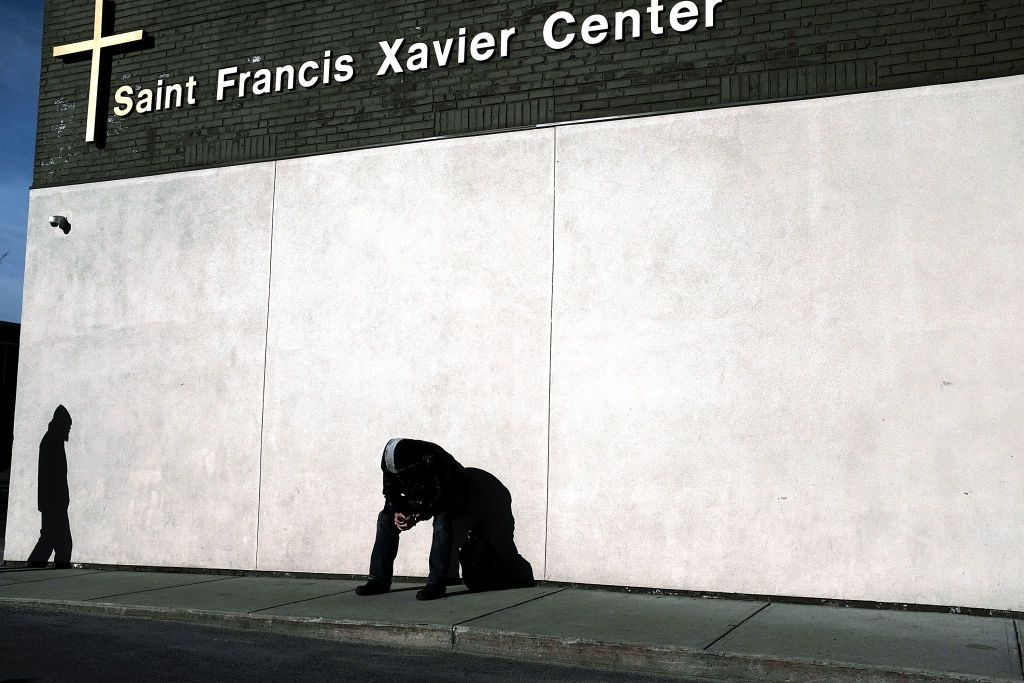
While Worcester says they offered the unhoused people at the Walmart camp beds in the city’s homeless shelters, they are not logistically feasible. One is only for women, one is in a state of miserable repair, and the third, a new addition called the “Hotel Grace,” in the basement of a church downtown, is often so full they have to turn people away. A doctor that works with the population said that none of the evicted people spent the night in a shelter. Cahill, the city official quoted above, told me only three people spent the night at Hotel Grace the night after the demolition. But these homeless shelters are all temporary and are not by themselves a viable alternative to a tent.
The bottom line is that the overwhelming majority of the people staying at the encampment chose to keep living outside. But now they’re more scattered and more distrusting of help. The camp had provided outreach workers, doctors, and community organizers a central place to drop off supplies and medicine.
 Luke O’Neil
“It would be nice if you solved the root of the problem,” another resident named Sam explained in a second video. “Lack of affordable housing and jobs and stuff like that, because me and my tentmate, we’re workaholics. He’s gonna come home, his home’s gonna be gone.”