Tattooed, Pierced, & Fucked-Up: A Scene Memoir 2004–2008
Orange pill bottle by Lauren Napier
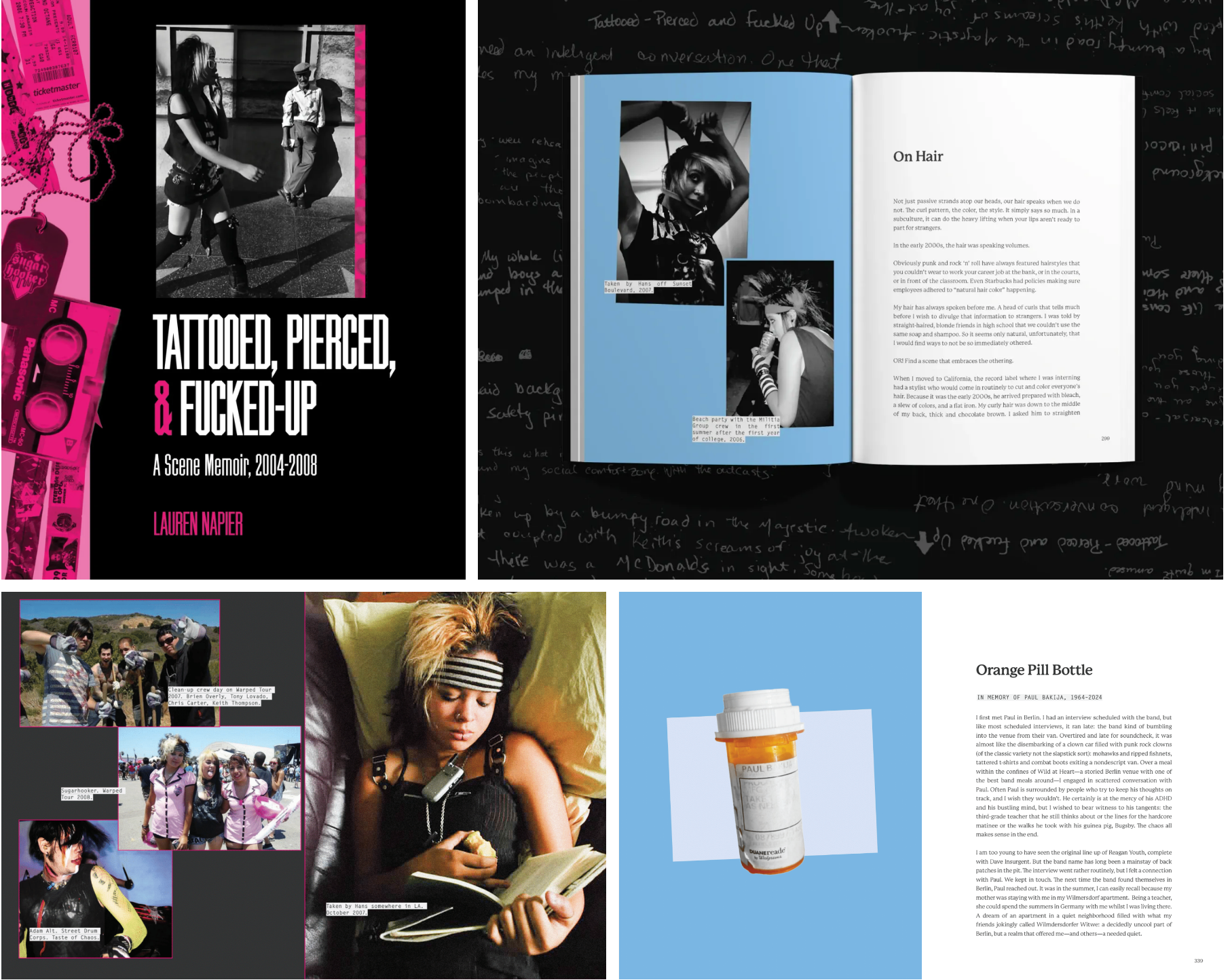
I have a terrible memory. We talked about this recently. And what memories I do have of my youth are often memories of a photo of an event rather than the thing itself. The problem for me is that for the bulk of my twenties there was little or no social media. People had digital cameras yes and we took hundreds of photos of everything and nothing at all but those too have been lost to time. File cards collecting dust in a box somewhere by now if anywhere. Some people on the other hand are good at saving everything. Lauren Napier for example. She not only wrote down and took pictures of her time spent in the punk and emo scene of the 2000s – a world I spent most of my own time in as well – she held onto them. Her forthcoming Tattooed, Pierced, & Fucked-Up: A Scene Memoir 2004–2008 – the first title from our friends at Dirt Books (pre-order it here) – collects all of that together in a collage of sorts amidst essays and interviews old and new with the older version of Napier commenting on the thoughts of her younger self throughout. It's also a really uniquely designed and lovely-looking book. I'm happy to share an excerpt today about her friendship with Paul Bakija of the iconic 1980s (and later reformed in the 2000s) punk band Reagan Youth.
Dirt Books describes it like so.
Writer, musician, and visual artist, Lauren Napier spent her youth in underground venues and festival crowds, ascending from fan to music journalist to band manager in the shaky early decade of the New Millennium.
20 years later, in the face of explosive nostalgia marketing and an unrecognizable music industry, Napier’s TATTOOED, PIERCED, & FUCKED-UP collects interviews, photos, diary entries, ticket stubs, call sheets, and other personal ephemera from her life in Los Angeles, Berlin, and the proverbial road.
Alongside green room access to the era-defining Vans Warped Tour and early interviews with bands like My Chemical Romance, Sugarcult, and the re-formed Reagan Youth, Napier expresses her passion for the artists who never make it big—and raises questions about what it means to be part of a subculture at risk of extinction.
If you like Reagan Youth you'll probably also appreciate this recent piece on Crass.
 Luke O’Neil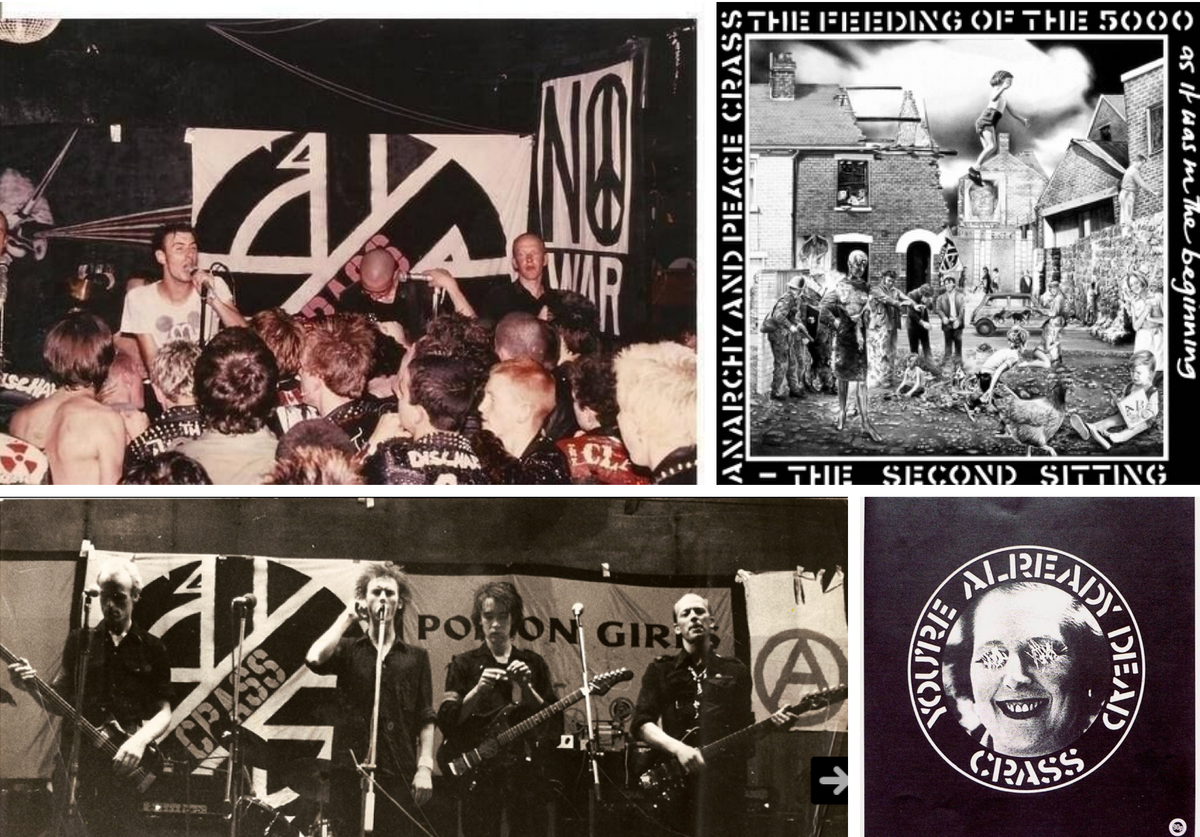
In other book news of late you can read an excerpt of All My Dead Cats and Other Losses by s.e. smith here.
 Luke O’Neil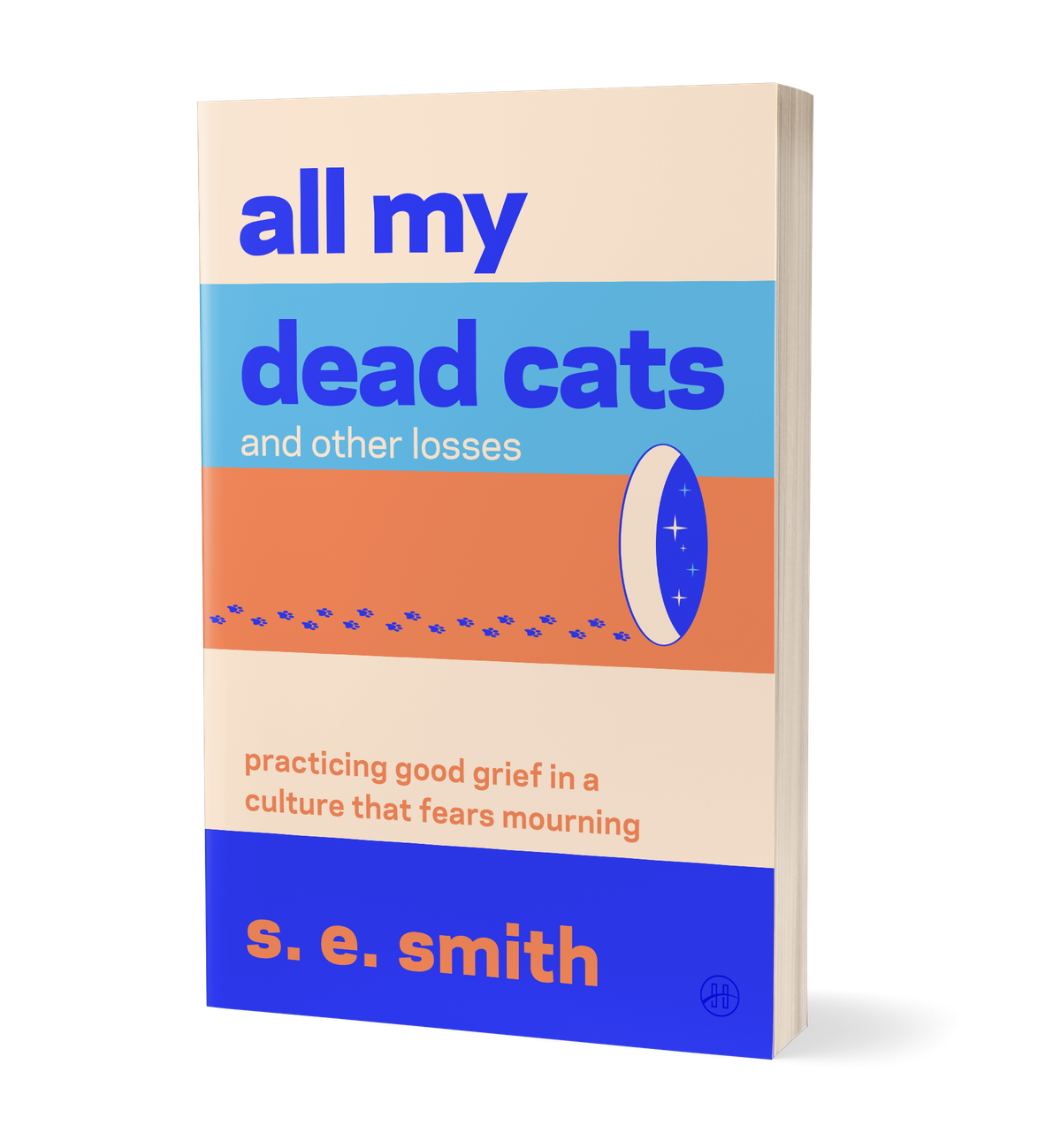
Orange pill bottle
In memory of Paul Bakija, 1964–2024
by Lauren Napier
I first met Paul in Berlin. I had an interview scheduled with the band, but like most scheduled interviews, it ran late: the band kind of bumbling into the venue from their van. Overtired and late for soundcheck, it was almost like the disembarking of a clown car filled with punk rock clowns (of the classic variety not the slapstick sort): mohawks and ripped fishnets, tattered t-shirts and combat boots exiting a nondescript van. Over a meal within the confines of Wild at Heart—a storied Berlin venue with one of the best band meals around—I engaged in scattered conversation with Paul. Often Paul is surrounded by people who try to keep his thoughts on track, and I wish they wouldn’t. He certainly is at the mercy of his ADHD and his bustling mind, but I wished to bear witness to his tangents: the third-grade teacher that he still thinks about or the lines for the hardcore matinee or the walks he took with his guinea pig, Bugsby. The chaos all makes sense in the end.
I am too young to have seen the original line up of Reagan Youth, complete with Dave Insurgent. But the band name has long been a mainstay of back patches in the pit. The interview went rather routinely, but I felt a connection with Paul. We kept in touch. The next time the band found themselves in Berlin, Paul reached out. It was in the summer, I can easily recall because my mother was staying with me in my Wilmersdorf apartment. Being a teacher, she could spend the summers in Germany with me whilst I was living there. A dream of an apartment in a quiet neighborhood filled with what my friends jokingly called Wilmdersdorfer Witwe: a decidedly uncool part of Berlin, but a realm that offered me—and others—a needed quiet.
Paul asked, very simply, if he could hang out. I took the inquiry at face value, ran the idea by my mother, and we went to meet him for coffee. Somehow the evening wandered, past show curfew and after the meandering goodbyes, and I realized that Paul intended to come home with us. After a quick aside, mother and I decided we could pull one of my mattresses onto the floor and he could sleep on the floor; mom and I could share the bed. It was just a studio apartment—room for a girl and her cat, not a girl, her mom, a punk, and a cat.
Touring takes a toll and, even if you enjoy your touring companions, you need a break from the chaotic caravan every once in a while. You grasp at the possibilities: a chance at doing laundry and sleeping in a room all to yourself; a moment to take a bath and breathe; an offer of a home cooked meal and bit of normalcy; or simply speaking to someone else besides your bandmates for more than five minutes. It is not that you want that all the time—the road cures most of what ails—but any routine welcomes respite.
He kept us up late talking and regaling us with tales of his family history and touring life. Even after a show, Paul was never really tired: some punk Energizer battery existed within him that kept him talking right into the arms of slumber. My cat, SAMO, curled up next to him and was content with his presence. When the sun shone through my picture window, his fingers were strumming my acoustic guitar: awake and ready for the day. Not quite a morning person myself and, like mother like daughter, I took my eager guest on a walk through Wilmersdorf—giving my mother a reprieve and Paul an outlet. Past the local cheese shop and bakery and past the two churches in the vicinity and to the bustling street of Kurfürstendamm and back again. Years later, he could still recall what we ate—a chocolate croissant—and the conversations we had with the locals: details not lost to time.
During Covid, when life slowed down and I indulged in a train trip from Seattle to New York City, I was able to visit Paul and take ambling walks through Tompkins Square Park and St. Mark’s. Just wandering and talking. We’d end up back on the stoop smoking a spliff or in his apartment with the windows open, perched in separate corners. In the midst of sharing chord progressions and Paul attempting to convince me I needed to add a Würm tune to my set, he started pulling guitars from seemingly nowhere. From the recesses of the Ave D apartment, Gibsons and Firebirds appeared, each with a story about its origins. A fire engine red semi-hollowbody found its way into my lap, its hue mirroring the electric guitar that I had in college—the guitar that started my musical protest. This one even came complete with a hammer and sickle sticker. Paul insisted I take it home with me. I protested. It seemed beyond extravagant, and instruments are precious. This one in particular was riddled with labels from his prescription pill bottles upon the back. Hospital bracelets. And other intimate details about struggles that he often remained stoic against.
“Take it now, so I can see the smile on your face, or I’ll just will it to you.” he insisted.
It was then I realized the hidden gravity of his health situation. His sentence was in earnest and I accepted the guitar and his request as such. It gave us both the memory rather than the fulfilling of a posthumous, contractual obligation. I was originally supposed to take the subway from Alphabet City to the Bronx. After realizing the weight and value of what I would be carrying back to the Bronx, a ride was quickly arranged. It’s still a guitar that stays at home more often than it sees the road: I’m nervous to take it into the world, into the elements. That Gibson writes different songs, too, channeling something ethereal and beyond myself. Not only are instruments precious, they all have different personalities, singular stories to tell.
“Your face lit up when you held that one, the Firebird not so much,” he texted me later.
Paul continues to be present, even when he is not, whether through the Gibson or my own songs with lyrics he inspired, or in a prescription pill bottle of his I toted around, not knowing it would be the cause of international upset. The same evening he gifted me the Gibson, he put a bit of marijuana into a pill bottle he had lying around: the room was riddled with guitars, Reagan Youth merch, and pill bottles. Just enough for later; I never have felt comfortable traveling with such—legality notwithstanding. Long after the weed was gone, the bottle found a home at the bottom of my bag: usually out of sight and out of mind, but the moments it would surface would bring a smile to my face as I read the name of my friend. I have always been fond of mementos.
One moment, returning to America from Canada after playing some shows with [my partner Vic Ruggiero] as the Witch and the Burro, that pill bottle resurfaced. Vic and I must look terribly suspicious as we go through government checkpoints: the feathers we collect decorating the dashboard, rocks from rockhounding and fresh produce under the seats, his floppy stingy brim hat, my fishnets, our guitars? I am never quite sure what sets them off, but we get pulled aside nine times out of ten. We were pulled into secondary and asked to leave the van and sit in the waiting room: a tiny grey, uninspiring square complete with a man who seemed to have been waiting in the same plastic chair for weeks.
“Paul Baki-jah.” A man in uniform says as he comes through the door behind the desk.
I don’t recognize the name through the mispronunciation.
“Paul Bakey-jah!” he says louder. And rattles a pill bottle. The percussive sound gets my attention and I look up. He has an orange bottle in one hand and my recognizable wallet in the other.
“Oh, I guess that’s mine.” I answer, unsure.
“What’s in here? Do you know what’s in here? Why do you have this?” he rattles off questions.
Putting pieces together, I realize that it’s Paul’s prescription bottle and that the man has been going through my bags. Quickly shaking feelings of being violated and instinctively ruffled feathers, I answer him, “I don’t know what’s in there.
“Are you Paul?”“No.”
“Why do you have his bottle?”“He’s my friend.”
“Why do you have his bottle?”“He’s not well and I keep it as a memento?” I answer honestly.
“You have marijuana with you?”It was then I realized that there may have been some stems and seeds left behind in the bottle: remnants. Nothing of any note. Maybe two or three stems and a seed. The man in uniform shakes the drug detritus into his hand and shoves it into my face: “Is this yours?”“If it was in the bottle then, yes? but I don’t have any other marijuana on me.”Aside from being anxiety producing, nothing was produced from the search of the van because there was nothing there. He put the seed and stems back into the pill bottle and let us go after another hour or so. It became this joke to rattle the pill bottle and recall the look on the officer’s face. It still lives in the bottom of my bag. The seeds and stem are gone and Paul’s name is fading from the label, but the smile that it inspires is still just as present when it shows its transparent orange self.
Tattooed, Pierced, & Fucked-Up: A Scene Memoir 2004–2008 is available for pre-order now.
Read a few pieces from We Had It Coming over at Dirt here.
 Luke O’Neil
And speaking of saving or throwing away all your old shit check this one out too.
 Luke O’Neil