How to Throw Your Life Away
This piece appears in my book We Had It Coming.
The ceiling in my childhood bedroom is so low. You could jump and hit your head on it and knock yourself out if you really wanted to. You could break your neck. I'm not going to do that but I could is the idea.
The room itself is so small too it feels as if the walls are closing in. Part of that might be the way that everything in the home you grew up in seems smaller when you come back to it as an adult but it’s also probably because when the house was built a few hundred years ago people didn’t have as many useless possessions to hold onto forever as we do now.
They were a lot shorter then too in general hence the ceiling situation.
There’s a big rock out back with a plaque on it to commemorate the historic significance of the area but I forget most of the details now.
“They were born and then they lived and then they died.”
I used to climb onto the rock when I was young and unbothered by history and and look out at the farm next door that had a total of one horse and one cow. It always seemed like the loneliest farm in the world to me but maybe it was just an exceptionally efficient one.
Every year around the start of spring I get a call from my mother asking me to come contend with the entire history of my youth which has been jammed into this room for almost twenty years. It’s like the persistent alerts you get on your phone saying you’re running out of photo space and it’s time to upgrade your storage but even phones don’t (yet) have the power to guilt you into action like mothers do.
This year I finally gave in.
Inside the bedroom was a mess. I found box after box filled with the detritus of my past. There were old comic books my mother insisted must be worth some money and projects dating back to elementary school and high school and college essays. There too were some morbid poems written in an unrecognizable scrawl that I’d bound together into a book with a flowery wallpaper covering. I must have recently read Emily Dickinson’s Because I Could Not Stop for Death for the first time when I made it because one verse was clearly a rip-off. I laughed because at least it was proof to me that I’ve remained consistent in my miserable brooding all these years.
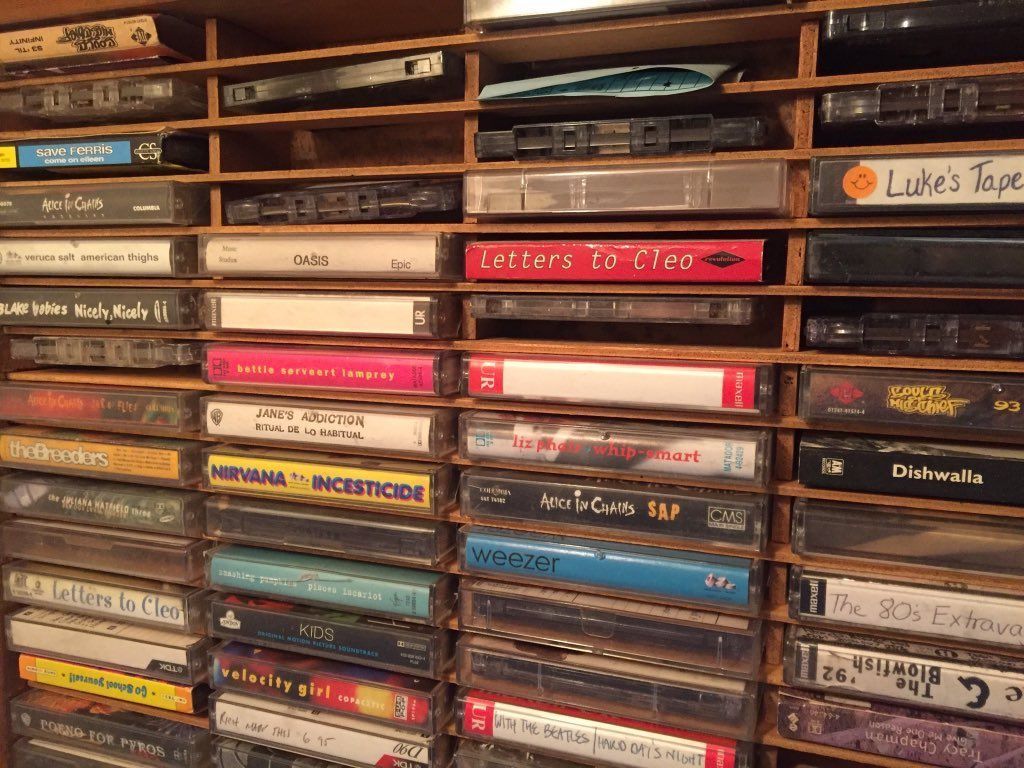
I found a treasure trove of cassette tapes as well including some I’d even listen to right now—Dinosaur Jr., Liz Phair, Alice in Chains—and some I wouldn’t such as a Hootie & the Blowfish live bootleg from 1992. I don’t know what to tell you man the 90s were weird.
Then some postcards from girls I no longer remember and long desperate letters from ones I always will. Pictures of friends whose names are lost to me and pictures of friends who I still see all the time and posters of concerts I’d been to by bands that haven’t existed in decades. There were Boy Scout badges and photos of me and my friends looking like we were in a 90s boy band and photos of my dead friend who actually was in a 90s boy band and photos of people I’d thought at the time would be in my life forever and of course would not.
I found my old shit in other words which feels like an appropriate term because I found it all surprisingly foul.
A high school friend came to visit me recently – I found a mixtape he had made me in the room—and he showed me his latest project. It was thousands of archived emails that our group of friends had sent each other beginning in 1996. At first I was thrilled about the prospect of being able to read what we were talking about back then and I jumped into the messages but the excitement didn’t last long. Here was someone writing under my name in a voice that no longer exists and what was worse speaking at length and with no shortage of emotional conviction about things I no longer remember ever caring about. I felt the same way about the dusty boxes of memories. A strange dissociative feeling like none of this had ever happened or had happened to someone else. Someone who wasn’t me. Reading some of the old letters and emails felt like eavesdropping on conversations that I wasn’t meant to hear or at least that my clearance level should have been revoked for by now.
It all engendered something like a sense of revulsion.
Throw it all away I told my mother later. I don’t want any of it. It’s not mine I said which hurt her feelings. That’s something I seem to be very good at doing lately. Why wouldn’t I want to dig through it all for hours and pick out the things I want she asked.
The repugnance I felt for my belongings seemed off to me. It’s supposed to be hard for people to let go of their sentimental clutter from what I understand. But the more I looked at these things the less real the memories actually felt.
People keep stuff for all kinds of reasons. Some do it because they feel loyalty to the person who gave it to them and think throwing the item away would be a sort of betrayal. I have had a number of old letters my grandmother sent me stashed away for over a decade now because disposing of them would feel like desecrating her grave in a way.
Maybe other people feel that getting rid of something would be a break from the past that they don’t want to go through with?
It’s not that the inherent value of an item has changed over time but rather that we ourselves have changed.
A few days later I called my mother back to ask her if she’d thrown everything away yet. Don’t I told her. There are a few more things I want to keep. I needed to return to take another pass at editing down my story. I’d already taken some photo albums with me and a scant few books including the Emily Dickinson that had inspired my young doggerel.
My mother is a quilter. When someone dies his or her family often brings leftover possessions to her — t-shirts and sweaters and so on — to stitch together into a blanket that they can wrap themselves in weaving together the literal fabric of a life into something tangible. Oftentimes there’s simply too much so decisions must be made. It’s similar to how we have to deal with our own lives as we go along. You can’t hold every memory in your head at once it would be maddening. Instead we pick and choose which ones to keep sometimes subconsciously or sometimes by deciding that a certain day or a certain interaction or a certain smell or a handful of objects among hundreds will be the ones we think we will want to remember forever. And then we put the rest in a little box somewhere and bury it in the earth. And then one day we crawl into the box too.