The presumption of innocence
MA State Police officers charged with involuntary manslaughter after a trainee boxing match
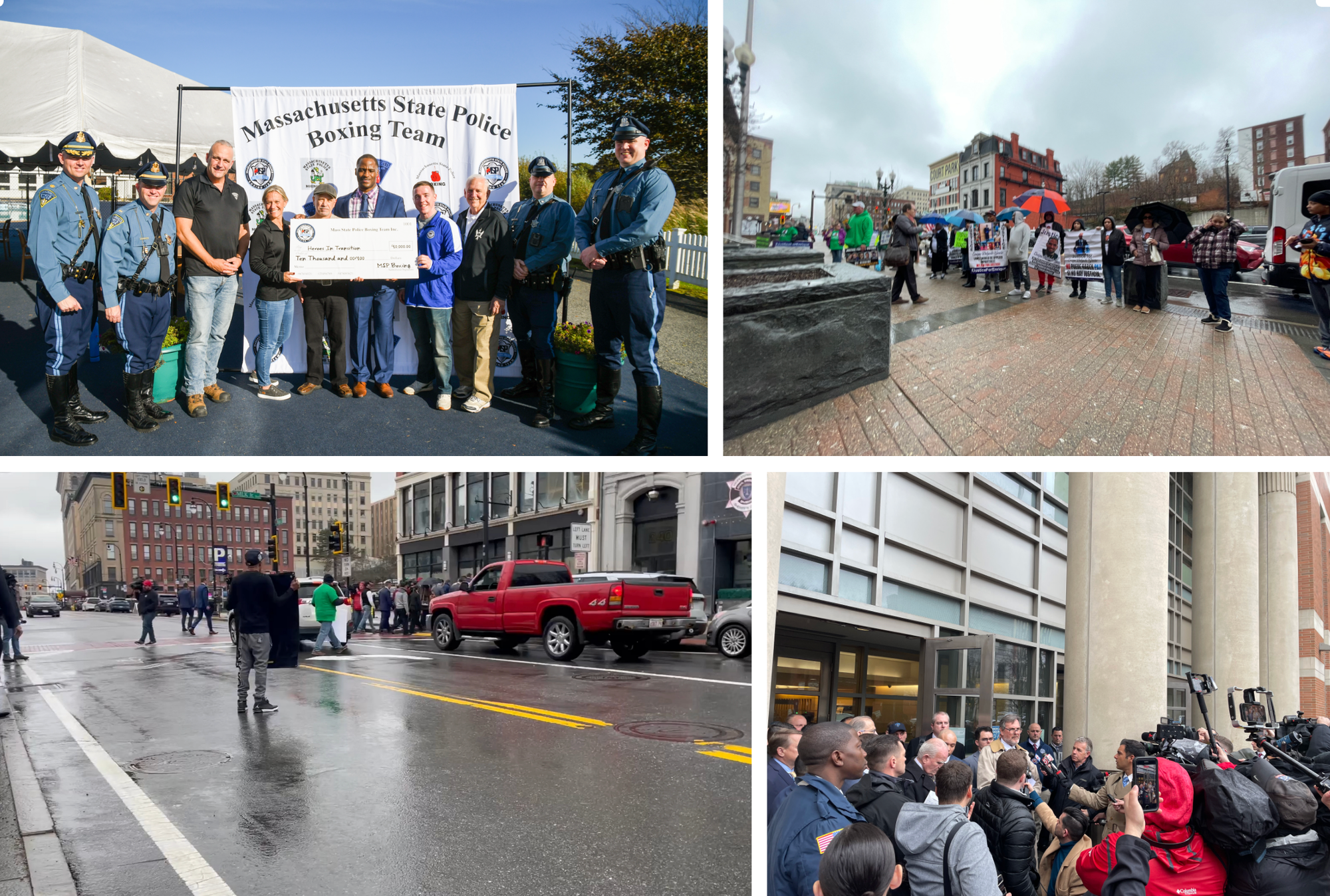
Bill Shaner reports today on the arraignment of Massachusetts State Police officers charged with involuntary manslaughter after the death of a police recruit during boxing match training.
This will go out in the next edition of the newsletter. Subscribe to get every issue in your inbox.
Shaner previously reported on the kidnapping by ICE of a Worcester resident.
 Luke O’Neil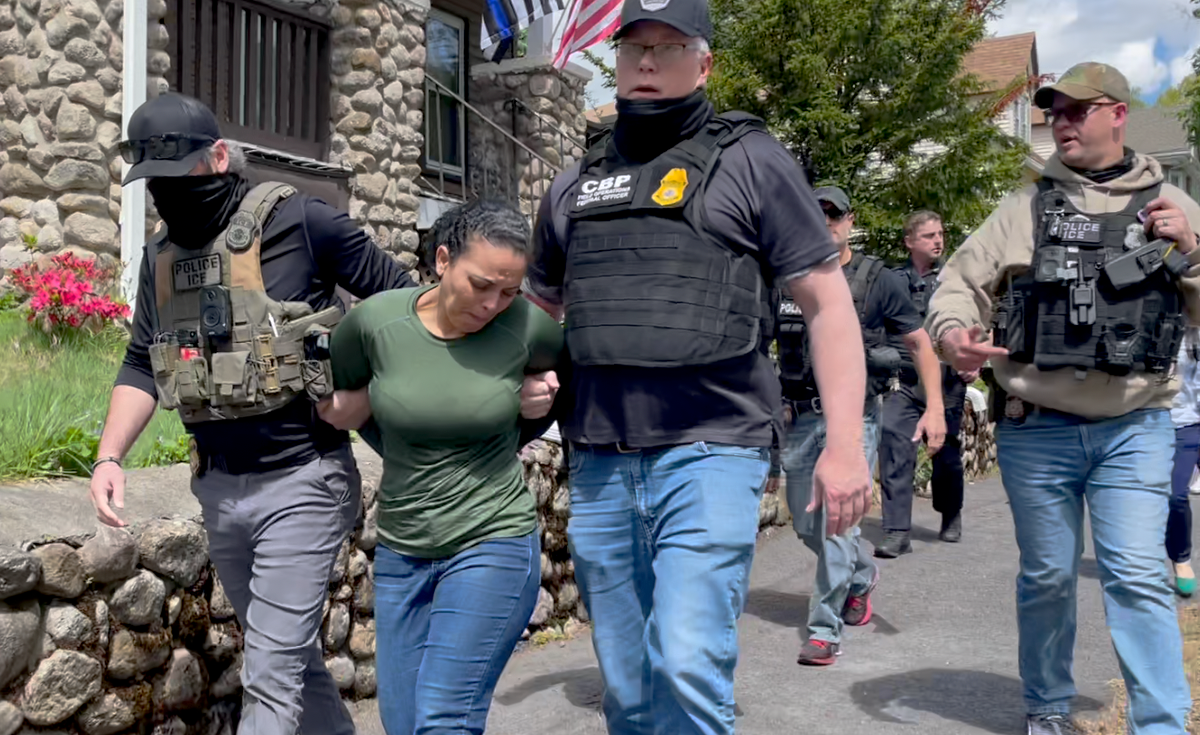
In February I wrote about the fall out of that story and spoke with Etel Haxhiaj – a Worcester City Councilor at the time of the incident – who was absurdly found guilty of assaulting a police officer that day.
Luke O’Neil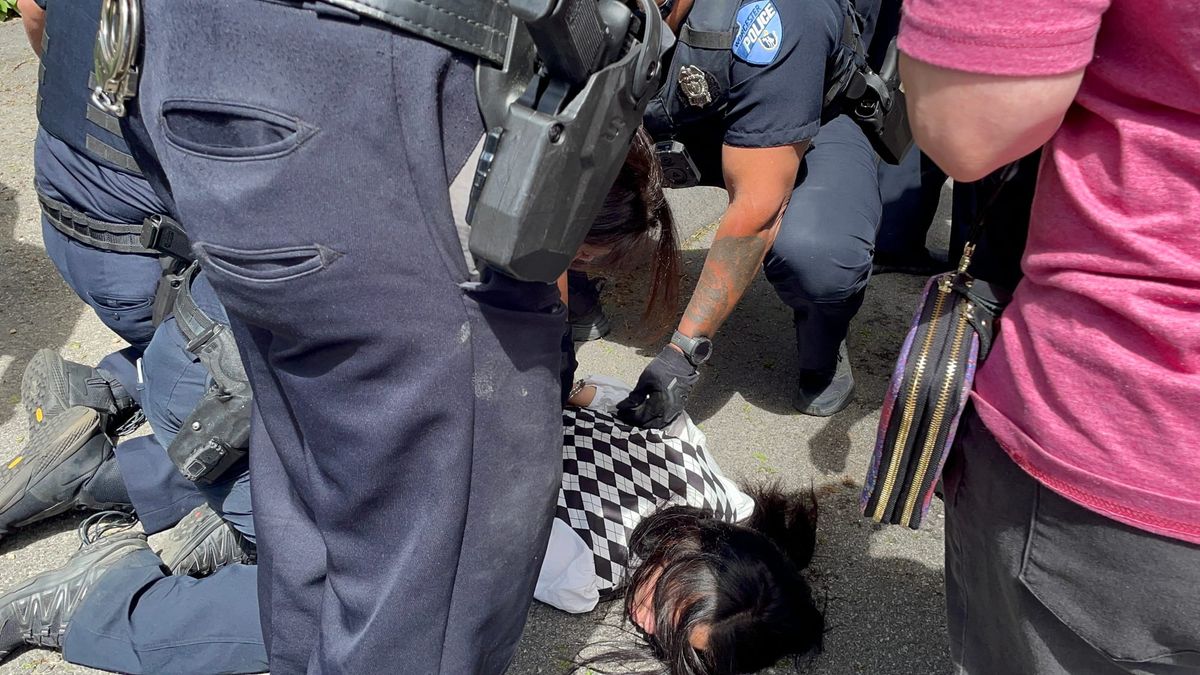
Exceptions to the rule
by Bill Shaner
Three of the four Massachusetts State Police officers charged in connection with the boxing ring death of a recruit were arraigned last week. Sergeant Jennifer Pen, (now a Lieutenant) and troopers David Montanez and Edwin Rodriguez pleaded not guilty to manslaughter charges. A fourth trooper, Casey LaMonte, will be arraigned on April 14. They all presided over the 2024 boxing match – and an “unofficial” match the day before called “unapproved and unsafe” by investigators – that left 25-year-old Worcester resident Enrique Delgado Garcia unconscious. He would die the next day. New details from the state’s investigation provided at the arraignment offer a glimpse at a deeply embedded culture of violence in the Massachusetts State Police that suggests the institution is well past the “militarizing” phase. Now it’s just plain old military.
Not that such incidents are reserved for the Commonwealth. At least 29 other recruits have died in basic training law enforcement exercises around the country in the past decade an investigation by the AP found.
It was an odd scene outside Worcester County Superior Court on a dreary Wednesday afternoon. I arrived just in time for the press scrum, the tradition where reporters from the Boston stations stick their microphones in the faces of some scumbags in order to get lied to. By the main exit, a gaggle of press types all with their hands in the air completely concealed who they were questioning. On the sidewalk, where they'd undoubtedly been pushed back to, a few dozen people under umbrellas held signs in support of Delgado-Garcia.
Court officers idled around the no-man's-land between the two groups, yelling at people for serious infractions like standing on the stone slabs that decorate the front entrance. Other stuff they were making up as they went along I'm sure. The real goal, having observed the way these court officers straighten their backs and flatten their ironing around "real law enforcement," was to impress the many State Police officers in showy suits, apparently there to serve as body guards for the officers that had just pleaded not guilty to varying manslaughter charges.
With some difficulty I was able to talk briefly with Delgado Garcia's uncle. A friend of his translated as I asked the sort of obvious questions you ask someone about the killing of a family member. My go to is a simple one:
"What brought you here today?"
"I want justice,” he said. “I want justice. For my nephew. I want justice."
Just before we spoke, Julio Cesar Garcia and others chased after the freshly arraigned officers as they walked to the parking lot across the street, surrounded by their besuited body guards like casino owners in a cheesy mob movie. Delgado-Garcia's family and their supporters shouted and chanted, mostly in Spanish, and threw up their signs.
The pack of state police did not look back. Not even once. They got to the parking lot and two of the self-appointed pro bono body guards stood at the closest and most obvious entrance, as if it were a gate to their private property – which, in a functional sense, it is.
Earlier, Brian Williams, the president of the State Police Association of Massachusetts, hilariously and appropriately named SPAM, took center stage to address the media outside the courthouse.
“These members and our entire defensive tactics staff are among the best in the nation and all established protocols are strictly followed,” he said.
“Accountability is essential, but it must be grounded in a strict adherence to the facts. It cannot be driven by public pressure or by incomplete and inaccurate information. It is important to stress that each of these members is entitled to the presumption of innocence. Both in fact and by law today, they are all innocent. We are confident that their innocence will be upheld at the conclusion of these proceedings.”
“In the meantime, our association looks forward to the department issuing a public statement in support of these members. Thank you.”
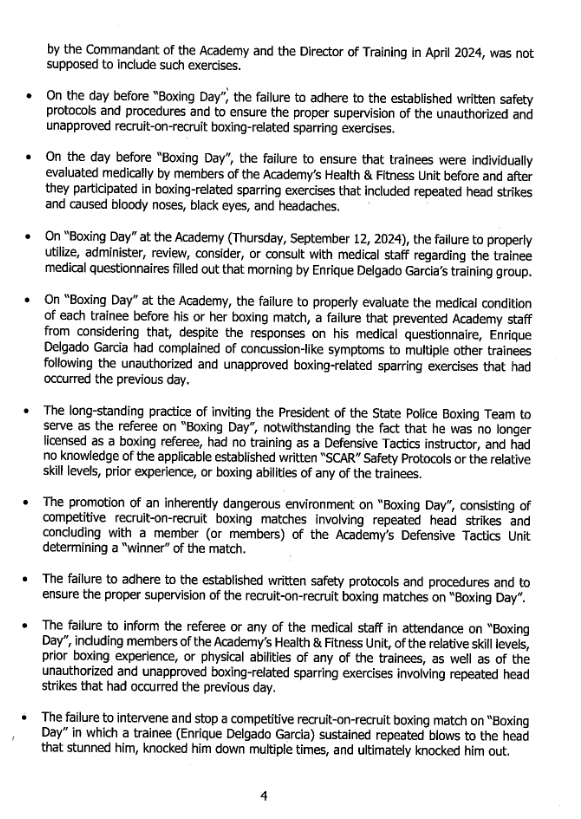
While comments were apparently kept short in the courtroom earlier that afternoon, the special prosecutor that brought these indictments, David Meier, filed an 11-page statement of the case with the court, which you can read here.
The document offers the best glimpse we've had to date of what actually happened in the days leading up to and following that boxing match. What follows is a reconstruction of the narrative Meier provided.
The day before the match that killed Delgado Garcia, there was a round of “unofficial” boxing matches. What that term entails remains murky. "Neither the members of the Defensive Tactics Unit nor the Academy command staff were able to provide a clear picture – whether verbally to investigators or to the Special Statewide Grand Jury, or in writing in the daily Academy activity reports of who had been present and what had occurred during the boxing-related sparring exercises on Wednesday.” It was Wednesday, September 11, 2024. Delgado Garcia sustained concussion-like symptoms during that unofficial boxing match.
Among the recruits, there was one especially experienced fighter. Enrique Delgado Garcia was not an especially experienced fighter. Ahead of "boxing day," each of the recruits were matched roughly on size and ability. A large and physically fit guy was paired with the experienced fighter. On Thursday, Sept. 12, the day of the match, this large and physically fit guy wimped out.
Instead of saying, “OK, no one is equipped to fight this guy, sorry bud you are too scary” the training staff instead asked for volunteers. Enrique Delgado Garcia was apparently the only recruit to step forward. So he entered the ring with concussion-like symptoms to face a fighter so scary the second scariest guy had said no thanks.
Once in the ring Delgado Garcia was under the supervision of a referee who was not trained nor certified to be a referee, but was rather a micro celebrity in the SPAM community: one Charlie Murray, president of the State Police boxing team.
One can presume what sort of hold a local boxing figure like Murray would have over Delgado Garcia’s opponent. From "experienced" we can infer that kid wanted to be a fighter of some kind. Being observed up close and personal by a seasoned guy, he would obviously fight like hell. Apparently he did. He knocked Delgado Garcia down. He knocked him out. Knocked him unconscious.
We still don’t know who this fighter is, by the way, and we can only guess he has at this point graduated the academy and is out there somewhere in Massachusetts, glowering under the wide brim of the State Police-issue hats pulled from the Blood Meridian cinematic universe, interacting with the public he is taught by the Defensive Tactics Unit are always potential combatants and wolves in sheep's clothing. The boxing match is just one component of a pointedly “paramilitary-style” training academy all Massachusetts State Police officers must go through. It was drafted in part by a former Green Beret and leans heavily on military metaphors, according to a Boston Globe investigation.
Within minutes of the match ending, a recruit reported to a trooper on scene that Delgado Garcia had been complaining about memory loss, headaches and "missing the day" after the unofficial sparring, whatever that really means. From this we can infer that when Delgado-Garcia "volunteered" to fight again he did so in a fog of "concussion like symptoms." The trooper passed the information up to his supervisor, Sgt. Penton, who decided not to relay that information to the doctors in the ER or the EMTs on scene, according to the prosecutor’s statement of case.
Instead, the whole group apparently set about to cover their tracks. Meier, the special prosecutor, explained:
Shortly after Enrique Delgado Garcia was taken by ambulance from the Academy to UMass Memorial Medical Center, and after conversations and communications with Sergeant Penton, Trooper Rodriguez, and other Academy staff, Trooper LaMonte accessed and revised the previously-approved Lesson Plan for the Defensive Tactics exercises on Wednesday, September 11.
Specifically, Trooper LaMonte revised the approved Lesson Plan after-the-fact by inserting language suggesting that "Boxing Fundamentals" were a part of the approved Defensive Tactics exercises on Wednesday, September 11. Trooper LaMonte also created a second boxing-related document shortly after Enrique Delgado Garcia's boxing match on Thursday, September 12 that inaccurately described the training activities on Wednesday, September 11, and Thursday, September 12.
Delgado Garcia was pronounced dead in his hospital bed the next day.
A week later, Penton lied about having been told about the concussion-like symptoms to investigators, then later to a grand jury, according to Meier.
In his statement of case, a bullet-point list of sixteen "wanton and reckless acts and omissions" make a compelling case that the police's militaristic training regimen is indeed wanton and reckless.
This all feels almost too cartoonish of an example to use as a launching point for analysis on the militarization of police, the increasingly blurry line between law enforcement and the military, all conveniently occurring at the same time as the blurring of home front and frontlines. “There is a reality out there and it is catching up with us fast," wrote David Harvey in A Brief History of Neoliberalism. The argument being that the contradictions of America'a maintenance of hegemony without the heel of the USSR and the financialization of everything lead us necessarily down a path to naked repressive authoritarianism.
The circumstances of Enrique Delgado Garcia's death read as though they were ripped from a rough draft of Full Metal Jacket. I don't mean to make a joke here. I'm more serious than I've been in some time. An idea Kubrick would have found too loud for his most on-the-nose polemic on American militarism is now, some 50 years later, a non-fiction story in American policing.
That story draft never makes the evening news. No one is reliably informing the American people that "we live under a regime many magnitudes more repressive than it was the last time it was seriously tested, some 80 years ago." No one is reporting on how the cops’ union said out loud on Wednesday that they plan to use this story to pin the administration into submission. Did you catch it up there earlier? In that line I quoted about how "our association looks forward to the department issuing a public statement in support of these members"? It was as if to say you will be punished should you stand in the way of the escalation of our barbarism.
And boy, let me remind you of Massachusetts Rule #1: The More You Know The Worse It Gets. That threat is anything but idle. The union very much can and likely already has gotten the bent knee of the supposedly reform-minded administration cobbled together by Governor Maura Healey, herself a cop, while under the pressure of other myriad scandals. Like Worcester patrolman’s union president Thomas Duffy demanding the charges against former city councilor Etel Haxhiaj after she stood up to ICE officers ripping her neighbor off the street, this is their way of calling the bluff on anyone who thinks they have, in real life practice, the democratically proscribed authority over them that they have, in theory, via the designs of our democratic system. Like District 1 City Councilor Tony Economou said of the DOJ’s investigation of the Worcester Police Department on his way to election victory last fall, that authority is "just words on paper."
I keep returning to the scrum, to the intellectually insulting nature of the questions asked and the responses provided by the State Police officials and attorneys. These people are barely able to articulate an argument – a fact that has little bearing on whether their argument will, in the end, win out, as we saw in the Haxhiaj trial. Kevin Reddington, Montanez' attorney, set a new low bar for pro-police discourse.
“Put yourself in a cruiser at three o'clock in the morning on the side of a road, in the middle of a downpour, with a 300 pound guy, left out of his mind with a knife coming at you,” he said. “And they tell me that this type of training is excessive or dangerous. It is not.”
“And the only thing I can comment on, if that occurred to me, and I know you're all familiar with the movie, with Jack Nicholson, and he was the Marine. And he said, you need me on that wall. You want me on that wall to protect the people. You cannot protect yourselves.”
“And it's either George Orwell or Winston Churchill that said, people are able to sleep secure at night in their beds because there are men and women who are able to defend themselves against people that would do violence on them. And that's what you have right here. This is open season on police officers. You can see it every day.”
Either George Orwell or Winston Churchill. My god.
Brad Petrishen's reporting in the Telegram captures some of the scene from inside the courtroom, including this bit right here. It’s stunning.
Reardon (the judge) also overruled requests from defense lawyers that (Meier) not put in place a so-called protective order – which limits where and how lawyers can share evidence disclosed by prosecutors with their clients.
Such orders are not unusual in cases involving violent defendants or gangs; defense lawyers argued they weren’t necessary for state troopers, with one lawyer remarking that the defendants aren’t members of “La Cosa Nostra.”
Reardon said he was approving the order only until the next court date, June 16, saying that it’s possible “other people” tied to the defendants could potentially get the kind of sensitive information about witnesses that Meier was trying to protect.
I read that again this morning, remembering the body guards in the parking lot and the casino movie suits and the SPAM scrum. No, the defendants aren't members of "La Cosa Nostra," they're members of something arguably worse. It’s a crime family sanctioned by the state to kill, for whom there will never be any wiretaps or RICO cases. A class of people who in polite discourse are collectively treated as heroes, a vaunted status from which only individual officers can fall, in the rhetorical context of “scandal,” to then be treated as exceptions to the rule.
In reality they're merely the clearest portrait of the norm. Any given scandal in question almost always inevitably subsides with the rest of the heroes given no reason to act any different going forward. And so they get right back to their business, having learned nothing and made no changes, until the next time someone is hurt.
Bill Shaner writes the newsletter Worcester Sucks and I Love It.
He has also reported for Hell World on Massachusetts Governor Maura Healey's rather Trumpian approach to addressing migrants and homelessness in the Commonwealth, a No New Women’s Prisons anti-incarceration march, a strike by nurses at Saint Vincent Medical Center, the cruel displacement of the city's unhoused population, and the Department of Justice investigation into the police department of Worcester, MA.