It does as it pleases and continually destroys

Sean T. Collins on Godzilla and America

It does as it pleases and continually destroys

This post will go out in the next edition of the newsletter. Sign up for free or with a paid subscription to help pay our great writers.

If you missed this newly relevant Sean T. Collins piece please read it it's a good one.

A high heel, jammed into a human mouth, forever
Sean T. Collins on The Hunting Wives

It does as it pleases and continually destroys

by Sean T. Collins 

“It was man that created that monster. Mankind is far more monstrous. Godzilla could be said to be a nuclear weapon. What’s more, a living nuclear weapon. It does as it pleases and continually destroys.” 
– The Return of Godzilla (1984)

Like a flag or a cross or a cartoon frog, Godzilla is a symbol onto which many meanings may be projected. As a kid mostly familiar with its battles against other kaiju, the genre the original film jumpstarted, I always saw it as a marvelous hybrid of monster, superhero, and pro wrestler — Smaug, Superman, and Hulk Hogan rolled into one. Godzilla meant power, yes, but also justice and kindness. It stomped on Tokyo only to teach valuable lessons or throttle King Ghidorah neck by neck by neck.

What meaning may we assign it today? In its most recent piece of filmed media, Apple TV’s quite good series Monarch: Legacy of Monsters, Godzilla has a surprisingly personal application: Its accidental rampages, immensely destructive even though they’re in service of a greater good, represent the vicissitudes of fate that separate people from their loved ones due to death or estrangement. This leads to some of the most achingly romantic material on television, believe it or not. Here Godzilla serves the role of the Second World War in Casablanca, the force that drives people together only to force them apart again.

Monarch is a spinoff of the so-called “MonsterVerse” series of films from Legendary Pictures, which have also added King Kong as a permanent fixture. The lizard and the ape first tangled in 1962’s King Kong vs. Godzilla; a persistent legend holds that who won depended on which country you watched it in, but Godzilla was firmly a villain at the time, so Kong always swam away victorious. Now the two are, if not friends, then allies with a begrudging respect for one another, holding their respective spheres of influence safe from far worse threats. A little too much has been made of this being a uniquely and revealingly American interpretation of the character, as though Godzilla hasn’t been portrayed similarly in Japan on and off for its entire career.

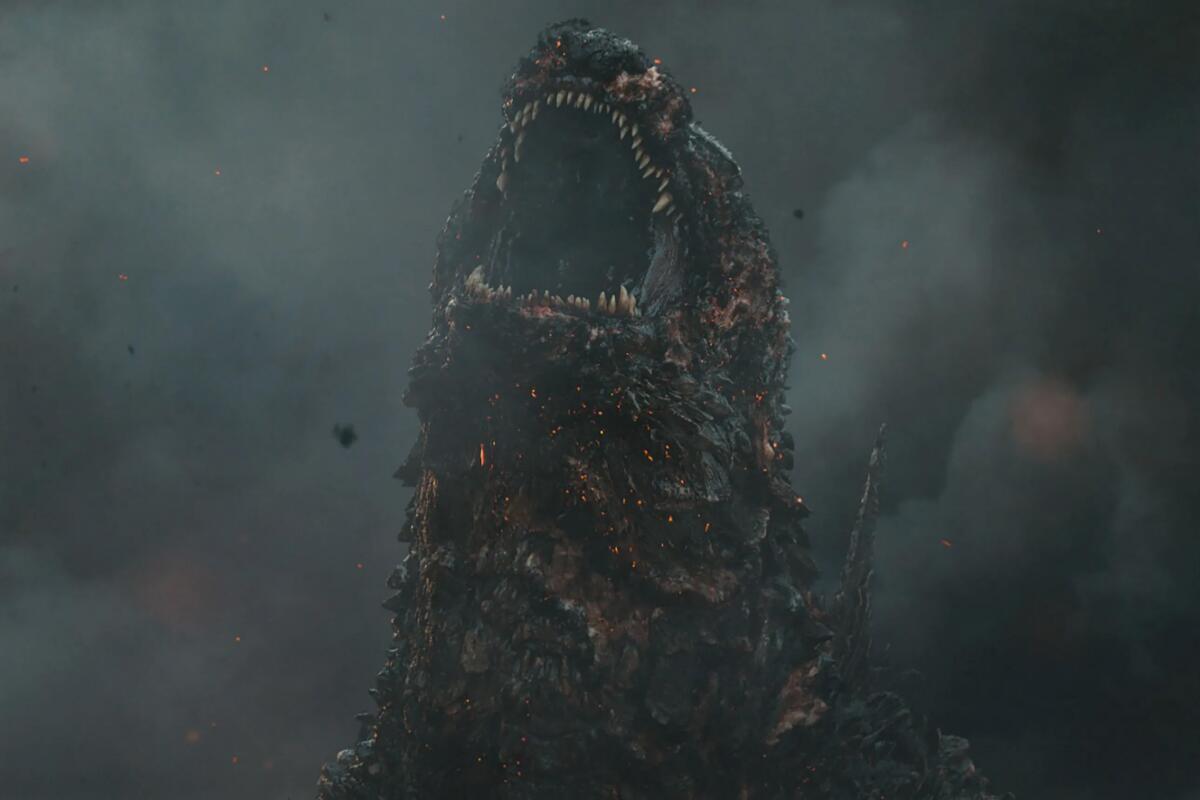
But it’s the “off” that I want to focus on here. Here in the hallowed halls of Hell World I’ve written about the recent Japanese Godzilla movies Shin Godzilla and Godzilla Minus One, the most acclaimed films in the series since the 1954 original. Shin speaks to the then-recent fears of the Fukushima disaster and the coming of climate change; Minus One addresses the past trauma of Japan’s destruction during World War II, which the film argues is the fault of an authoritarian government that saw the lives of its own people as disposable. (The protagonist is a kamikaze pilot who shirked his duty. That movie doesn’t mess around.)

Shin and Minus One are two of the four Godzilla movies in which the titular beast does not fight another giant monster. The third of the four needs no introduction. When the monster debuted in 1954, it was unambiguously a symbol of the horrors of Hiroshima and Nagasaki. American atom bombs disturbed it from its traditional deep-sea environs, irradiated it, infuriated it, imbued it with atomic breath, and set it loose on Tokyo, which itself had been firebombed into near-oblivion. 

Thus filmmakers from the only country ever to have been attacked with nuclear weapons unleashed a new nuclear weapon upon themselves. Japan’s only hope is that one of its own most brilliant scientific minds, the angst-ridden eyepatch-wearing Dr. Serizawa (Akihiko Irata), can be persuaded to use his Oxygen Destroyer, a weapon so heinous he planned never to reveal it to the world at all. Serizawa destroys the plans, then sets off the device himself, committing suicide by Oxygen Destroyer, but reducing Godzilla to a pile of massive bones, and then nothing at all.

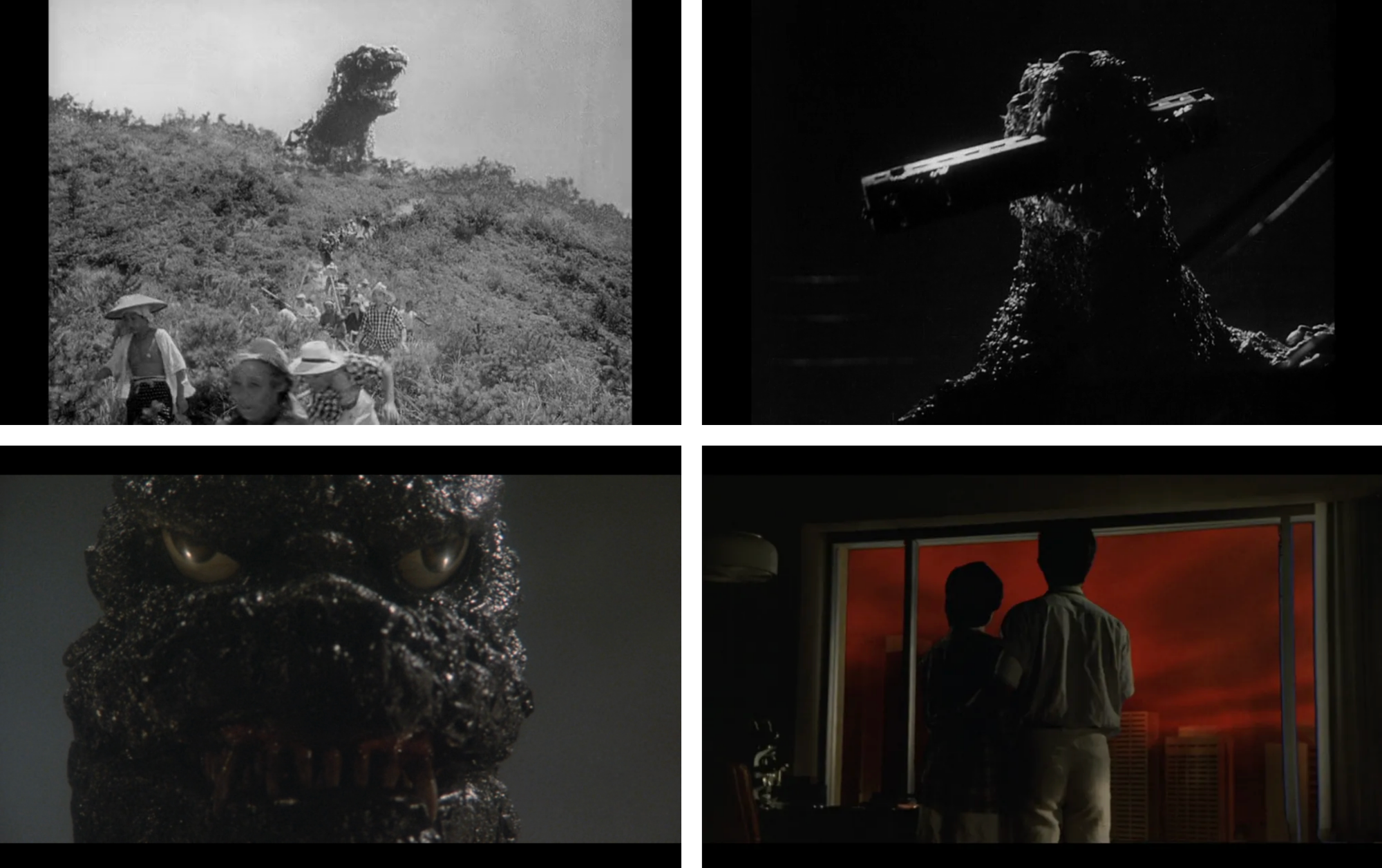
Watching the 1954 Godzilla, with its gritty black-and-white style and the gnarly radiation-scarred look of Godzilla’s hide, is like watching the Cloverfield monster wander through the cover of the first Killing Joke record. It’s a society at rock bottom — Serizawa’s behavior, and his prior role as a military scientist, suggestively hints at Japan’s own crimes during the war — being pushed even lower by a side-effect of the horrific weapon that already killed hundreds of thousands not even ten years prior. 

Who dropped those bombs? Who set off those test explosions throughout the Pacific? The United States of America, leader of the free world. Godzilla is an emblem of what it’s like to be at the mercy of forces completely beyond your control, set loose by people who do not pay the price for what they’ve done. It’s a living atomic superpower, pursuing goals unintelligible to outsiders and leaving a trail of destruction, intentional and otherwise, in its wake. 

The fourth of the four non-battle movies, 1984’s The Return of Godzilla, is the most overlooked. I can understand why. Godzilla 1954, Shin Godzilla, and Godzilla Minus One are masterpieces of the genre, and breathtaking filmmaking by directors Ishirō Honda, Hideaki Anno & Shinji Higuchi, and Takashi Yamazaki to boot. Return’s director, Koji Hashimoto, was a veteran of the studio’s kaiju and sci-fi epics, and his work here shows the limitations of continuing the guy-in-a-rubber-suit method of making Godzilla in a post–Star Wars/Spielberg world. Some of the monster effects early on barely pass MST3K muster, and in lieu of another kaiju Godzilla runs into trouble with a flying saucer built by the Japanese government named Super X. It’s not a compelling antagonist.

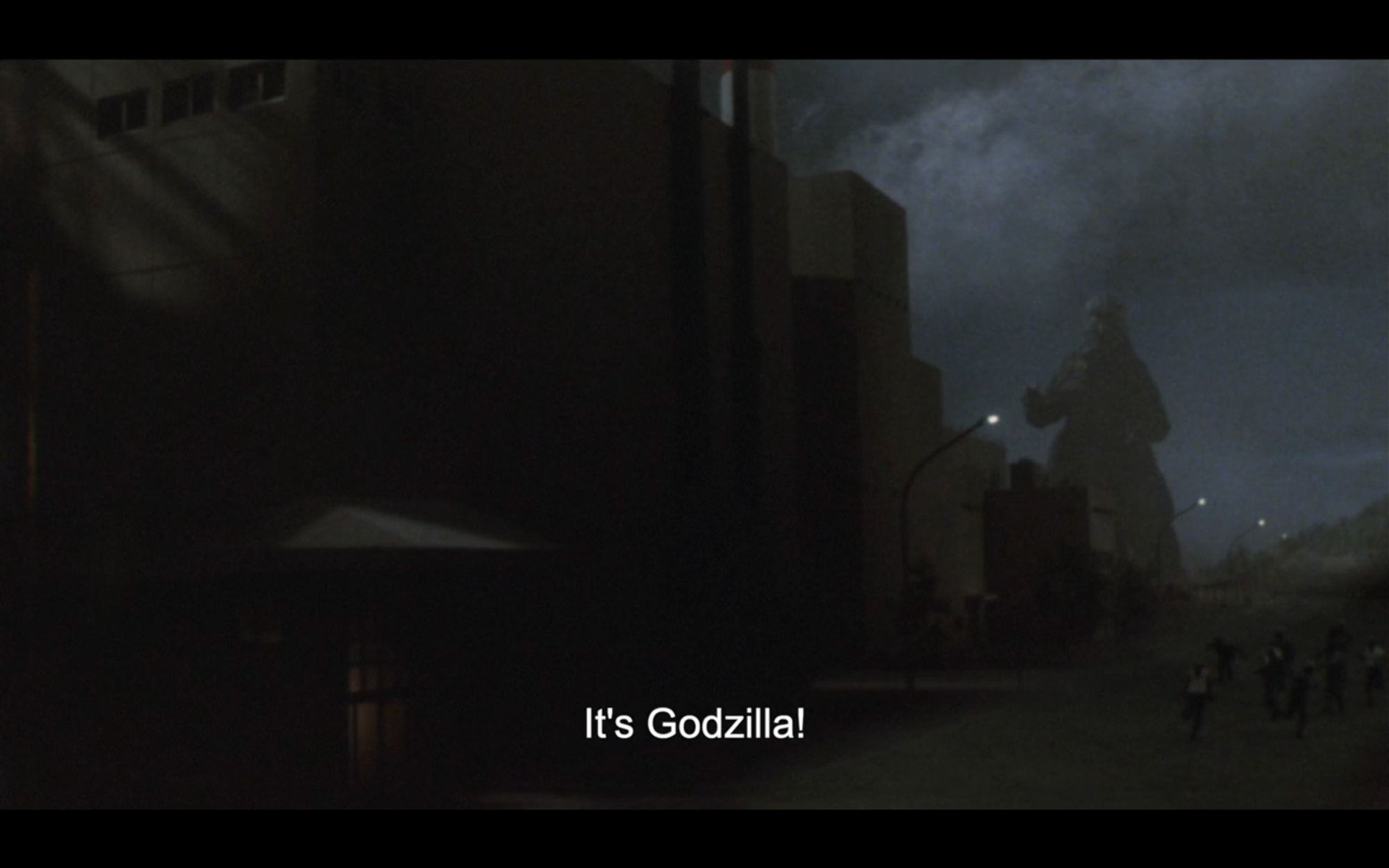
After all that throat-clearing, time for me to expel some atomic breath: If you like any of the “big three” good Godzilla movies (or Monarch!), this is a film you must watch. Director Hashimoto’s hands may be tied by the suit to an extent, but the scale photography of Godzilla among miniature power plants and skyscrapers is shot with expressionistic verve. The air Godzilla walks through is gray, thick with soot or fog from the sea. Later, the entire world is illuminated red due to events in the atmosphere above the conflict, adding an infernal glow to Godzilla’s attack. 

Shin, like Minus One, is the story of how the collective action of everyday people — selfless knowledge workers, brave pacifist veterans, experts who donate their time, fishing captains who donate their boats — are what enable them to defeat Godzilla. (But for how long?) Return smartly anticipates Shin’s emphasis on the government inaction, jurisdictional battles, and bureaucratic red tape that hinder response to the monster until it’s almost too late.

But its villain is America once again. This time we’re a two-headed dragon with the Soviet Union, our nuclear-armed Cold War rivals. Huge segments of the film play out like some Armando Ianucci farce, as ambassadors from the USA and USSR find themselves in agreement — more in sadness than in anger, really — that for the good of the world Godzilla must be nuked, even in the middle of Tokyo, and Japan must sit there and take it once again. It’ll just be a small blast, they say. You’ll barely even feel it. Lie back and think of Mothra.

Even after the Prime Minister refuses to allow the attack, imperialist arrogance nearly wins the day anyway. A clandestine, mobile nuclear-missile launch system hidden away on a cargo boat in Tokyo Bay by the Soviets gets damaged in Godzilla’s attack, triggering a missile launch. Only an American interceptor missile saves Tokyo from incineration.

But don’t think that lets the Americans off the hook. From the moment both sides of the Cold War seem so eager to agree with one another about nuking the kaiju, Japanese officials can smell a rat. They recognize a nuclear strike on Godzilla as “an experiment,” an attempt by both sides to test their tactical, limited-scope nuclear capability for future combat use against one another. (That’s some shrewd, prescient writing right there.) 

“There is no such thing as ‘safe’ nuclear weaponry,” the Prime Minister (Keiju Kobayashi) lectures the ambassadors. “What’s more, should we use them just once, it would destroy the balance of power that has made them a deterrent force. It would lead to the world’s end. That is the nature of nuclear weapons.” Reagan’s America, having unleashed Godzilla 30 years prior, is now preparing to help an even rougher beast slouch toward Bethlehem to be born in the waning days of its “better dead than Red” mania.

Japan escapes both Godzilla and war crimes by the skin of its teeth. After the nuclear missile is detonated in the atmosphere above Tokyo, turning the sky blood red, Godzilla is lured out of the city by sound waves that mimic its birdlike “homing mechanism.” (Kaiju science is a bit like MAHA medicine — they more or less just make it up as they go along, all while several thousand people die.) They draw it to the caldera of a dormant volcano which they then detonate, sending a screaming Godzilla plummeting to ots fiery grave and leaving the humans responsible in stunned silence. It packs a wallop.

Especially now. The mindlessly destructive, implacably angry Godzillas of 1954 and 1984 feel like a custom-made representation of America, the country responsible for its creation, in 2026. Godzilla loves sinking ships full of sailors. It loves recklessly attacking nuclear facilities. It loves carelessly ripping up famous architecture in the capital city. It loves spreading a trail of uninhabitable environmental ruin wherever it goes and leaving rubble in its wake. And it loves stepping on people too slow or sick or just too unlucky to get out of the way. As Return puts it, “It does as it pleases, and continually destroys.”

If Donald Trump and his coterie of Nazi pedophiles were mutated into one giant spray-tanned Mar-a-Lago-faced monster and it attacked the United States of America tomorrow, could it possibly do anything worse than what the actual Trump Administration has done to us? Could a giant monster possibly set us any farther back than we’ve already been set, and are poised to be set back further still? 

“We’re going to join Daddy!” says one hysterical mother to her terrified children in the 1954 film, as they await their impending death from Godzilla’s assault. “We’ll be where daddy is soon!” The line hits like a concrete block to the face every time I hear it, and especially now. Since its inception, Godzilla has symbolized an out-of-control America. By the next time we see it, it will need to evolve to keep up. 

Through war, through the obliteration of voting and reproductive rights, through ICE abductions, through the demolition of the economy, through the force-feeding of AI into every sphere of life, through the repulsive impunity granted to powerful pedophiles, through the genocidal cuts of USAID — through all of this, how many families like that one have our overlords annihilated and then walked away from, as casually as a kaiju swings its tail and reduces a neighborhood to nothing?

Sean T. Collins is a critic who has written for The New York Times, Rolling Stone,Vulture, Decider, Pitchfork, and others. He is the author of Pain Don’t Hurt: Meditations on Road House, published by Mutual Skies in 2021. Together, Sean and Julia Gfrörer are the co-editors of Mirror Mirror II, an anthology of horror and erotic comics and art, published by 2dcloud in 2017. They live with their children on Long Island.

He previously wrote for Hell World on The Chair Company and I Love LAOne Battle After Another and KneecapThe Hunting WivesSinnersFargo, The Curse and the 2024 electionSexy Beast, vampires and class warfareGodzilla Minus One and the trauma of war; and the surveillance cinema of The Curse, The Zone of Interest and Skinamarink.