Grief is a mountain / an abandoned car
Katherine Hudson on losing Kaleb and Joel Pinckney on an ICE kidnapping
Texas forever. I say that because I've been rewatching Friday Night Lights for the first time in many years (and crying every single episode) but also because by chance we have a two-parter today from two great Texas-based writers. Neither of the essays are particularly fun though I'll tell you that. Quite the opposite. Well the newsletter isn't called Nice World what can I tell you.
One year ago today we lost the great writer Kaleb Horton. I am still very sorry that I won't ever get to read anything new by him ever again.
I wrote about his passing here:
 Luke O’Neil
"In an earlier time he would have been the kind of writer being paid $5 a word by magazines to go write about whatever he pleased. And no one would be pissed off or jealous about it either. All of the rest of us scrabbling for that kind of gig just nodding in approval. That makes sense. He has that coming."
Today his partner Katherine Hudson joins us to write about her experience of loss and grief over the past year.
 Luke O’Neil
"When I was born, ripped out of my old reality and slammed into my new life, I balanced on a peak as sharp and narrow as a sword," she writes.
"I can see some other people on other peaks, on their own grief mountains. I watch them through binoculars and wave. Everyone else is down in the valley. They think we’re all supposed to get back to them, to rejoin society and act like we didn’t just go through all of that. Instead I make camp in Gethsemane. My agony is between me and God and we rehash it every night."
Please treat yourself to this collection of Kaleb's work his family have put together as well.
Also today Joel Pinckney writes about watching a man being kidnapped by ICE in his neighborhood in Austin. The man's car still sitting where they left it days later.
 Luke O’Neil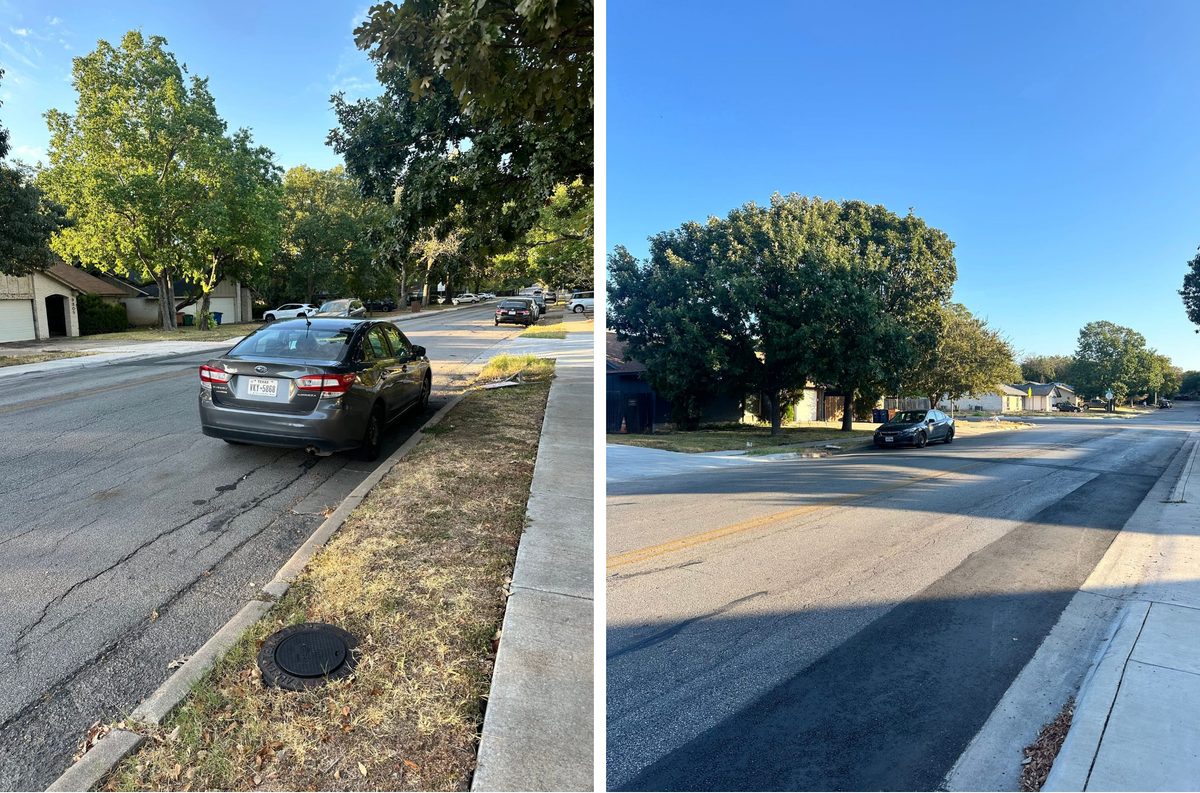
"I know nothing about this man, except where he was at 8am on Saturday; except that I was the last person to catch a glimpse of him before he officially entered the hell and terror of ICE detention. I can imagine he knew this day might come; I can imagine people he loved had disappeared without explanation, and yet with but one explanation; I can imagine people who loved him spent much of Saturday trying to reach him, looking for him at his usual places, before reaching the horrible, desolate, unavoidable conclusion that so many here and across the country have had no choice but to reach in recent months."
As you know it costs money to run this newsletter and pay my writers. Subscriptions of late are – I wouldn't say "in free fall" or "taking a nosedive" – but not exactly great. If you've ever wanted to support our work here now would be a good time. Thank you for reading all the same.
In other news I'll be in Brooklyn in a few weeks with this great lineup of writers and musicians (and more importantly numerous Hell World contributors.)

Get tickets here.
I'll also be reading October 6 at The Sinclair in Cambridge as part of Adam Voith's release for his new book Recommended If You Like: A Novel.
And! The latest print edition of Flaming Hydra has arrived! It's mostly a look back at Gawker ten years after it was shuttered by a vindictive tech billionaire ghoul.
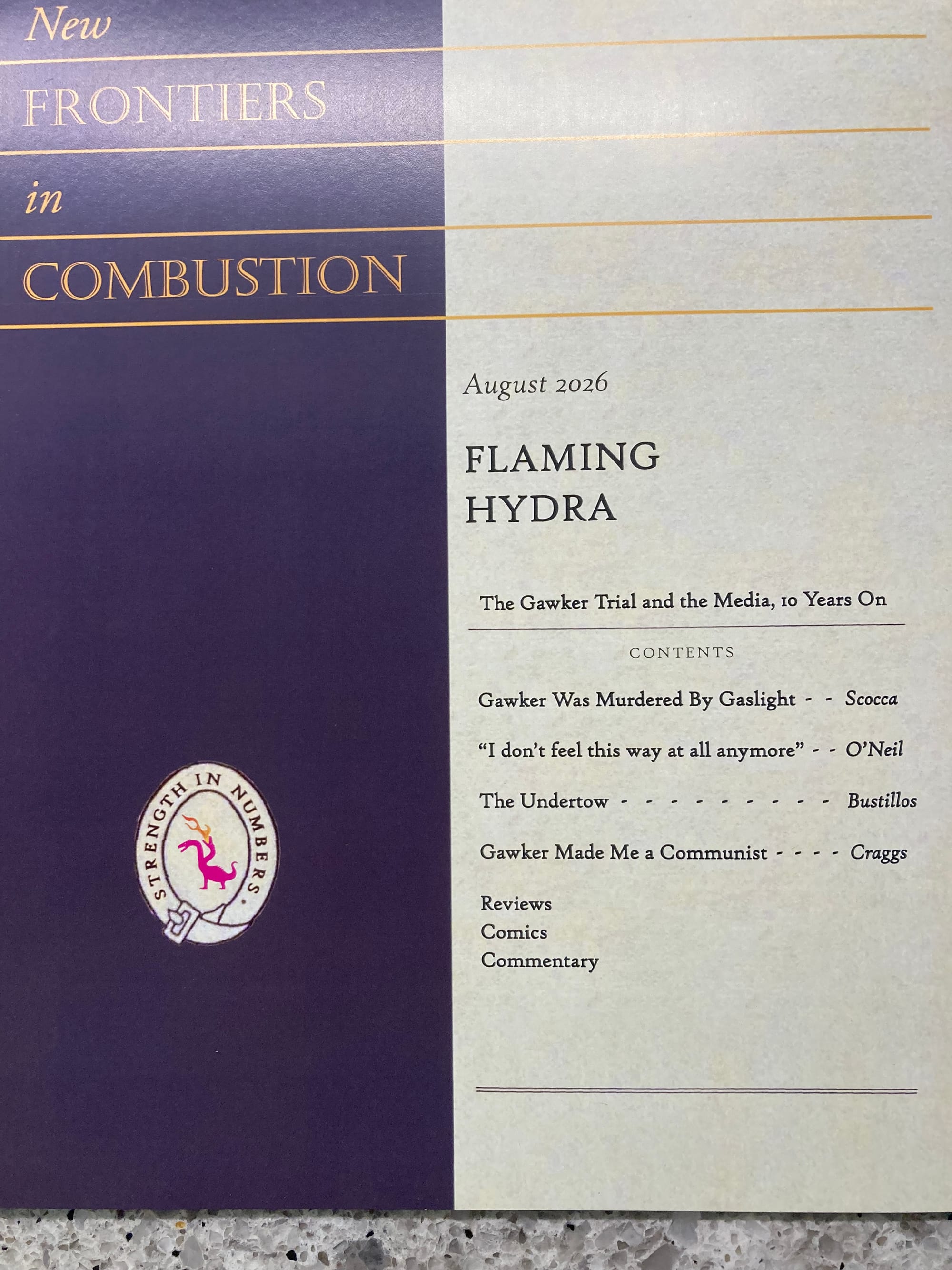
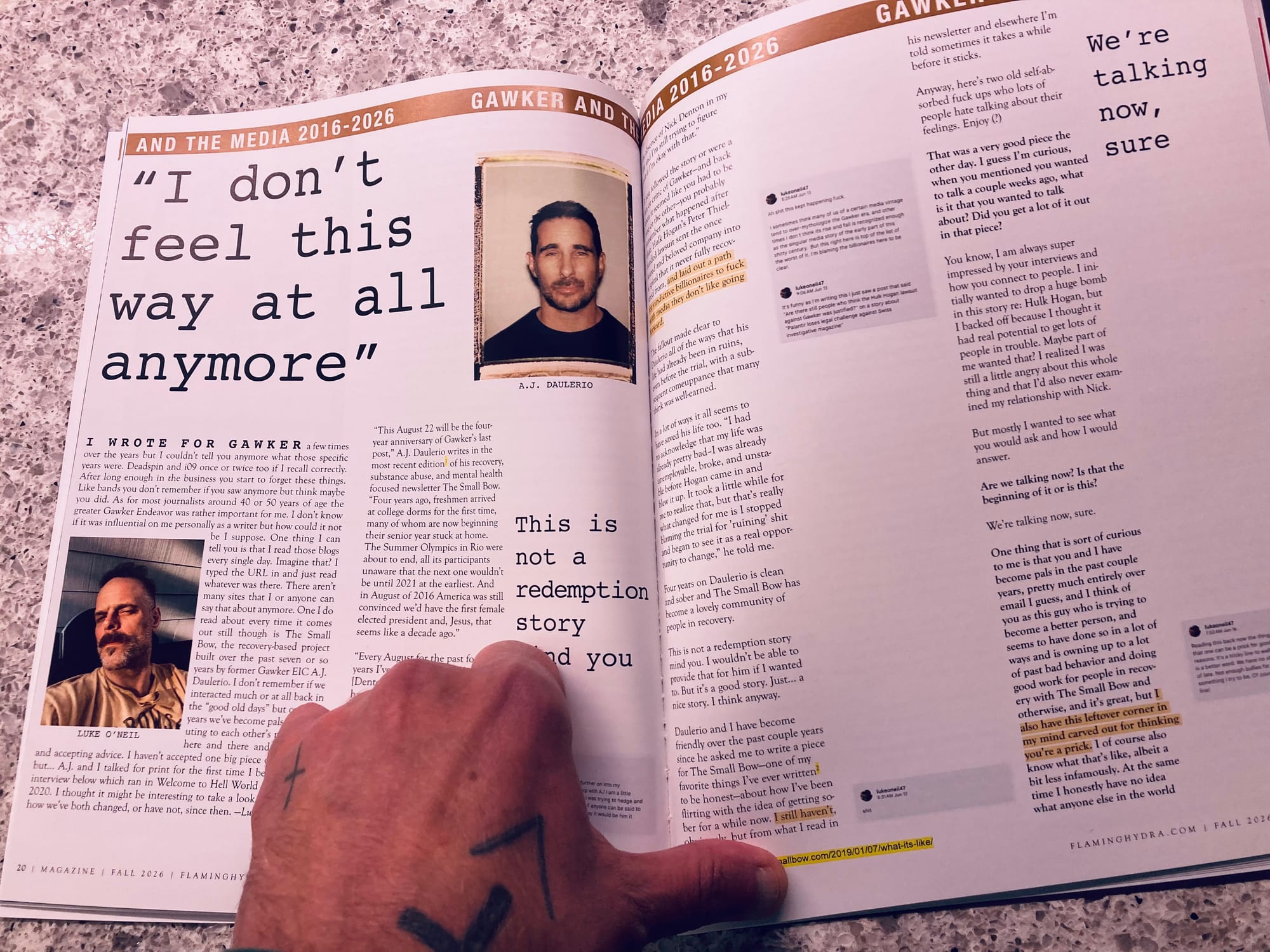
For my thing AJ Daulerio and I went back and annotated an old interview we did years ago to see if we still think the things we said at the time or whether or not our perspectives have change. I really liked how it came out. Cheers to Joe Macleod for his layout work. Get your copy here.
There is only before and after he died
Losing Kaleb
by Katharine Hudson
Grief is my mother. She bore me that night in reverse, a new person bursting from the news like Athena plucked from Zeus’s head. The gestation came later. That night the phone call so radically changed me that I could not help becoming a different person. There is only before Kaleb died and after.
He was a Bakersfield native and damn proud of it. He couldn’t stand Redding, where his family moved before he started high school. He was a writer. He was immensely talented and not recognized nearly enough for it during his lifetime. Born in 1988, he was the oldest of four. All boys. The baby came when he was seventeen, and Kaleb doted on him so much that strangers assumed he was a teen dad.
Kaleb loved Mark Twain and Charles Portis, X and Billy Joe Shaver, David Letterman and Norm Macdonald, Harry Dean Stanton and David Lynch. Kaleb loved me. And I love him still.
I thought suddenly losing Townes, my orange tabby, to a swift and aggressive cancer in April 2025 would be the worst thing to happen to me in a long time. The universe is cruel like that.
Kaleb died suddenly of dilated cardiomyopathy. The seizure disorder he developed after being prescribed bupropion had been killing him slowly, as each tonic-clonic seizure drowned his heart little by little. He was on anti-seizure medication and had an MRI scheduled. We had no idea how seriously they were harming him. He had at least three the day he died.
The shock of the news was a birth and also a baptism. The physical prickling in every cell of my body made me feel like I had been dropped into the ocean. A fever roiled throughout me, moving from my head down through my legs and back up again. The physical sensations came fast, and my brain took longer to catch up.
We know now that for years pop culture has misunderstood the five stages of grief. I’ve seen dozens of Instagram graphics showing dotted lines wandering between the stages and looping back around in confusing paths, to show that grief isn’t linear like these stages imply. This correction is still not accurate. The five stages aren’t for those who have lost someone. They are the stages experienced by a person being told they’re dying. But haven’t we, the bereaved, died with them?
The next morning I laid in his unmade bed hugging his pillow. I handed his Bible to his mother and she and her husband took me home with them. They wouldn’t let me see him. It wasn’t a cruel refusal, it was a kindness. My mother agreed with them, telling me she doesn’t want me to see him like that, the way she saw her dad after he died. I listened. I both regret it and don’t.
His ashes, a small portion of them, are on my shelf. The rest are with his parents. The big urn we will bury in a plot next to his grandparents, and a small one each for me, and his mom and dad, Bill and Debbi. Each urn sits on its own altar, full of pictures and knick-knacks. I have a small Elvis-branded pocketknife from his grandfather and a John Prine bandana he treasured. I’ve added a crucifix and a brass sacred heart to my arrangement. Kaleb didn’t like Catholicism, but he understands why I need them there.
No one ever asks how grief feels. They either know, think they know, or desperately do not want to know. I’m going to tell you what it feels like.
My grief is a birth and a baptism but it is also a mountain. I struggle with explaining it in plain language. I can’t get across how deep and wide and consuming it is without these metaphors. Kaleb said to me, “I love you so much I don’t have the words for it.” Imagine that! A writer of generational talent, a wordsmith, a real live authentic storyteller, struggling to put it into words. I love him so much and I hurt so much that I don’t have the words either.
When I was born, ripped out of my old reality and slammed into my new life, I balanced on a peak as sharp and narrow as a sword. I can’t throw myself off. That’s not an option, if only because he would be furious. “You IDIOT. What did you do? You know you can’t commit suicide! That’s a SIN. A really big SIN. Don’t you know that?” he’d say.
There are no trails. I must pick my way down blind. Each step is a guess. I desperately want to hear his voice, to receive a sign, to know I’m going the right way.
There is no one here with me. I can talk to people on radios. They keep asking what I need. I don’t know? They keep telling me that they’ll check in. The radio has been silent for months. It feels hard to breathe. My tears sting my eyes and my keening scares the birds.
It feels like throwing yourself off is a really good option. No, it’s not. It’s not an option. I’ve paid too much money for a good psychiatrist, several anti-depressants, Transcranial Magnetic Stimulation, individual therapy, a grief support group, and an Intensive Outpatient Program of group therapy, for it to be an option.
I can see some other people on other peaks, on their own grief mountains. I watch them through binoculars and wave. Everyone else is down in the valley. They think we’re all supposed to get back to them, to rejoin society and act like we didn’t just go through all of that. Instead I make camp in Gethsemane. My agony is between me and God and we rehash it every night.
The curriculum in my grief support group is emphatic: anger is normal and allowed. Especially anger at God. Job is peerless. The rest of us mortals, we all feel the anger, the unfairness, the jealousy. We question what we did to deserve this, knowing our person certainly didn’t. I’m jealous of people who “only” lost a sibling or a parent, a nasty, unkind thought. The tears are romantic; the anger is ugly and shameful. But it is there, and normal, and even encouraged a little bit. Feeling angry feels a lot better than feeling sad, if I’m honest.
Grief feels freezing cold but also as if you do not want to make a fire. It feels like being burned and parched yet unable to drink from the stream. It feels so lonely. It is the worst anguish you can imagine. And that’s the problem, you can’t imagine. Until you suffer a tremendous loss, you cannot imagine. (As soon as I realized, I felt so guilty for all the poor support I had once offered to friends and family in the past, not having a clue.)
It feels like Magical Thinking. Joan Didion’s experience seems common. Maybe if I perform the rituals enough times, he will come back. Maybe I can invent time travel, or shift to a parallel universe.
It feels like bottomless dark sorrow and raging anger and complete numbness all at once. It literally, physically, hurts.
My company told me to return after a week, even when I said I didn’t know when I could come back. I thought it would be healthy to have something to occupy my mind. Turns out I can’t force something else in to displace the grief. I know some people can, even in early grief.
Not me. I had to go on leave and go to full-time group therapy. The care team wrote “crying spells” at the top of my intake paperwork.
Kaleb was a devout Christian, and we often discussed how we would overcome our difference in faith. I told him I was open to attending church with him. We prefer the same style of liturgy, and there’s no chance he’d end up a member a conservative megachurch. On occasion he would go to Sunday services at new churches with his retired neighbor, and after I’d ask how big the screens were or if there was a smoke machine, and we’d die laughing. He would always note if there were donuts.
I was agnostic, accidentally raised that way. After his death I felt an urgent need to understand his faith. I thought I would have had decades with him to ask at my leisure. So I started reading, learning, and praying to understand. While in my intensive group therapy program, I started attending the grief support program hosted at my nearby parish, and began to spend a lot of time in prayer.
One of my uncles, the only open atheist in the family, described belief to me like a switch. You either believed or you didn’t. I simply never had. In my grief, I started poking at the switch while praying the rosary. After a few months, it became clear my previous comprehension was infinitesimally too small. One night in December last year, the understanding came suddenly to me. I saw how subatomic substances in the universe that we don’t understand or even know about wove together in radiant light. Samsara is an equation and the dance our atoms make expressing it.
Biblical scholar Pete Enns had this to say about the Book of Lamentations:
“[Lamentations] reminds us that sorrow, confusion, protest, and even anger have a place within the life of faith. The question is not whether we will suffer. The question is whether we will have the language to bring that suffering before God when it comes.” My suffering arrived, so I needed to go to God with it.
I’m making a conscious choice to believe and participate. I guess it makes a lot more sense to stop believing in any kind of higher power after a tragedy. At least, I don’t think it’s common to come to it. But I come to Our Lady of Sorrows like a little child, needing a new and invisible substance to form my life around. It will fall apart otherwise.
I’ve chosen to join my mom’s family and complete my sacraments in the Catholic Church. I’ll be baptised in this other way and consecrated at Easter Vigil, but I’m already born again. My mom, even though she didn’t take me to church as a child, is happy. That’s why Kaleb understands; I can never agree with him on Calvinism, and this is my family’s culture.
I worry my friends will think I’m abandoning my leftist principles, abandoning them. I promise I’m not. I worry they will think I’m changing and becoming a different person, then remember that I am a different person.
People pray I will come down from my mountain. They don’t pray the way he prayed for me. I’ll never hear him say, “God guard ye and protect ye,” as I drift off to sleep ever again. I don’t want to come down; I want to stay up here veiled in the clouds. If I stay up here, maybe I can keep him close.
Katharine Hudson lives in Texas with her cats. To read Kaleb Horton’s writing visit kalebchorton.com
His car is still sitting there
An ICE kidnapping in Austin
by Joel Pinckney
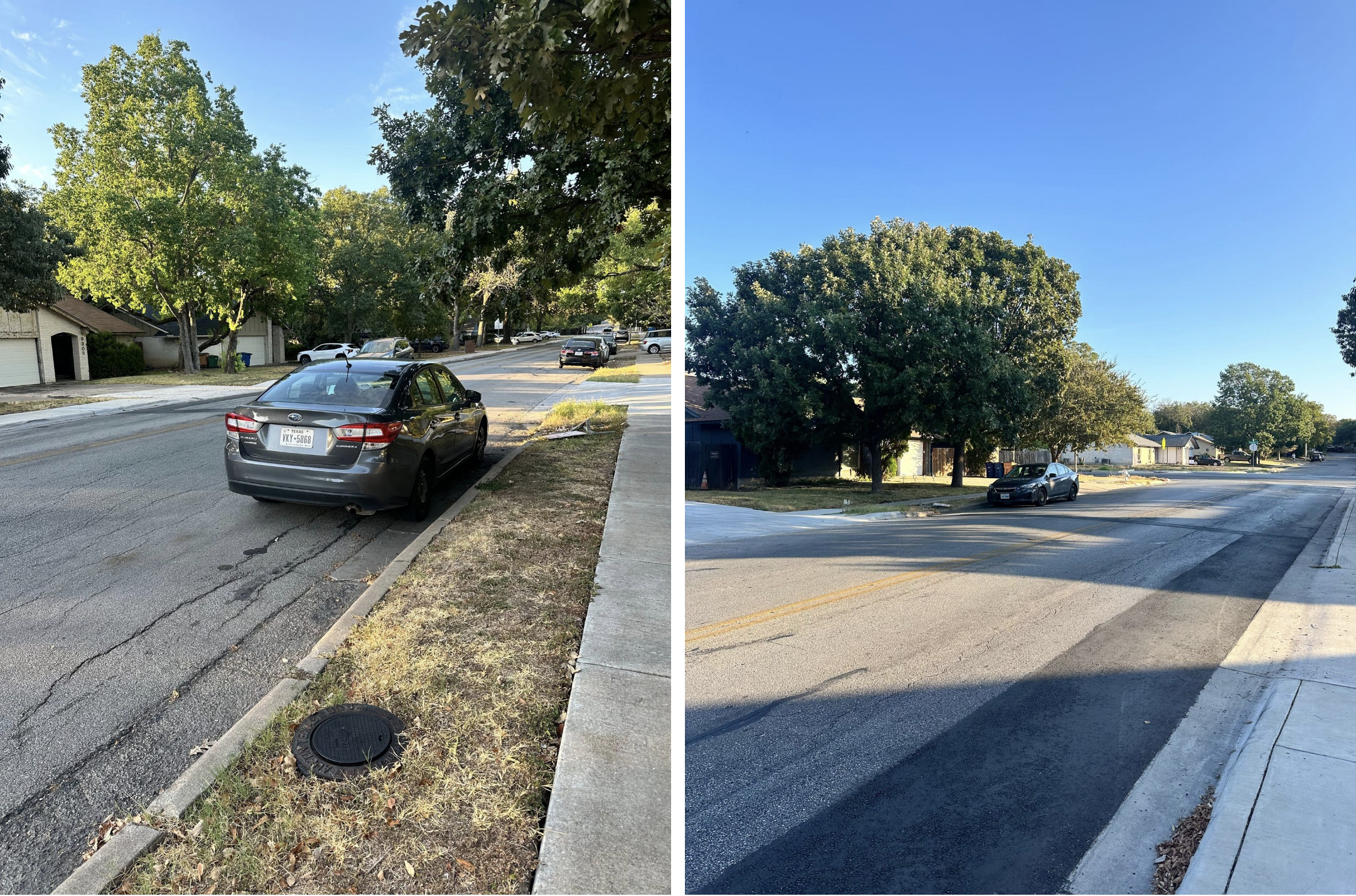
There’s a gray Subaru Impreza parked on Hunters Trace in Austin. It has sat there, unmoved, since 8am last Saturday. You can see it just where you turn right onto the street from Rundberg. I walk this way almost every morning with my kid.
On Saturday we went a different route, looping around a few other streets before approaching Hunters Trace from the other direction. It was a beautiful, quiet morning; we had the streets almost entirely to ourselves. Earlier in the walk, we had stopped for a while to watch a couple of squirrels chase each other up and down a tree; my three-year-old was delighted when one of them paused, looked at us, and flicked their tail, as if acknowledging our presence. As if seeing us there meant something to them.
Not long after I saw an unmarked black car quickly flash blue lights and swerve in front of a small hatchback. Behind, another unmarked car turned on its lights. The driver of the hatchback was boxed in; he had no way out, no choice but to stop. He was alone in his car, alone on the streets—there were no other cars going in either direction. I watched as masked ICE agents exited the two cars, removed the driver from the hatchback, and put him in handcuffs, depositing him in the vehicle in front. He didn’t resist, so far as I could tell.
I know nothing about this man, except where he was at 8am on Saturday; except that I was the last person to catch a glimpse of him before he officially entered the hell and terror of ICE detention. I can imagine he knew this day might come; I can imagine people he loved had disappeared without explanation, and yet with but one explanation; I can imagine people who loved him spent much of Saturday trying to reach him, looking for him at his usual places, before reaching the horrible, desolate, unavoidable conclusion that so many here and across the country have had no choice but to reach in recent months.
This man was taken amidst what has been referred to as a shadow surge: ICE arrests are way up across the country, and ICE’s tactics, often thanks to the willing collaboration of state and local police, are much more subtle than they were even just a few months ago. Texas leads the country in ICE arrests, as a September 22 piece in the Austin American Statesman pointed out, “with more than 1 in 5 U.S. arrests this year occurring in the state.” The Statesman piece also noted that ICE arrests in Austin tripled this summer. The surge here has been particularly concentrated in the Rundberg/North Lamar area of North Austin, as highlighted recently in the Austin Chronicle, an area of town with a particularly large immigrant presence. The majority of these arrests are happening in the shadows, during quiet hours, when almost no one is looking.
After putting him into their vehicle, one of the ICE agents got in the driver’s seat of the hatchback, turned it onto Hunters Trace, and parked it where it still, today, sits. I’d seen one other woman walking on the other side of the street; she quickly walked away when it became clear what was happening. A moving van had turned on to Rundberg from Hunters Trace just as the ICE agents were removing him from his vehicle, and kept going past us in the opposite direction. To my knowledge, no one else witnessed what happened. On the video I took, after ICE drives off, I hear birds singing; I hear my three-year-old asking why.
Within three minutes, the quiet of the morning, interrupted for just a few brief moments, had returned. To anyone walking by at 8:05, the car parked there would have meant nothing; it would have been as if nothing happened. It feels like a tear in the fabric of the universe, that anyone seeing that car would have had no way of knowing what its presence represented; that it was the only visual acknowledgment that ICE had taken someone there just a few minutes prior, beginning what may have been the worst day of his life—perhaps excluding the days that have followed it. Shouldn’t the car be able to share the story that it holds? Isn’t it bursting with meaning? I can’t help but think of the biblical passage in Luke, where Jesus says that “the very stones would cry out” if his disciples were silent, such is the force of what they have to say.
After the ICE agents left with the driver, I walked up to the car to see if I could learn anything of use. In the well of the passenger seat sat a white Styrofoam cooler; an Uber Eats cooler bag was folded up on the seat. I imagine, perhaps, that the driver had just begun his day delivering food; maybe he was headed to his first pickup, or maybe the Styrofoam cooler held his first delivery. There it all sits, still, in the Subaru Impreza, parked on the corner of Rundberg and Hunters Trace.
A little more than 24 hours later, Wilber Rafael Garces Perez was shot by ICE agents at Research Boulevard and Anderson Square, just over a mile away from where the hatchback sits. According to reports, Garces Perez was shot while delivering for DoorDash. We later learned that he was released by the hospital back into ICE’s custody after a mere four hours there, without pain medication, the bullet still lodged in his back. He was taken to Pearsall Detention Center, nearly three hours away from Austin, where he lost feeling on the left side of his body. According to his attorney, he now sits in an isolation cell, given only ibuprofen and Tylenol to deal with the pain of the barely-treated gunshot wound, retaliated against for speaking to the press.
I’ve thought about these two men almost constantly over the last few days: about the precarity of the labor they were doing; about the vulnerable, lonely position they were in when ICE tracked them down; about the cars they left behind. I was told that Garces Perez’ car, riddled with bullet holes, was towed away in the hours after he was shot and taken by ICE. Not so the car of the man I saw taken. I suppose even ICE knows that the ghosts some vehicles hold are too much to bear, that they too transparently tell a story, too obviously indict; others can blend in, the meaning they hold indiscernible to all who encounter them. One day, the city will come and tow them away.
Nothing has been reported about the man I saw taken. I know nothing about him, except that his life was precious; except that he deserved love and safety, care and kindness. I walk past his car every morning. A few times a day, I drive down Rundberg and glance up Hunters Trace. Every time I see his car, I try to hold some kind of quiet vigil. If you find yourself nearby, I hope you’ll do the same. Drive by and hold him in your mind; say a prayer for the man who’s name we’ll almost certainly never know, whose world changed forever in the quiet of a Saturday morning, taken by masked agents of the state who only wished him harm.
Joel Pinckney is a writer and book worker living in Austin, Texas.
A related poem of mine.
Who will clean any of this up?
At a church service in Chicago they had set up cardboard cutouts in the pews to represent the worshippers who would have attended mass if not for fear of being disappeared. Not far away I saw a laborer’s lunch had been left uneaten and spilled over onto the sidewalk outside of a home he must have just been working on. Laboring on. There’s a dumpster out front and a red white and blue flag themed porta-potty from a company called Patriot Portables. Three ladders still leaning up against the building.
It looks like it would have been a pretty tasty lunch. Even tossed aside like that and wasted now. A smear of orange hot sauce on the cracked styrofoam container. Not yet taken away by the wind. Such a beautiful seeming neighborhood too. I imagine it’s a very nice place to live. They say that Chicago is still surprisingly affordable.
It shows me home listings when I scroll now because I clicked on one or two at some point and so the computer believes that this is an integral datapoint that explains who I am. I just saw one hanging ten off a bluff that has been pummeled by eons of waves and so will not exist for much longer. Neither house nor bluff. Overlooking the water on Cape Cod. You could squeeze a couple of good years out of it still I thought. Until one awful night. I can’t afford it even now despite the implication but it’s a nice little nightmare to have.
I thought of a friend who was recently diagnosed with a terrible albeit not yet terminal disease but maybe that’s a bad analogy. A beach house is worth so much more than a person.
I don’t know how much longer it will sit there. Either the house or the guy’s lunch. Maybe everyone passing by assumes another worker is going to arrive soon to take care of it but it could be he’s already been disappeared himself.
Some further reading on ICE kidnapping and violence in Hell World.
 Luke O’Neil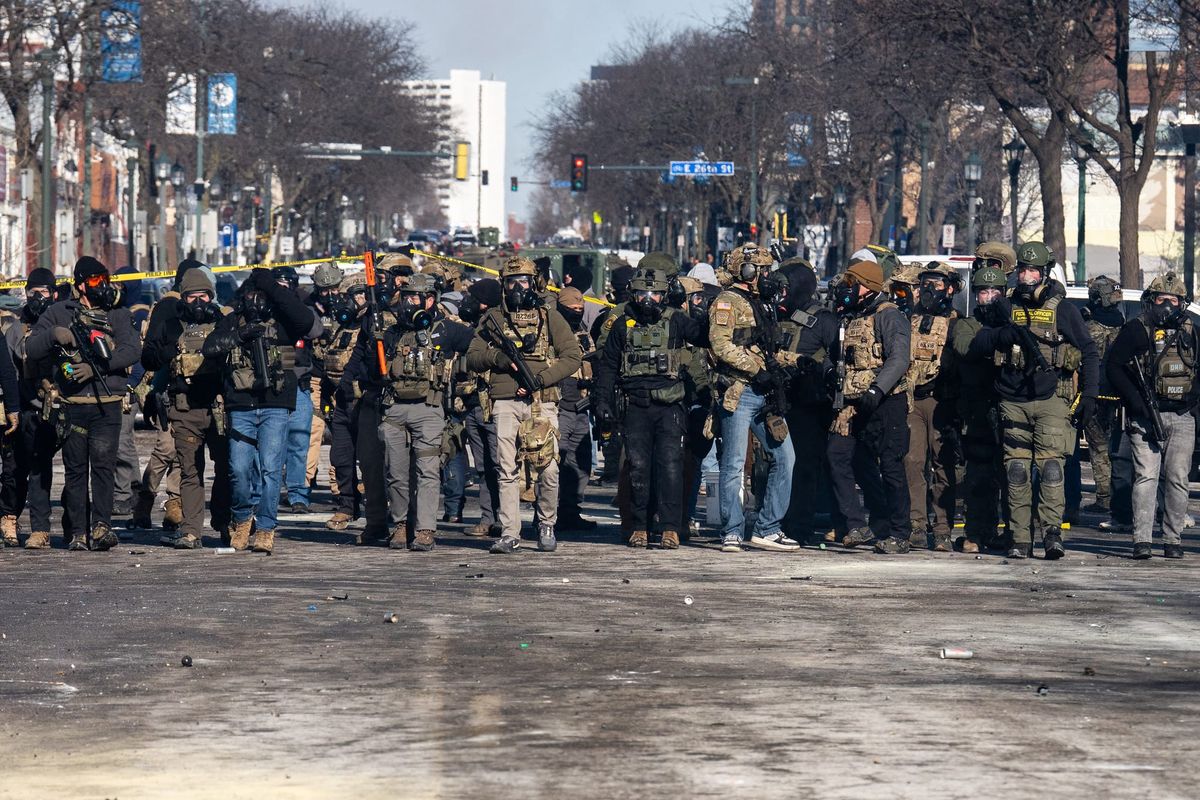
 Luke O’Neil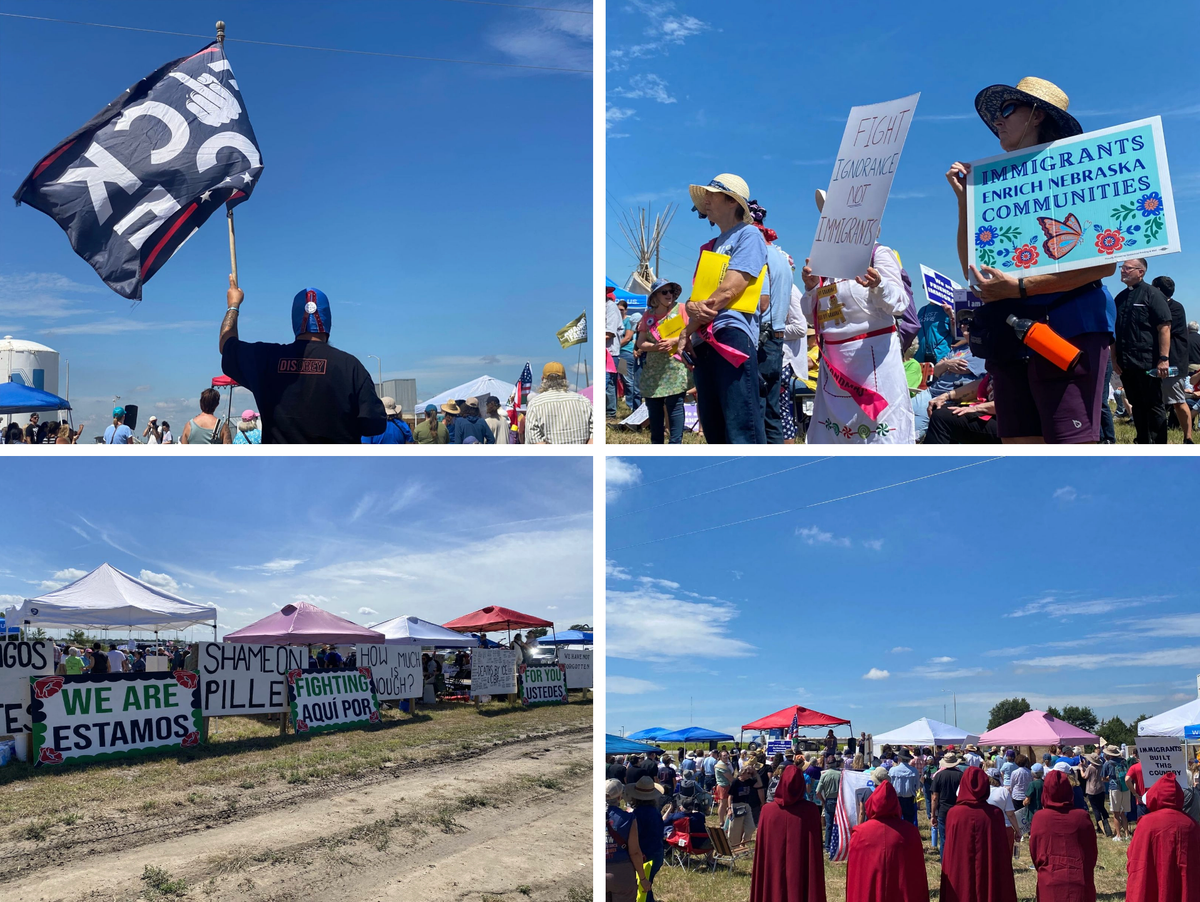
 Luke O’Neil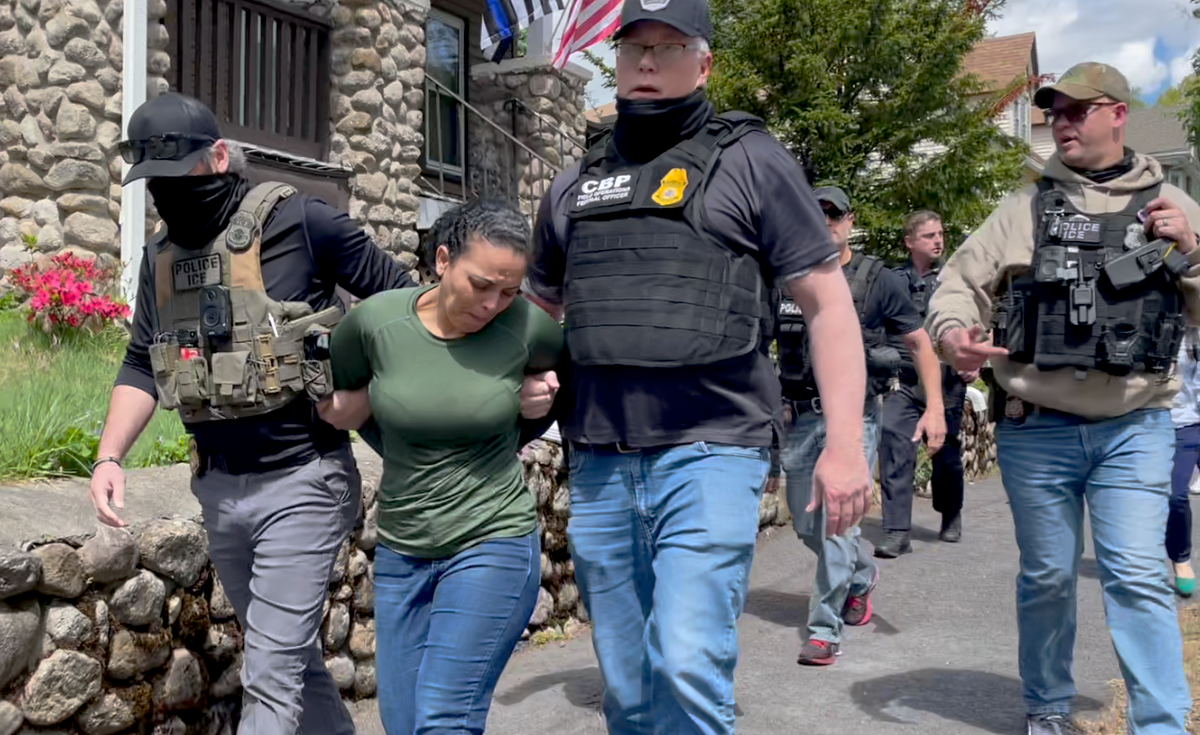
 Luke O’Neil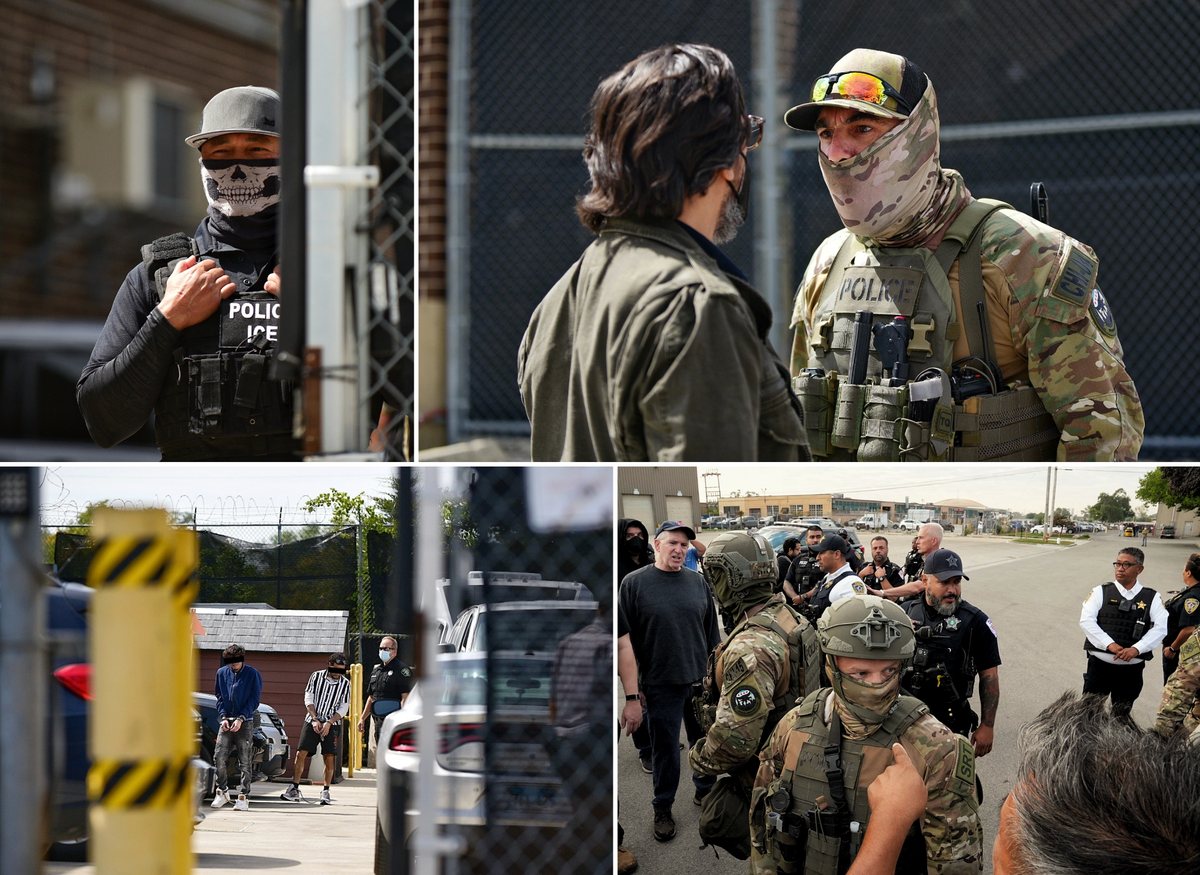
 Luke O’Neil
 Luke O’Neil
 Luke O’Neil
 Luke O’Neil
 Luke O’Neil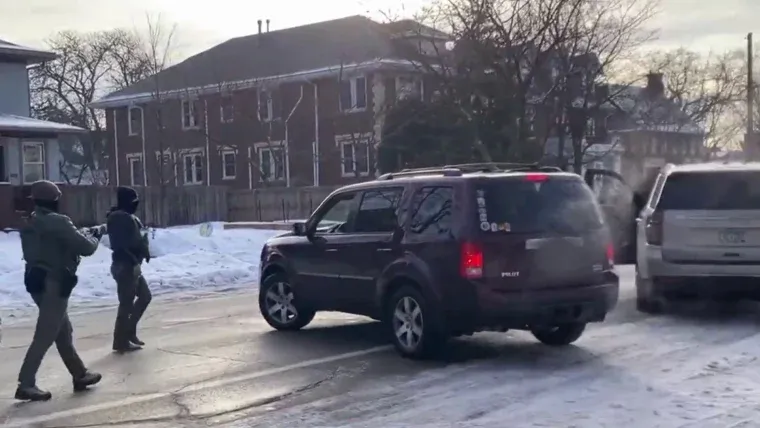
New War on Drugs!!
Rest in peace to Chad Glibert of New Found Glory and Shai Hulud.