The little actions of little men

Rax King on reading They Thought They Were Free in the age of ICE

The little actions of little men

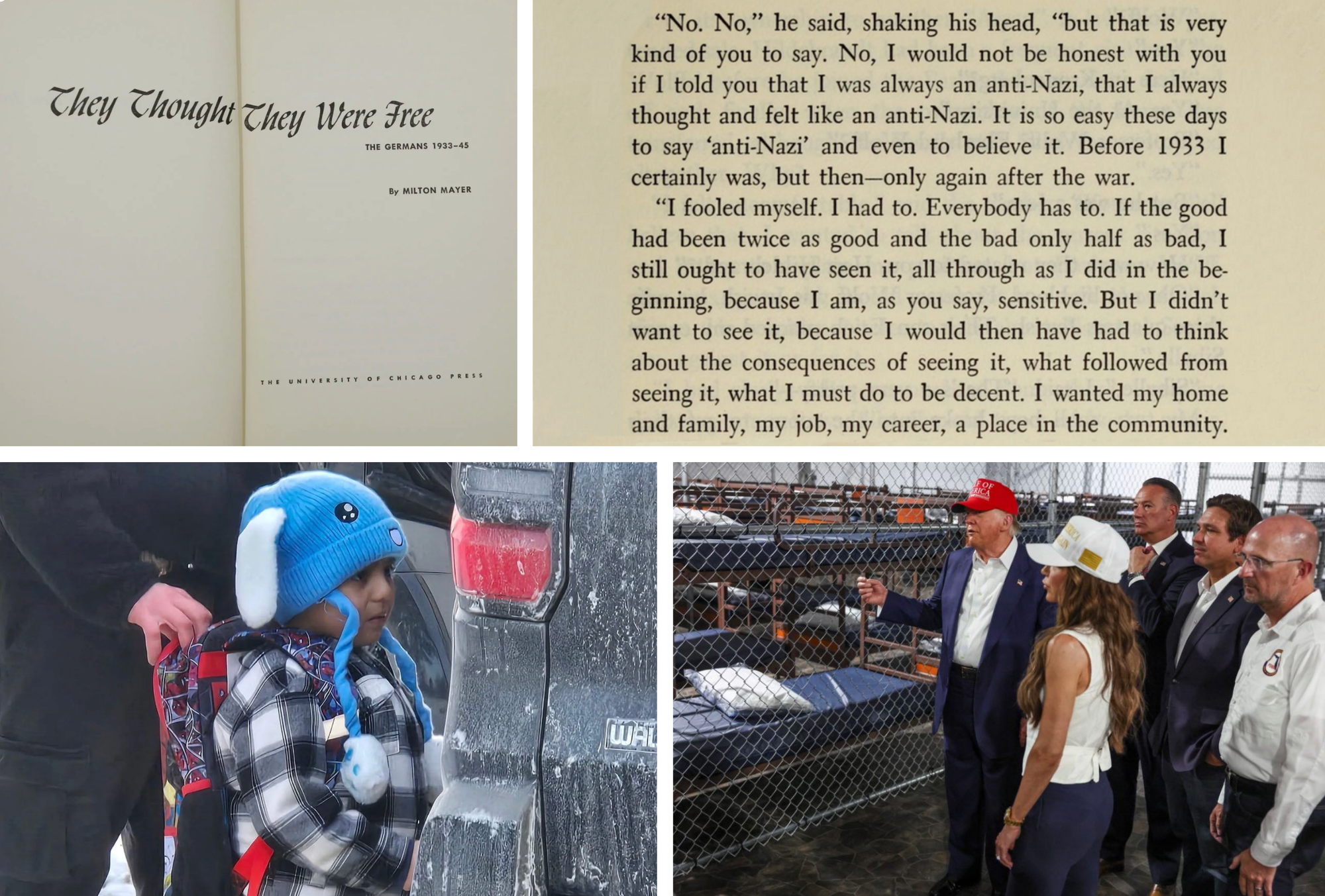
A real powerful one today from Rax King on reading Milton Mayer’s 1955 book They Thought They Were Free: The Germans 1933-1945 in the age of ICE.

"Still, one glaring similarity offers itself up readily: ICE, like Hitler’s brownshirts, are not presently undertaking a campaign of extermination. The current project is separation," she writes.

"Incompetence might be the simplest explanation for their splashiest kidnappings, like that of five-year-old Liam Conejo Ramos — allowing that sweet little boy to be photographed in his bunny hat on his way into a police vehicle was a tactical catastrophe that they’ve since tried, with mixed success, to avoid. For every Ramos whose kidnapping goes viral, who knows how many people are being snatched up much more quietly? As of February 7, there were 68,289 people in ICE detention, and I’m ashamed to say I can name maybe five of them. Moreover, ICE is notorious for shipping detainees all over the country and outside of it, making it exceedingly difficult for even their lawyers and loved ones to find them, much less the public. The American press must be grudgingly credited with advertising a few of the horrors, some of the time. The most significant difference between us and the Germans in 1938, it seems to me, is that we have access to a little more information than they had."

Rax most recently wrote for Hell World about Emerald Fennell's “Wuthering Heights."

The love we all deserve
Rax King on the carnage, sensuality, and longing of Frankenstein

Please be sure to also check out her recent thorough eviscerating of an "A.I." user in her advice column.

God, where to begin. Here, I suppose: if this letter is an example of your Claude-less writing, you're bad at it. That sentence was gentler when I first drafted it, but why should I stir any of my good cheddar into your grits? You're clearly not worried about offending me. So I'll tell you very bluntly that you need to worry about style and usage before you think about getting your memoir published. Your copy is dirtier than this simile is folksy, boy. You've outsourced clarity to AI, retaining for yourself the coveted role of "ideas man," but look at how you struggle when parted from your precious fucking Claude for a five-paragraph email! Plenty of great writers draft messy and revise clean, but your lazy repetitions of words and obviously hurried sentences suggest the more fundamental problem that you think language is beneath you. But there, you don't traffic in anything so pedestrian as diction or syntax, do you, my little kapellmeister? You stand at the head of the room and conduct a symphony of ideas."

Please consider paying for this newsletter so I can give that money to writers. A simple arrangement!
The little actions of little men

by Rax King

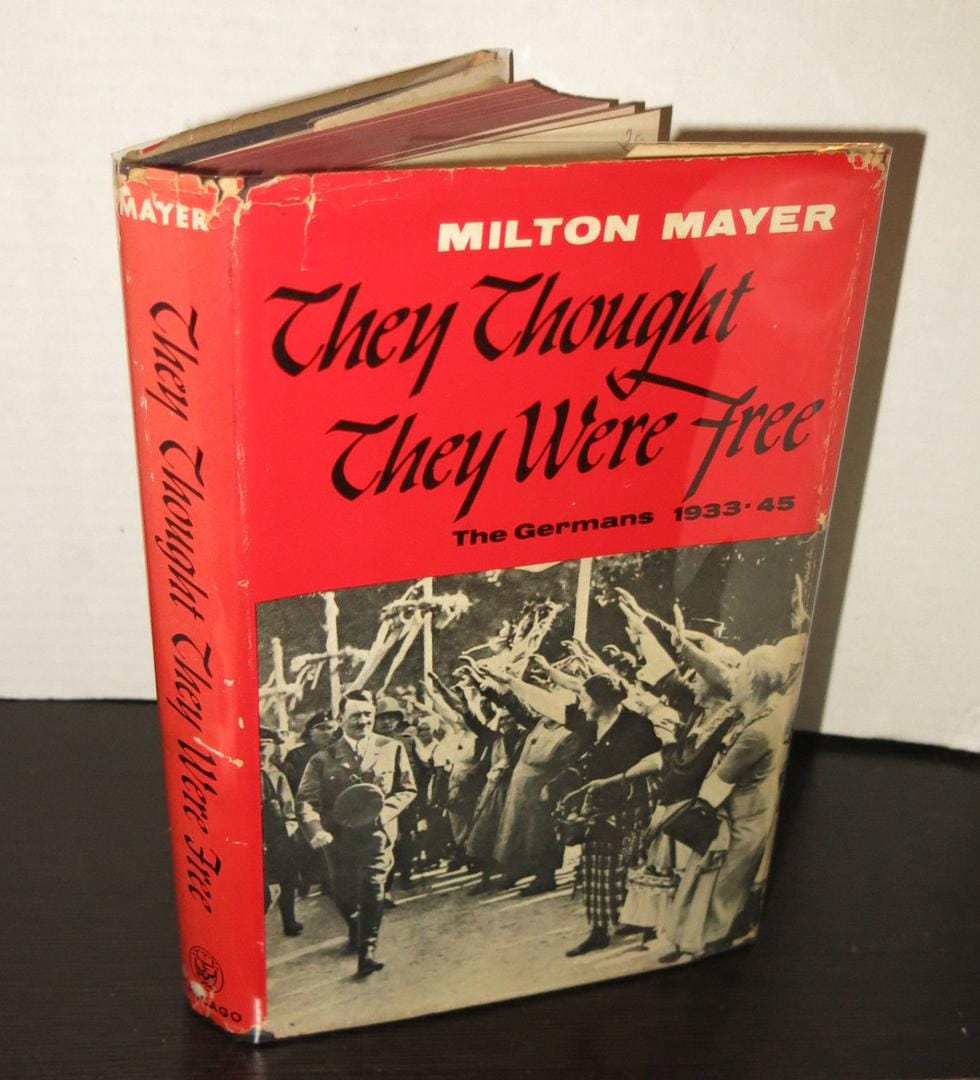
Milton Mayer’s 1955 book They Thought They Were Free: The Germans 1933-1945 is a profile of ten ordinary German men which was originally conceived as a profile of Adolf Hitler. The author spent a month 1935 failing to get Hitler, who was presumably a little busy that year, to sit for an interview in Berlin. When that project fizzled, the author (who was Jewish, and it matters) stayed in Germany for a time anyway. He was surprised to discover that the Germans he met seemed pretty upbeat for a people supposedly being crushed under the heel of a mad dictator. Nazism wasn’t one man’s insanity imposed on millions, he realized — it was a mass movement. “I wondered if Adolf Hitler was, after all, the Nazi I wanted to see,” he writes in the foreword. “By the time the war was over I had identified my man: the average German.”

The book that follows is an eerie profile not of one hateful lunatic but of ten “little men.” That’s no insult but rather the men’s own term, deployed repeatedly to distinguish their class position from that of the wealthy and the highly educated. All ten lived in the university town of Marburg, pseudonymized as “Kronenberg,” in the conservative (even “backward”) state of Hesse. All were members of the Nazi Party — functionaries and brownshirts only, no blackshirts among them. A couple had turned anti-Nazi by the time they sat for their interviews with Mayer, but most still saw their time in the Party as an unusually happy and fruitful period in their lives, and always for the same reason. These ten men were not, prior to their time in the Party, accustomed to being taken seriously. And they seemed to agree that they’d never be taken seriously again. 

“I liked them,” Mayer admits in the foreword. “I was overcome by the same sensation that had got in the way of my newspaper reporting in Chicago years before: I liked Al Capone. I liked the way he treated his mother. He treated her better than I treated mine.” 

His conversations with his little men were warm and cordial, to the point that he describes them most frequently as his friends. He initially struggled to establish relationships with all ten, winning them over by means of his ineptitude with the German language — postwar, they were all wary of spending time with an American professor until they realized they had something to teach him. They enjoyed making a show of their pedagogical patience with him, the sort of show which was rarely theirs to make. In a moment that’s chilling specifically because I don’t think it was intended to be chilling, Mayer admits he never told his little men he was a Jew, “on the advice of [his] German colleagues and friends.” The war was over, but for his cohort of warm and friendly antisemites (and, to be fair, for veterans of all wars everywhere), it sort of wasn’t. They Thought They Were Free has been criticized for only interviewing ten men in one country town and presenting those findings as representative of Germany more broadly. But for purposes of comparison to the present-day U.S., which is forced by the electoral college to give a huge amount of weight to a “median voter” who always seems to be a small-minded country bigot, that controversy might also be a strength.

The book’s organizing event is the burning of the Marburg synagogue on November 9 1938. Only the Torah scroll was salvaged; the town’s Jews were made responsible for the costs of demolishing the husk that remained of the building. All ten of Mayer’s little men shared their memories of the night. The local Sturmführer received the order to burn the building, while the baker abstained from visiting the scene, having just gotten in trouble for looting a Jewish cobbler’s shoe store after it was vandalized. The town policeman was tasked with taking the Jews into “protective custody” after the arson. A teacher at the classical high school silently worried about what the fire would bring. Only he (the least “little” of the men according to German class conventions of the time, due to his education and status) took a frank view of the event as a hate crime. The others seem to have been pleased, as they were so often pleased in their Party days, to have something important to do. To be taken seriously.

It’s an attitude that feels drearily familiar in a moment when kidnapping and torturing immigrants comes with a $50,000 signing bonus. On the FAQ page of ICE’s website, prospective applicants aren’t told they need to hate migrants (or, realistically, any darker-than-white person who might be a migrant). They aren’t promised the opportunity to commit blasphemies on a government salary. The listed benefits are the usual ones: paid sick leave, health insurance. Asked what qualities applicants should have, America’s secret police force requests officers with “integrity and courage.” With “professionalism and leadership.” With “strong critical thinking skills.” They’re the same qualities demanded by every employer in every Indeed ad. Nowhere is it mentioned that this job entails the high level persecution of migrant communities. Maybe applicants can be trusted to take that part as a given.

Early in the book, Mayer outlines some of the reasons his little men still cherish their time in the Nazi Party, and not one of them cites the carte blanche he had in those years to torment the Jews. Indeed, his friends sheepishly attest that, prior to the official expulsion of the Jews from their town, they’d all had relations with their Jewish neighbors ranging from the cordial to the intimate. The unpleasant task of mistreating them was just the cost of, to name a few perks, stable government jobs where before there had been only the university; free summer camps and activities for the kids; and deeply discounted trips abroad for provincial people who had never been outside Hesse, much less Germany. In Marburg, the ten little men all vigorously attested, “nobody” went hungry or cold or uncared for the whole time the Nazis were in power. (“Nobody they knew,” Mayer is quick to point out.) In their telling, even in the repentant schoolteacher’s telling, the Party was more civil-social organization than genocidal force — the Lions Club for antisemites. 

Even the most stubbornly loyal of his subjects admitted that the horrors happened, but it’s not like they were advertised. Two days after the burning of the Marburg synagogue, the local newspaper ran a story about it — at the bottom of page 4. “In the interest of their own security, a number of male Jews were taken into custody yesterday. This morning they were sent away from the city,” the story reads. It mentions the inciting event precisely zero times, and in any event none of Mayer’s friends could remember ever having seen that story or any others like it. (Or so they said. Mayer isn’t a credulous interviewer, and he reliably pushes back on his subjects’ frequent assertions that they never saw or said or did anything untoward, but if he included an “or so they said” disclaimer every time it was relevant the book would have been twice as long.)

There are, of course, considerable differences between Germany in 1938 and America today. German industry was on the rise in those days, while American industry is less on the decline than gasping its last. The Nazis had an ostentatiously public split from the German church, while the Republicans are heavily influenced by (and populated with) American Evangelicals. And then there’s the simple geopolitical fact that Germany is vastly more vulnerable to invasion than the U.S. will ever be. The fears Hitler exploited as an invader in his own right were somewhat justifiable even if his cunning plan to take the Jews and other marginalized peoples for his scapegoat was not. 

Still, one glaring similarity offers itself up readily: ICE, like Hitler’s brownshirts, are not presently undertaking a campaign of extermination. The current project is separation. Incompetence might be the simplest explanation for their splashiest kidnappings, like that of five-year-old Liam Conejo Ramos — allowing that sweet little boy to be photographed in his bunny hat on his way into a police vehicle was a tactical catastrophe that they’ve since tried, with mixed success, to avoid. For every Ramos whose kidnapping goes viral, who knows how many people are being snatched up much more quietly? As of February 7, there were 68,289 people in ICE detention, and I’m ashamed to say I can name maybe five of them. Moreover, ICE is notorious for shipping detainees all over the country and outside of it, making it exceedingly difficult for even their lawyers and loved ones to find them, much less the public. The American press must be grudgingly credited with advertising a few of the horrors, some of the time. The most significant difference between us and the Germans in 1938, it seems to me, is that we have access to a little more information than they had.

I haven’t spoken to any ICE functionaries for this essay, giving them the opportunity to describe their experience of the agency in their own words the way Mayer might have. I don’t have his sympathetic gifts or his poker face; I don’t care how America’s secret police force treats its mother. I’ve heard the arguments that immigrants are jumping the line, landing jobs in kitchens and orchards and daycare centers that rightly belong to the American-born. I’ve heard those arguments about the Jews, too — how it’s reasonable to hate them for cultural habits like lending money at interest and ambulance-chasing and so on. Of course, the Jews were originally confined to moneylending and the “free professions” like law because they were exiled from more respectable trades. Similarly, the jobs populated most heavily by immigrants aren’t exactly fending off American-born applicants, who have much more recourse to protest the exploitative conditions in those jobs than undocumented migrants do. 

And in both cases, importantly, the argument is moot. It’s sophistry to imply, and Americans are fools to believe, that building a life in the country where all the money is constitutes a violent invasion. There are very few things a person can do that would justify the fundamental inhumanity of stealing them from their family and shipping them to a faraway detention center. The only reason for such a shanda is to hide the person from the public eye, the better to rape, starve, and ultimately kill them. Every other basis we’ve heard for such an act is noise. It’s a campaign of separation, not extermination, but if we take lessons from Mayer’s little men we should assume that separation is merely the first step.

It may be an early step, but that means it’s all the more important to oppose it loudly and in every way available to us, even when doing so feels as pointless as it tends to feel. These small interventions and protests are, after all, so small, and even the good outcomes they achieve feel minimal and unstable. One judge may make an impressive scene about the unconstitutionality of dragging an asylum seeker to a detention center, but most do not. The public outcry may have helped get Liam Conejo Ramos released to his parents’ custody again, but now it’s likely that a judge will once again order him and his family deported to Ecuador. Even demonstrations comprising thousands of people struggle to get press coverage. It’s easy to feel that, because the point is not immediately visible, there is none.

On that issue, I’ll defer to a friend of Mayer’s whose interview appears in the book more or less uninterrupted — a chemical engineer, not one of his “little men.” He took the oath of fidelity to the Nazi Party in 1935 only because it had become mandatory. Refusing to do so would have cost him his job. To justify doing something he found personally reprehensible, he made the same internal arguments anybody might make. Losing his job for such a loaded reason would have made it impossible to get another, and surely he could only help people (as he intended to do secretly) as a seemingly respectable member of Nazi society, helping to take it down from within. So he took the oath, and proceeded to turn his apartment into a hideout for fugitives until he was arrested in 1943. His internal justifications even came true, at least to the extent that they could have. He did remain a respectable member of Nazi society, and it did give him the ability to save some lives.

But he denies in his interview that this was the right call. His very respectability as a man of status and learning, he argued, positioned him well to decline the oath; if he had been the first in his circle to refuse it, others would have surely followed. Everybody was waiting for the first person to refuse, and if they’d managed it, who knows what their collective show of principles could have prevented? What seems to haunt him most is that he originally did decline the oath, and only took it when a Party official urged him to take a day to think it over. “The day I said ‘No,’ I had faith,” he said. “In the process of ‘thinking it over,’ in the next twenty-four hours, my faith failed me. So, in the next ten years, I was able to remove only anthills, not mountains.”

I, too, feel like I’m waiting for the first person to do…something. I don’t even know what. Not refusal, in this case, because it’s not presently mandatory to declare one’s support of Trump and ICE, and so the cost of refusal is low. I attend demonstrations, I call senators, I do things that will have to remain mysterious here because I wouldn’t necessarily like to have them read back to me in a cross-examination. But I still carry a burdensome sense of awaiting marching orders, as if some messianic figure exists who can tell me how to prevent my government from enacting further atrocities. History is not a profile of Hitler. It’s a compendium of the little actions of little men, stacked on top of each other. Our duty is to ensure, as best we can, that our own little actions are righteous ones. If Mayer’s book tells us anything, it’s that the little actions add up.

Rax King is the James Beard award-nominated author of the essay collections Sloppy Or: Doing It All Wrong, and Tacky: Love Letters to the Worst Culture We Have to Offer.

She has written for Hell World about Emerald Fennell's “Wuthering Heights”, Guillermo del Toro's Frankenstein, Garth Hudson of The Bandher favorite Lana Del Rey songsthe film Anorawanting and sobrietyexpensive wedding traditionsthe film Priscilla, another Lana one about Born to Diethe band Creed, and her favorite Weezer songs.