Too long and still not enough
Jeb Lund on Alex Gibney's documentary 'Musk'

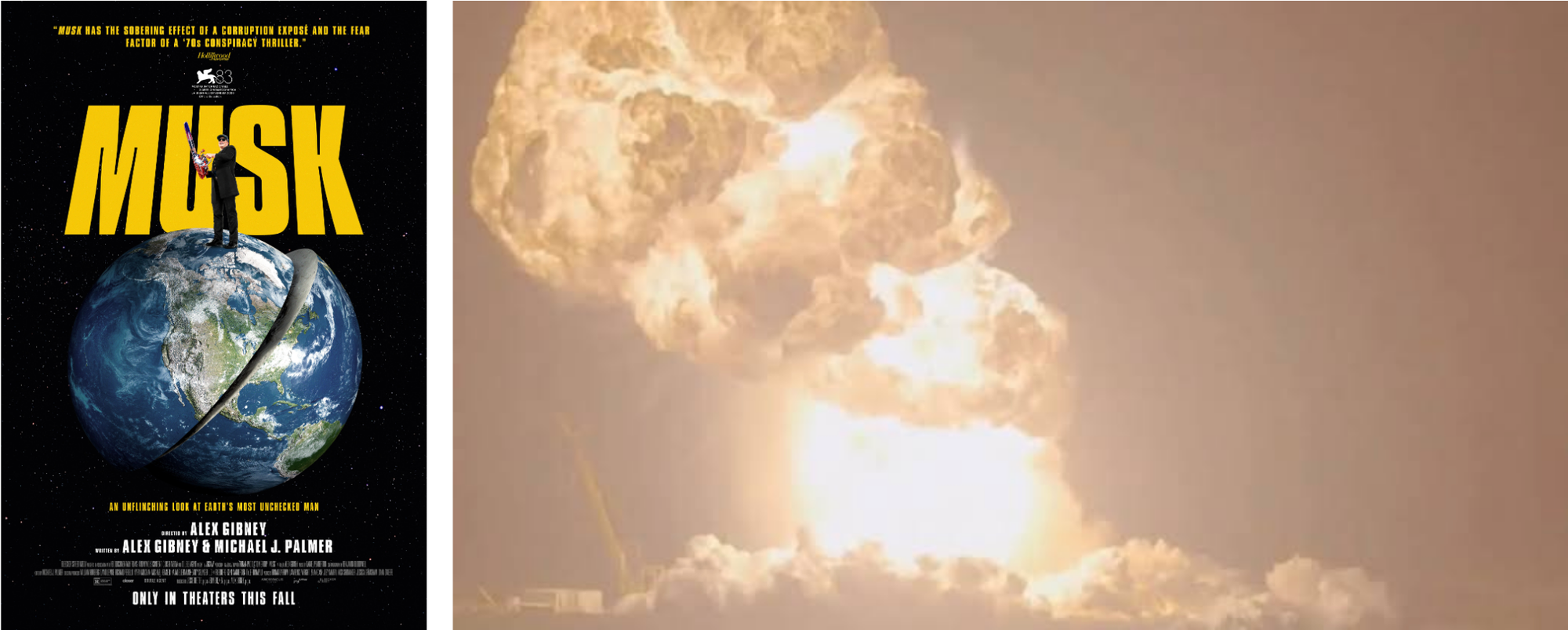
It's always a treat to have Jeb Lund write for Hell World and today's piece – on Alex Gibney's Musk documentary – is predictably scathing and brilliant.
He writes in part:
Interviewing Kara Swisher on the subject of the human, social and capital cancer that is Elon Musk is not interviewing Ernst Röhm about what made Hitler such a great door-to-door campaigner, but it's also not not that. In case Elon is reading, let me translate that into Baby: As a journalist, I know the most devastating interviews I can get for a profile of Jabba the Hutt will involve freeing multiple people from Carbonite. But if I want a real honest grounding about the day to day, I know that I am absolutely not starting with the hooting space lizard that lives on his stomach.
Be sure not to miss his most recent essay for us here.
 Luke O'Neil

It's a striking and elegiac and wending piece about memory and education and mothers and war and Florida and California and the warring parts of both states and this entire warmongering country of ours.
Also new this week is Josh Caress on the brief window of hope we are living through after the midterm elections, The Red Sox and the Cubs, Tolkien, and a dream of a better world. Both pieces will go out in the next newsletter likely tomorrow.
 Luke O'Neil

But we need to remember what it’s about, what we’re fighting for, and what we’re fighting against. Because the politicians are going to do everything they can to make you forget how you felt on the night of November 3. They’re going to try to steal your joy and sell it back to you as something else, something “pragmatic.”
Don’t let them do this, and god forbid you help them do it to others.
You'll need to be a paid subscriber to read this piece in full. Here's 33% off.
Too long and still not enough
by Jeb Lund
Years ago, I sat alone in a two-figure Airbnb and clicked on a 90-minute YouTube video. I was ready for a Wikipedia-deep dive and endless pauses to push the runtime long enough to trip more dynamically inserted ads. The video's title, "In Search of a Flat Earth," felt perfectly bleak, like the epistemic version of loading five more rounds into the revolver before spinning the barrel and lifting.
Despite the unassuming bearing and overall air of unstinting couth to the video essayist in question, Dan Olson, I still waited for an eruption of YouTubeness that never came. I'm a lifetime mark for one-stop articles where journalists debunk a moral panic, deconstruct trendy thinkspeak and pick apart a fraud. You can imagine, then, the dawning joy that crept across my face as I watched a politely exasperated man use the multimedia toys afforded him to stomp a mudhole in flat earth theory and walk it dry. When Olson—at a Hall of Fame level of exasperation—drove to a lake twice to film proof of the earth's curvature, all to metaphorically stuff the author of a by-then years-old YouTube video into the toilet, I felt my face erupting into a giddy awe. The essay wasn't even half over, and the proof wasn't the point. Or it was, inasmuch as it presented a model of a demographic whose malicious purpose and satisfactions spring from and thrive in a realm beyond proofs. By the time it was over—tears had long since welled in my eyes and spilled over. I admired its excellence, but I especially admired that it even existed. I felt so much gratitude that it did at all.
I thought about Olson and other talented video essayists repeatedly while watching Alex Gibney's gargantuan new documentary about Elon Musk, named simply Musk. I also thought of Christopher Buckley's deservingly ruthless review of Tom Clancy's Debt of Honor: "A herniating experience. Once you put it down, you can't pick it back up again." That the most remarked-upon feature of Musk is its length isn't that surprising. A four-hour movie invites comment, even if only on total bladder capacity, and a movie's length has the virtue of being an observation one can make without observing the movie itself. But it is also, cynically, the one thing one can say with certitude that Gibney achieves. He set out to release a movie that is long, and after watching it for four hours, one can say with certainty he nailed it.
To be fair, one can also remark upon how unsurprised one is in general. The internet never fully shook off the comment-section impulse to "firsties!" and, with maturity, the urge has been displaced onto calling dibs on preexisting knowledge of general nonfiction. A tragedy that you just learned about is a shame, but a tragedy that you just learned about and mentioned in front of someone who learned about it yesterday?—that's a tragedy. As such, the other general knock on Musk devolves to something like, "But I knew that already." Which in many cases is certainly true, but the sentiment is also not much different from walking into a high school American History class and tearing the pages out while sniffing, "Read it."
General commentary on a subject about which you're an expert can feel insipid even when not misguided; unfortunately, over a decade of anxiety and despair, many Americans made themselves experts in the news and, depending on their orientation, in varying degrees of emotionally compensatory awareness of Overton Windows and manufacturing consent. This is an unnatural state to be in, for general entertainment purposes, and as such it can make some aspects of what is, in aggregate, day-to-day American operations seem fundamentally tainted with the same shabby dishonesty that's come for so much of the commons.
Between a social media platform owned by Elon Musk that force-feeds people Elon Musk content and another that flourishes in part because of tens of thousands of refugees from Elon Musk specifically, it was going to be difficult to make a documentary about the guy without seeming inessential or commonplace for a substantial portion of the sorts of people who go see documentaries. That being said, given that it took a decade of his being a noticeably and progressively more embarrassing loser online, then a self-pitying pants-pissing bigot, then underwriting the GOP in 2024, then a pair of sieg heils, then DOGE for public opinion to finally round on Elon Musk himself, it's safe to say the movie has an audience.