A better world is possible
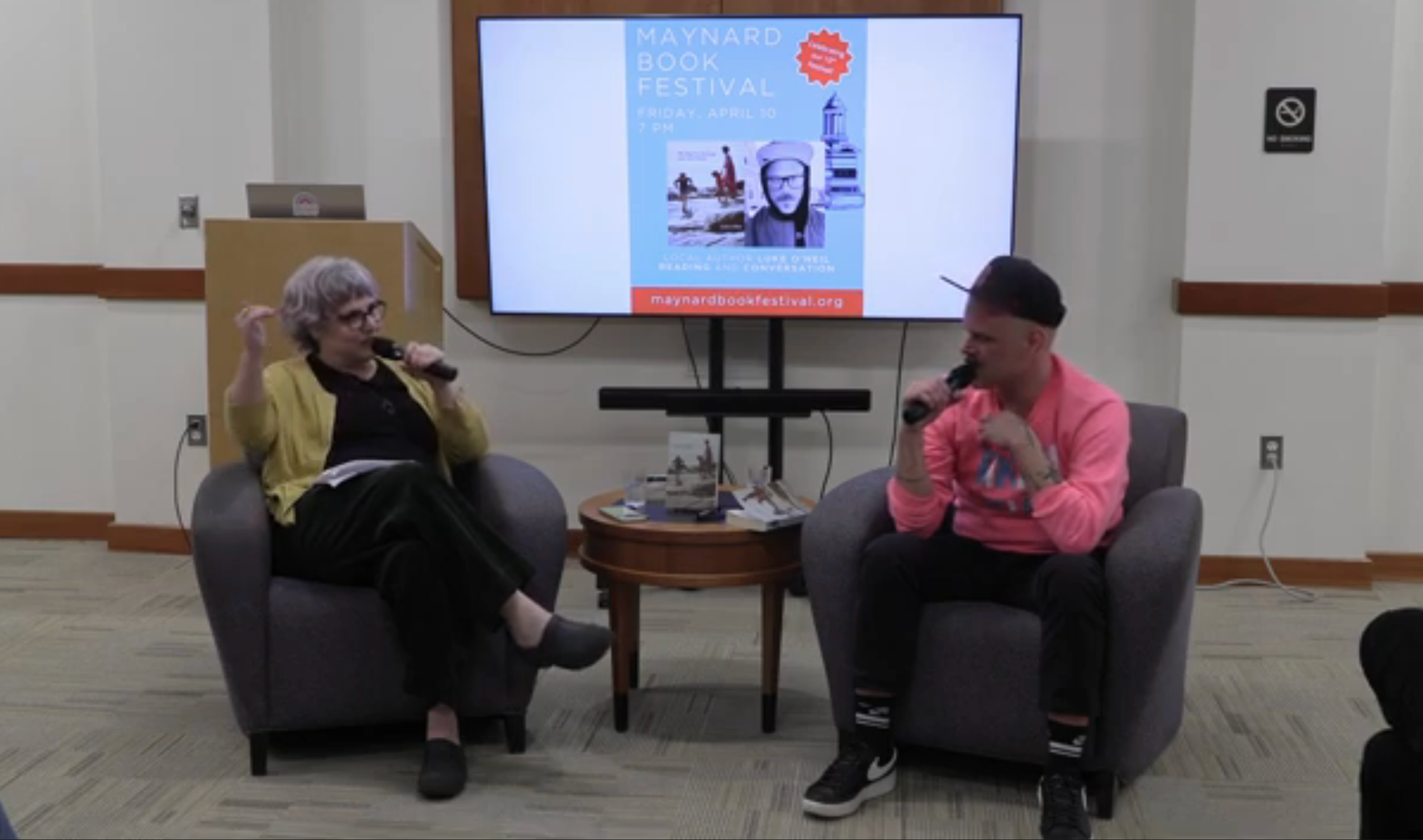
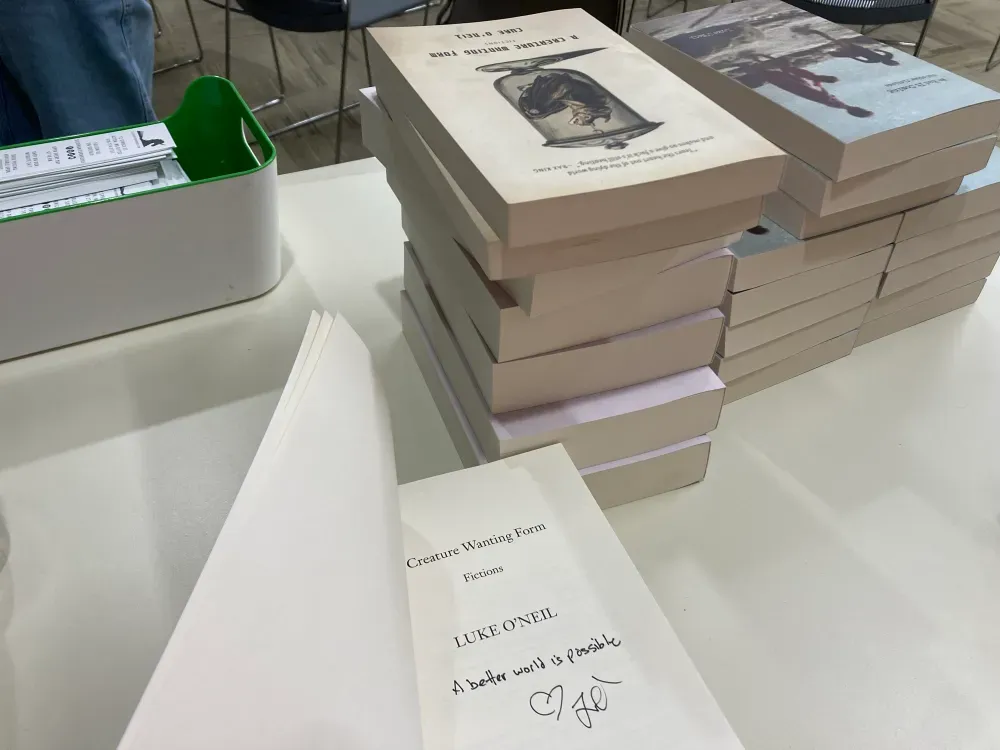
A couple of weeks ago I was happy to take part in my town's 10th yearly book festival. I gave a reading at the Maynard library where I was interviewed by Rebecca Connors – author of the lovely new collection Split Map – and got to talk to a bunch of smart readers. You can watch it here or read my hastily transcribed edit of it all below. Thank you to Stow TV for warning people about the Adult language and drug references.
Rebecca Connors: The world is kind of absurd right now. And whenever I feel like I can't believe what I'm seeing, I turn to Luke's writing because you can bet he has seen it too and has already written about it. His book, We Had It Coming, is a mix of short stories, microfictions, and poems. And it travels from early memories of family vacations, to poems jettisoned passed the moon, to the churning anxiety of being in public spaces now due to, well, everything. His work examines our current conditions in excruciating detail. Writing like this is vital because we need this documentation. We need stories that help us feel not so alone to un-gaslight us if you will. I was particularly struck by this passage in it: “The point of all this.”
This probably applies to all of you. People in possession of human souls who have at least on occasion felt the divine in a work of art. Everything I write myself and everything I love to read or listen to or watch has one bedrock component to it, which is this. Jesus Christ, I'm alive right now and you are alive right now and someday we will not be but for the duration of this we are both stupidly and beautifully alive. Please bear witness to my humanity and take some small portion of it for yourself. Return the favor to someone else later when you can.
Welcome Luke.
Luke O'Neil: My wife and I live here in Maynard, and we're very proud to be part of the community here. We moved here six years ago, and I don't know if you guys remember, but something called Covid had just started then. And we didn't get to meet any of our new neighbors for a long time, but we're glad that we eventually got a chance to. And that was all fake, too, by the way. It was a plandemic if you ask me.
I'm glad you read that one. That piece that you read from, if I could summarize it, it would be like this, and I hope you all agree with me, and sorry to the people watching at home: Fuck AI! Fuck AI! Thank you.
I don't know if you're allowed to curse at a library, but if you're not, I'm in trouble. I'm going to read a number of these. They're pretty short. The book is a mix of poetry and more traditional short stories. I'll read some of the shorter ones just so we can keep it moving. I'm going to start out with something light. This one is about being paralyzed by the sudden realization of an indifferent and uncaring God. It's called “No new word.”
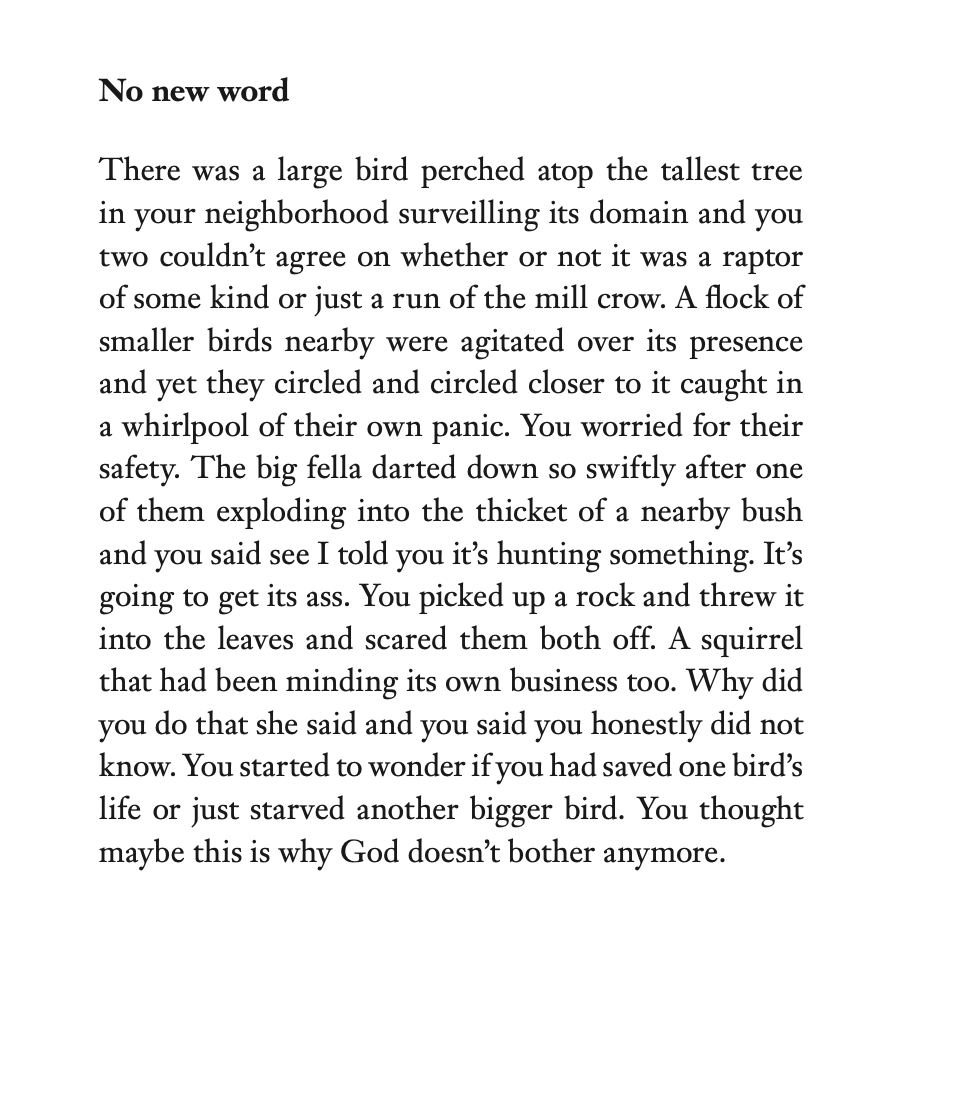
I had a chance to do a good amount of touring for this book earlier in the year and I always like to explain the influence to that one is one of my favorite poets and musicians, David Berman. On his album, before he died a few years ago, Purple Mountains, there was a song called Margaritas at the Mall, which my wife and I always sing when we go to El Hupil to have margaritas, even though it's not the mall, but you know… The line that sort of influenced this one is “How long can a world go on under such a subtle god? How long can a world go on with no new word from God?”
I'm Catholic, so that wasn't the first time that occurred to me, but I think about that one a lot.
Okay this one is sort of the thesis statement of the book. “How good we had it.”
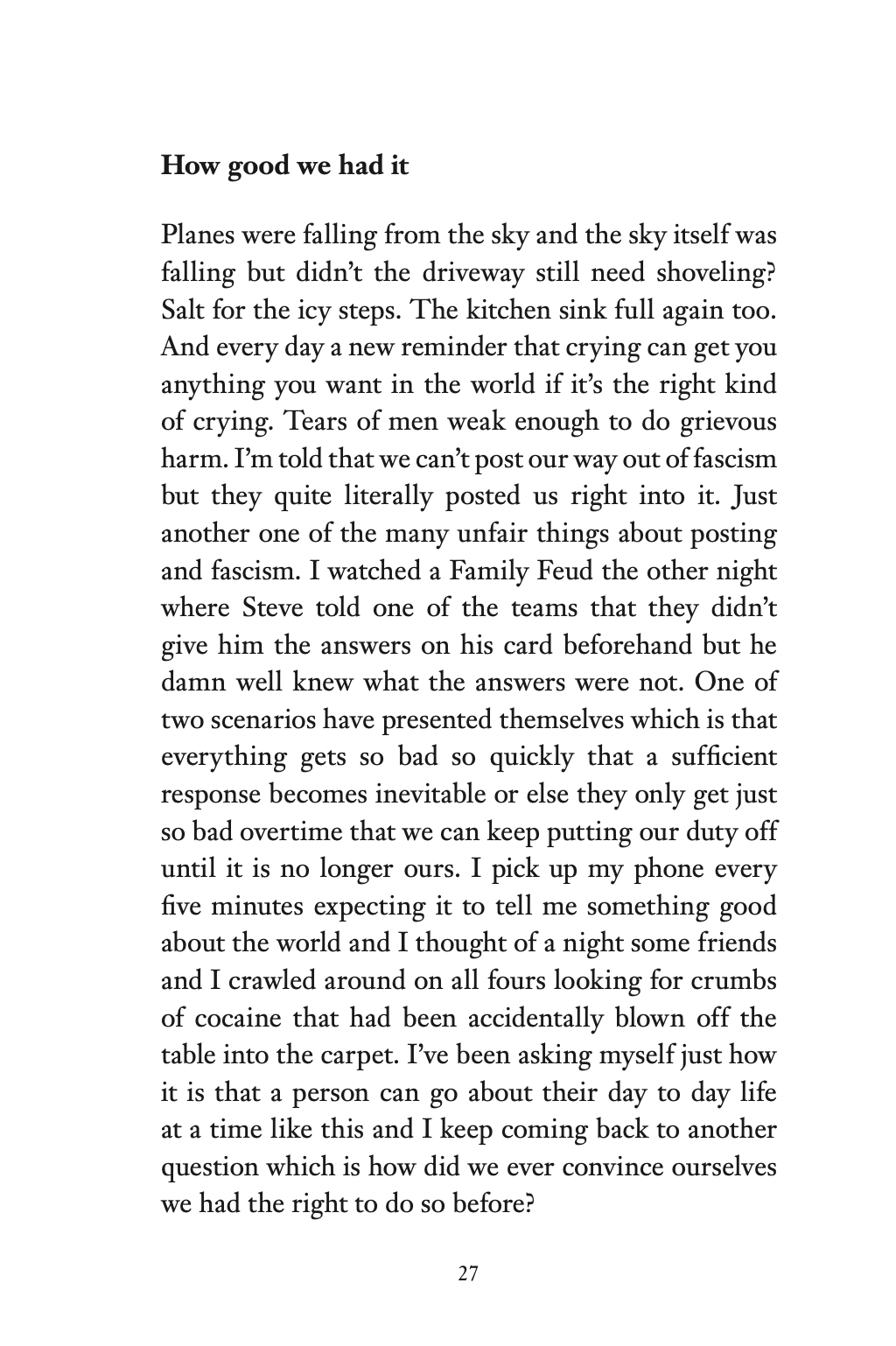
The country didn't just get bad a couple years ago.
I usually like to dedicate this one to my dear, uhh, friends, who never stop fighting for us, in the Democratic Party. This is called “The rules.”
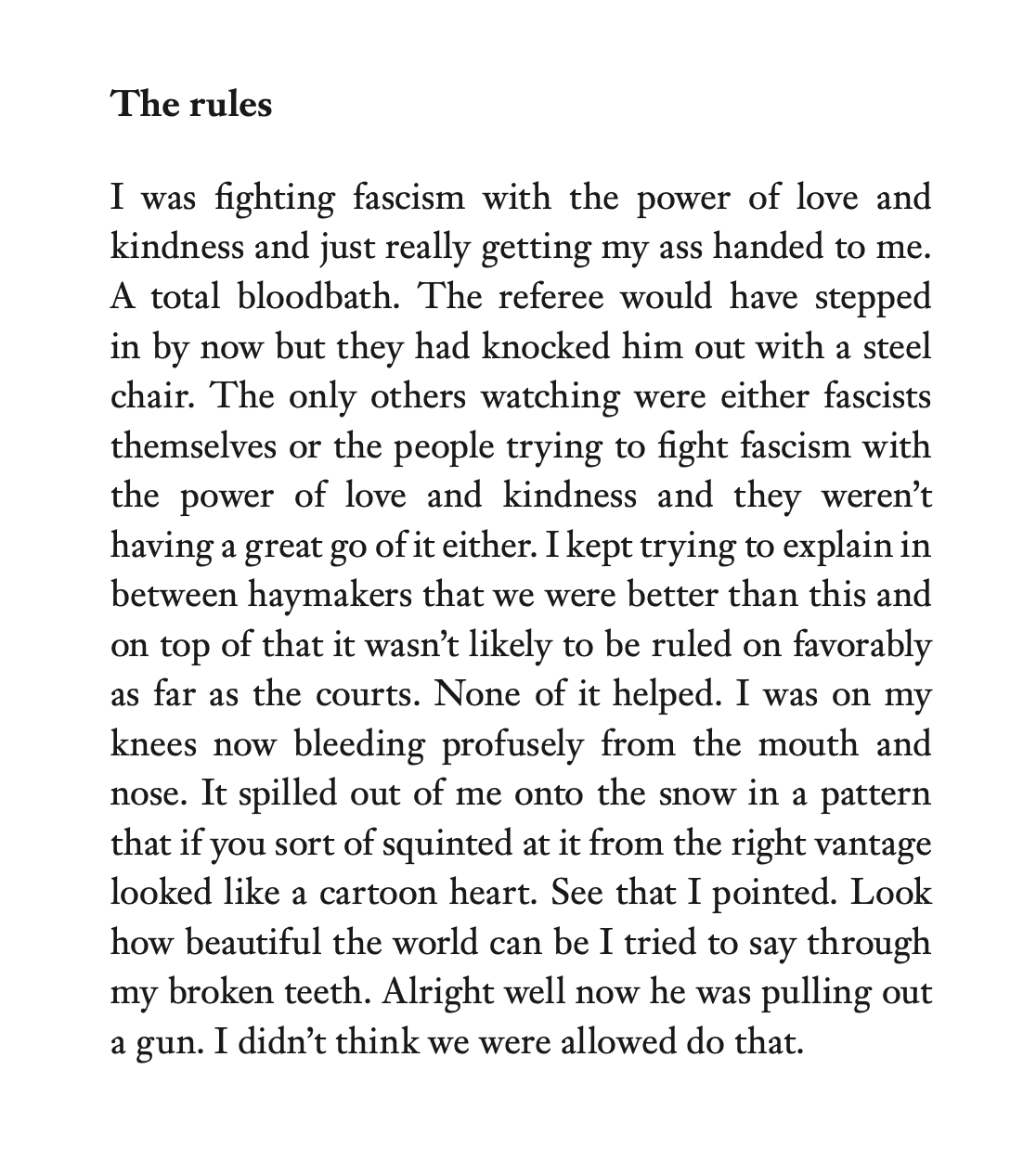
You gotta follow the rules.
This one was written about the children of Gaza, but it could be about children in Iran right now. “This is my blood.”
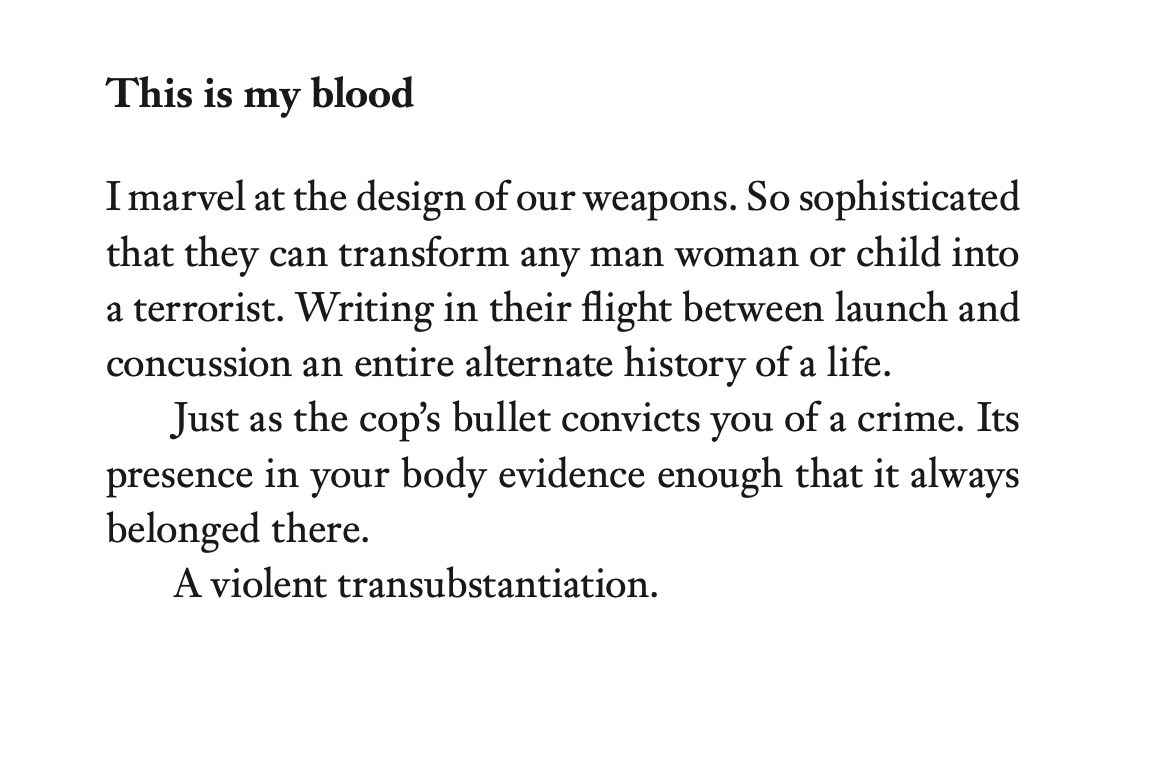
There’s a lot of Catholic damage in here. Maybe that's just me, or Massachusetts, I don't know. Let's see what else we got...
It's really nice of you all to come out here. This is a pleasure and thank you for inviting me and thank you to the library and the Maynard Bookfest and everybody. It’s really very nice to get to meet more people around here and see we have such a vibrant arts community which is one thing I really like about living here. A little far from the city for my taste though!
Sorry, I should have prepared better. Oh, I know what I'll do. I've got a couple new ones I want to try. Brand new! Okay, I have a feeling you folks might like this one. Do we want the funny one or the sad one first? Well, they're all funny and sad, yeah.
This one is called “When it Happens.” It happening… you know what I'm talking about, right? We all know we want It to happen.
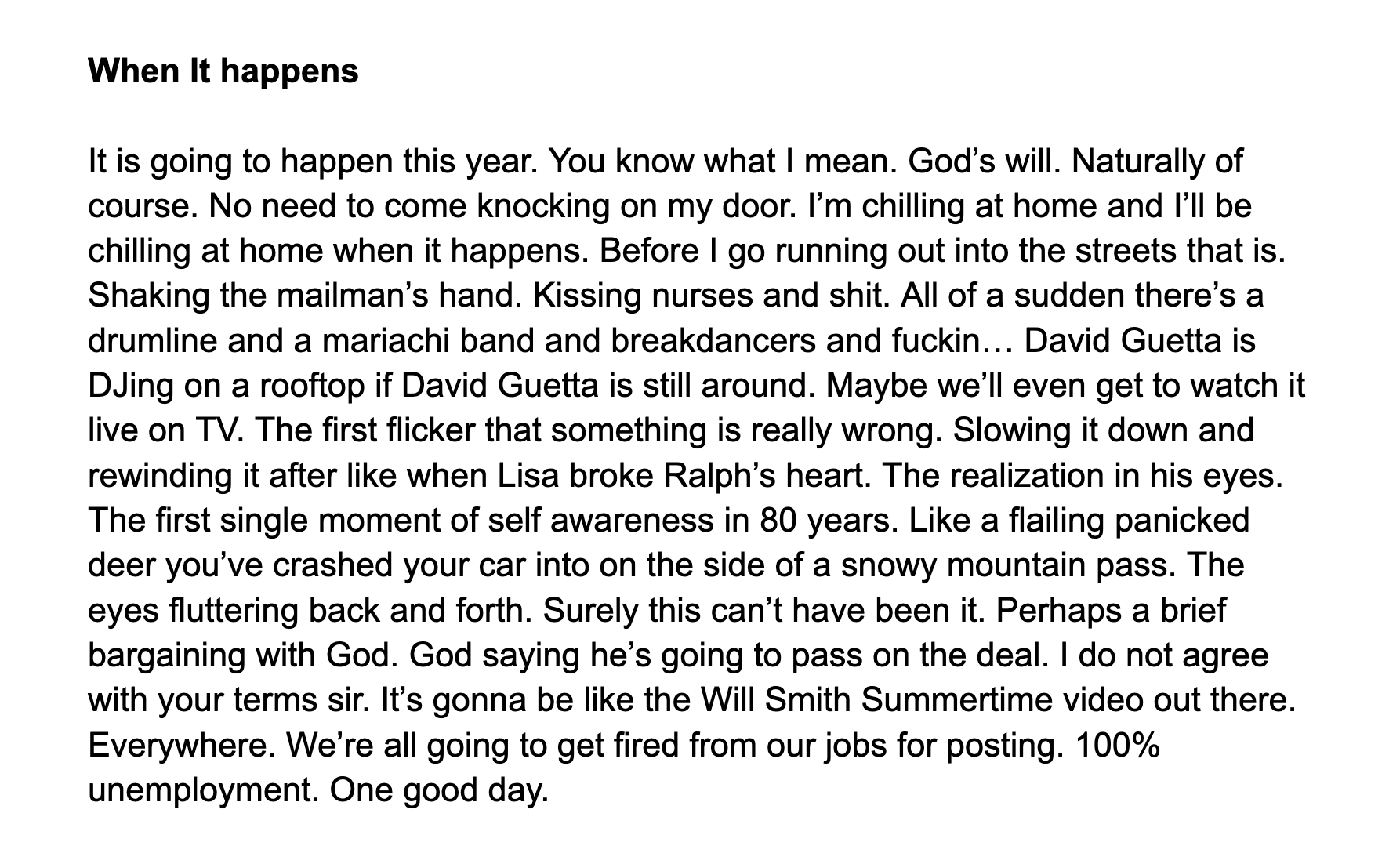
All right, this one is less funny. It’s called “An argument.”
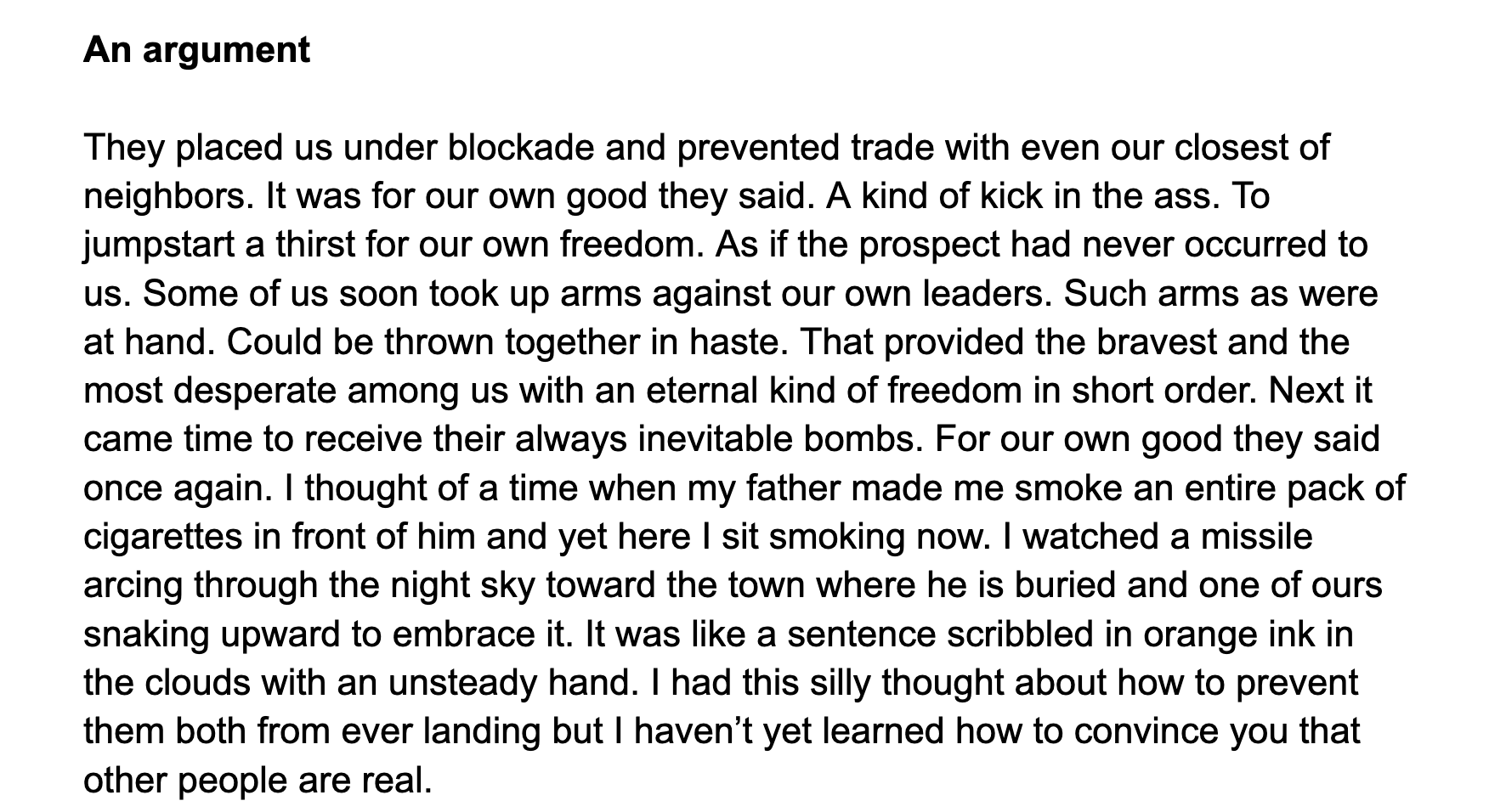
Maybe just one more. Let me see. This is another fun one. This one's called “Terroir.”
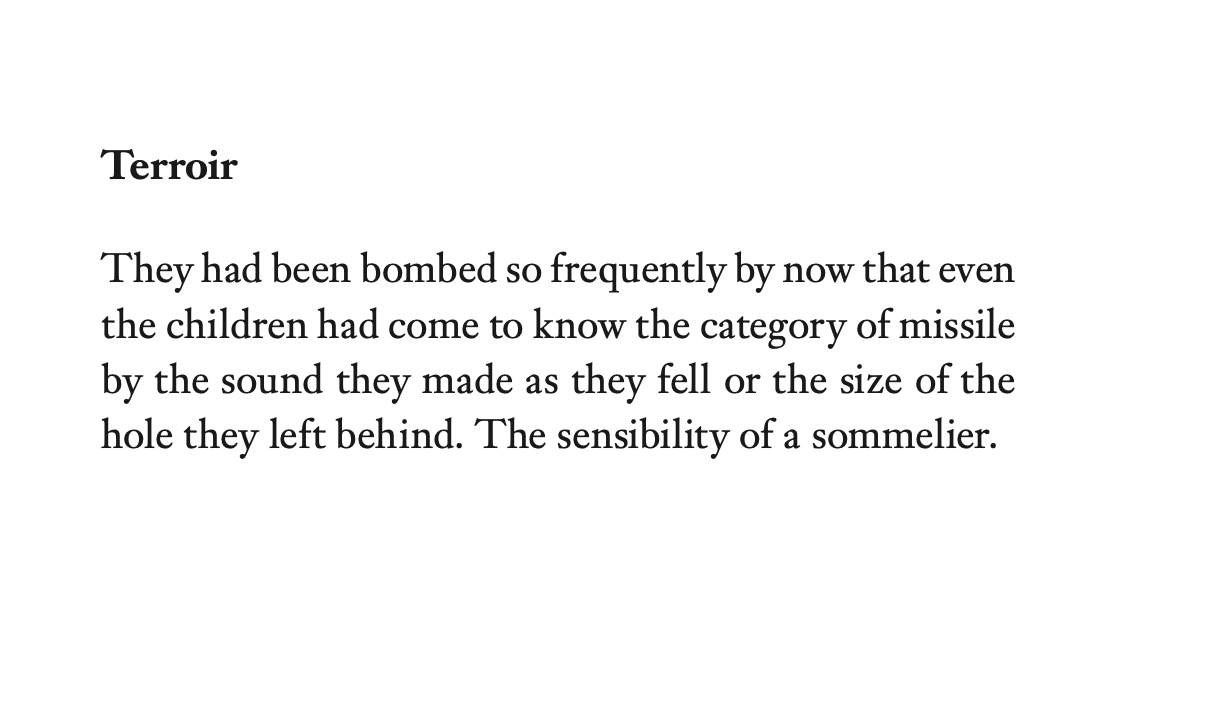
There's a lot of stories about people being bombed in here because we've been bombing a lot of people. So sorry to focus on those ones.
Thank you everyone. Sorry. My newsletter is called Welcome to Hell World. It's not called Welcome to Fun World.
RC: I wanted to start first with thanking you for coming and then asking a few questions about writing. Can you give us a bit of background on how long you have been writing? Because it sounds like from your bio you've been writing for a long time. You started in journalism perhaps.
I'm only 25 years old
Oh, yeah, of course.
Actually that's about how long I've been writing. My goal, when I was young, I wanted to write short stories and poems, or be a music journalist. And I went to school to do an MFA in poetry. And this was in the early 2000s. And then I got a job at the Weekly Dig, which was the alternative weekly at the time. I was like, okay, well, I guess this decision was made for me. I'm going to be a music journalist. And back then... you could never make a living as a poet.
I know!
As I'm sure many people know. But back then you could still kind of make a living as a music journalist. You can't make a living as a music journalist anymore. So I did that, and then I, you know, I sort of slowly climbed the ladder and wrote for the Globe many times, and then got a job at Esquire and wrote there for years, and The Guardian for years. I don't know if this will be surprising, considering my politics, but you can't really keep a job that long at like a liberal institution newspaper if you're a socialist. So I either got fired or quit in anger from every single one of those newspapers or magazines. And about seven years ago, the newsletter thing, which is everywhere now, hadn’t really kicked off yet. I thought I'd try it. And for some reason, it really took off, my newsletter, Welcome to Hell World. And before long, I was making a living at it and making more money than I ever would have at freelancing. The thing about it was I got to write about whatever I wanted. I didn't have to ask permission. I didn't have to temper my language. And this was very important to me. I didn't have to write both sides. Which you have to do, if you write for the Globe, or… This fucking microphone sucks.
If you write for some place like the Globe, you don't actually write both sides, you write, you know, the center right side. So it turns out there's an audience for journalism that doesn't lie to you. One decision I made early on was to write it in this sort of languorous poetic fashion. So it was reporting and journalism, but I was writing it as if it was a poem in a way, and that really seemed to take off. So that brought me to this. The book sort of came out of that.
There's a strong lyricism in your work. I could tell that you have a poetry sensibility in that, and I think it's really amazing to read work that is journalistic and also emotionally resonant and touching.
I mean I'm not saying I invented that sort of thing, but it wasn't that common years ago. And the best thing for me now is that the newsletter has gotten bigger. I get to hire people regularly all the time. I get to hire freelancers and pay them decently. The dream for me, being an editor, is I get to go, you're a good writer. Why don't you just write about whatever you're interested in? And it doesn't have to fit the news cycle. It could be about a movie from 20 years ago. I really feel like in a lot of ways I won the lottery. But then again, my publisher sent me my royalty statements today and I was like, fuuuuck. The newsletter does very well, but it's not that easy getting a bestseller with like leftist poetry journalism.
Understood. Understood.
Thankfully my beloved wife is a teacher, so we get that good Massachusetts health insurance.
I was just thinking about the current media landscape and how it must seem so lovely to be able to write about something that happened maybe two years ago, because everything is always so quick and moving forward and we forget things. I think that's one thing I really like is how there's an attention to events, and they don't have to be something that just happened. It can be something that happened, but there's a depth to that. That's really important. I was going to ask, with the popularity of your newsletter and the writing and editing that it requires, how do you find time to do the creative writing? You just pulled up some stuff on your phone, so… the balance between journalistic and creative writing?
It actually kind of sucks, since I do work for myself and I am my own boss, I spend a lot of time at home. And you may or may not be able to glean this from my work, but I tend to brood a little bit. So I get super excited when somebody turns in a piece and I get to edit it and I can feel like an actual person of the world. Being a poet or short story writer is kind of a fake job. We know that. If you're not a writer I’m sure you suspect that. But it's true. But you constantly have to… every single thing you do…. like I'm writing a story about this right now in my brain as we're doing it, you know? And I'm specifically going to focus on the one weird looking person in here. Who is it about? Just kidding. I can't see. I don't have my glasses on. I can't see anybody.
I think that was one thing I noticed, is when I was reading the mention of Planet Fitness and the mention of how hot it was the day after the election. I was like, oh, I remember that day too, because I walked around the neighborhood in this very unwieldy, humid November.
The day after the election was so hot! A lot of these are set in Maynard. I don't know if that makes you want to buy it more, but…
I was going to ask about your press. Did you work with the same editor?
It was a different editor. I work with a publisher called OR Books in New York, and they're a very cool indie publisher, and they do tons of people that I admire, and some people I don't. I can't really go demanding they stop working with Matt Taibbi, for example. No, but there's tons of great socialist and and communist writers. They did a book with the late Mike Davis. They're very good to me because they kind of just let me do my thing and I'm very lucky to have that. But like I said, it doesn't come with the $100,000 advance or whatever. I don't know if anyone gets that anymore if you're not a superstar.
Yeah. I think you have to be.
Or like a shitty politician who has a ghostwritten book.
Who writes five memoirs in three years or something. When did you start writing this collection because it seems very current?
Maybe this is too in the weeds. I don’t know if anyone gives a shit. When I write the newsletter I'll send it out, and then when it comes time to write a book I'll go back through the different issues and pull stuff out, like, oh, that was a good turn of phrase, that was an interesting paragraph. And I'll pull it out and then try to build something around that you know. And then some of them, there’s one in here about the No Kings march from a year ago exactly. So, this came out in November and I turned it in in May or whenever that was. I wanted it to be timeless in a way, but I also wanted to reflect what is happening right now.
I guess that answers my own question of like did you think of it as a collection when you began or did you write and write and write and then kind of bring it together? But it sounds like you kind of mine your own journals, so to speak.
Yeah, it's just that it's a public journal. And another thing I do is, I'm not on Twitter anymore, but I used to be like a super Twitter guy. Now I’m on Bluesky a lot, and I post way too much and I'm sorry if you follow me. But those little “nuggets of genius” that I turn out for free, I go back and it’s like, oh, that was a pretty good joke.
I think with my writing sometimes I set it aside and forget about it, and while I might have hated it when I wrote it, like six months later I'm like, oh, how smart was I?
It's either a present for yourself or else setting a trap for yourself.
Exactly. When I read your work, I often find myself thinking, like, yes, that's exactly how it is, that's exactly how I feel. And knowing how I feel, which is a lot of rage and frustration and futility and grief, I wonder how you keep going. Because this is your livelihood, but also do you get breaks?
I mean, every now and again. I don't know, ask my wife. She's saying no. I don't know. I am extremely mentally unwell. I cope very badly. I drink too much. I chain smoke and I go to Planet Fitness every day. It's an odd cocktail.
Like both sides of the coin.
Yeah. But no, I'm not doing well at all.
You push yourself healthy this way and then…
It's kind of like a speedball, you know? You lift weights, drink.
I feel like that is something that a lot of people who witness and have the job of witnessing… we didn't really think about them as much before. We're like, oh, thank you so much for sharing this horrific thing that you witnessed. But now as someone who feels those things, it's important to respect that and understand it…
The important thing is people who are… I'm lucky to have a fortunate life at the moment. I've suffered in a lot of ways before, but the people who are actually suffering, that's where the focus should be. I just believe that we all deserve better than this. And I believe that the world deserves better from us as a country. I'm just trying to convince five people at a time that that's something that can actually happen. And the one thing I find is that you have to… people sort of stop their own imagination when it comes to imagining a better world. This is something I write about a lot. People will be like, well, that can't happen. We can't do that. It's like, why not? Why are you already negotiating against yourself in your own imagination about what the world can be? If there’s anything you can take away from this, I would just say that a better world is possible and you don't have to cut yourself off before you start wanting that. The first step is wanting it.
What exists right now is from someone's imagination. It's just an imagination that I don't agree with, right? They imagined it and made it possible. So why can't we? That's what I think about having a positive vision of what you want. And I think that's where we get stuck a lot of times.
Audience member: One thing I've noticed in your writing, just from the few things that I've read, admittedly, my husband is a big fan of yours and I just came along for the ride tonight. But I'm super impressed with what you shared with us. All of the best writers are wonderful readers, and I'm curious about who some of your favorite authors and influences are.
That's always tough to say. Whenever they ask me that, I always defer back to like… it's like when you ask people who their favorite bands are, it goes back to those earliest ones that really taught you how to love music. So for me, in this case, and if anyone is familiar with them, you might think, oh, that's who he's ripping off, but, Donald Barthelme was a really big influence on me when I was young. Also Virginia Wolf. Most of you probably haven't read it yet, but there's like no punctuation in my book, and it's all run-on sentences, which makes it hard to sort of read out loud. But those are the two that always refer to. The lyricism of Virginia Wolf and from Donald Barthelme the humor of the absurdity of the modern condition. So those would be my two big ones.
Audience member: My girlfriend Morgan and I are trying to find a gym to go to. What’s all this I hear about this Planet Fitness place?
I like the Planet Fitness in Maynard, but there's one problem with it which is it's right next to the high school, so there's too many fucking kids. They all stand around the machines bullshitting, playing grab ass. The fuck out of here. I respect the kids though!
RC: As someone who also is a member of Planet Fitness, though not as dedicated in any way as Luke, I can't really go anymore because of the TVs. Because all the TVs are all like horrible news just running right in front of my face and my heart rate goes up, and I'm like, this isn't exercise….
Yeah, I don't like seeing the Fox News but I don't really love CNN either. There's a story in here about a woman on a treadmill at Planet Fitness when the end of the world happens, and all the TVs change to the end of the world, except for one down the end and it still has Pat McAfee and Aaron Rogers. It's like even the end of the world can't rid us of these fucking men. These ESPN talking heads.
Audience member: I wanted to ask about the cover of the book. It’s sort of immediately jarring, with the title, and the picture, and what it makes me think of is this sort of idea of white American innocence. And the title of the book shoots this dagger right at it. I wanted to know if you had some thoughts about
I appreciate that reading of it. We Had It Coming, the title, I think you can all probably glean something from what I mean by that based on my opinion of how much war we export around the world. And what we're living through now may be our just rewards in a way. But this actually happens to be me! A cute little boy! And my sister and my grandmother. My grandmother looms large in this book and everything. One of those Massachusetts grandmothers who ruins everyone's life, but you all nonetheless love her so much. This was taken in Round Pond, Maine, which is one of the centerpiece stories. But I really like that interpretation. I hadn't thought of that connection to it. Perhaps because I can't perceive my own whiteness. But yeah, that really works.
Audience member: If you're willing, could you tell us a little more about your writing practice? Some of the details like do you write every day? How long? What does that look like?
My ideal sweet spot is when I wake up and have coffee and a few cigarettes, and I'm usually going to know within like a half hour or not if it's going to be a day. Sometimes I’ll get into a flow, write for a couple hours, put it down, do my stuff, and then come back in the evening and I'll have a drink. For me, once I have one drink, a timer is set. There's 45 minutes when you're in that kind of nice drinking spot. And then the second one it's like I don't want to write anymore so you got to kind of squeeze that in. I drink too much, sorry. So it's usually a couple hours in the morning, and then maybe like an hour in the evening, and then the sweet spot is like late at night, maybe 9:00, after I’ve smoked for a while, then I go back in… This isn't healthy for a body, but I find you write sober for a bit, you write drunk for a bit, then you write stoned for a bit. Then the next day you edit sober. That's basically it. Don't… Well there's no young people here, but don’t do it! I don't think kids watch cable access anyway.
Audience member: To kind of pick up what you were talking about just now, have you always found it this easy, or it seems easy, to be as honest about yourself in your work, to let you personality kind of carry into your reportage, but also like the poetry and stuff. Or is that something you kind of built to over time? Because as a fellow Masshole, I feel like that's not always something that comes naturally in our makeup.
Yeah there is a lot of keeping shit inside. But that was the turning point for me when I started to do that. Like I said, I used to write for newspapers and stuff, and you can't be writing a story for the Globe and then all of a sudden interject like, oh, I'm kind of hungover today and, you know, I'm sad about my dead father, you know? They don't let you do that. But when you're in charge of your own thing, you can do that. And it turns out people like that shit you know what I mean? You can be like, I hate myself today because I ate an extra slice of pizza or something, you know what I mean? Which I tend to write about a lot. So it really is very freeing, and I really relish the ability to do that. I think it really resonates with people. Especially because most journalists that we all know of, the ones who are famous and everything, they have this image of being put together and like professionals on TV. And I come from, you know, indie rock and punk rock and stuff like that in Boston. We're all Massholes, and we're kind of loud, and we swear a lot and we drink too much maybe. I think that sort of resonates with people. And if you don't like it, you think you’re fucking better than me? Fuck you.
RC: That just kind of made me think about how our media landscape is so coiffed and perfect and they only say a certain amount because there's just such a hold on reputation in a way. They don't dare ever say… and I think I sometimes have that where I want to scream at the TV, why aren't you asking the question that you should be asking? You're a freaking journalist! Yeah. And so to be able to just write what you're thinking… I think that's why it resonates with people. Because we're all so kind of tired…
We are. And I'm going to say what I'm thinking right now which is these people are sick of hearing my bullshit, so let's fucking stop. You're all dismissed.