The little actions of little men
Rax King on reading They Thought They Were Free in the age of ICE

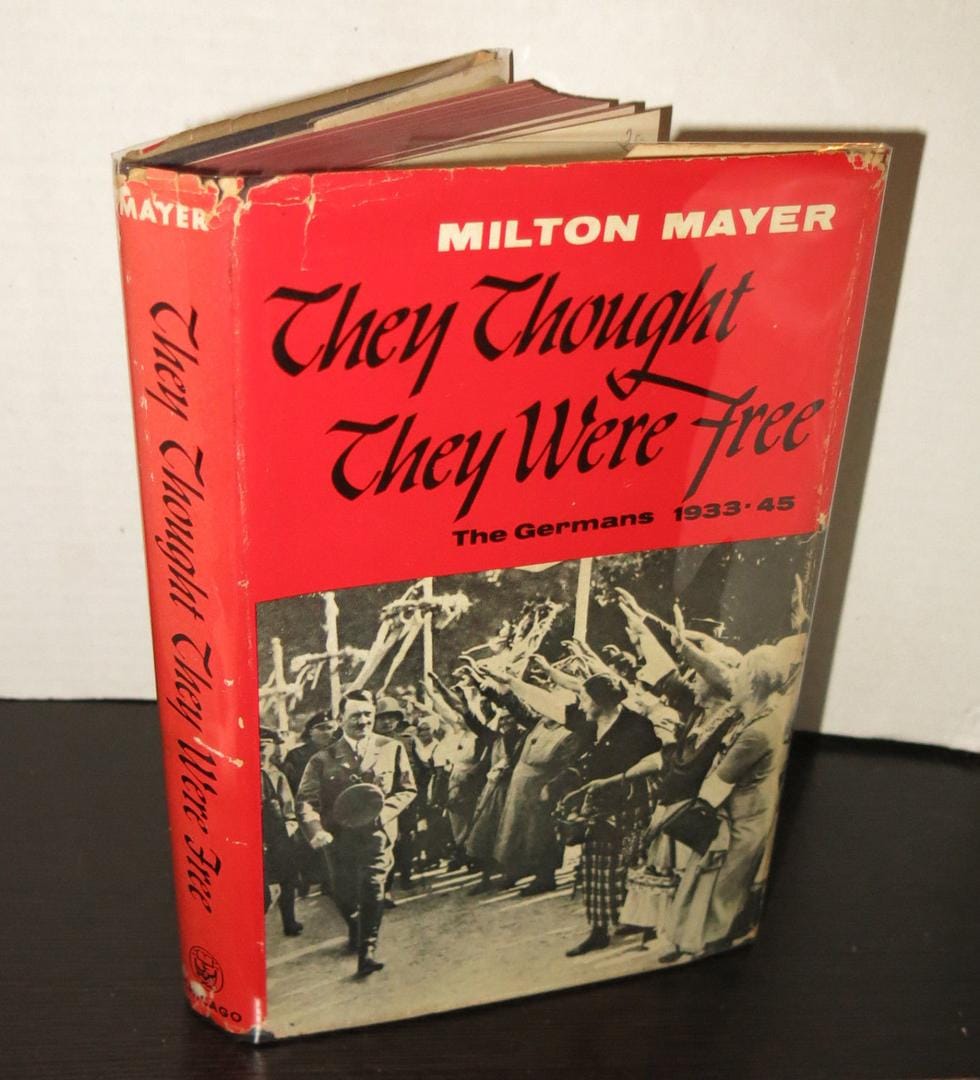
A real powerful one today from Rax King on reading Milton Mayer’s 1955 book They Thought They Were Free: The Germans 1933-1945 in the age of ICE.
"Still, one glaring similarity offers itself up readily: ICE, like Hitler’s brownshirts, are not presently undertaking a campaign of extermination. The current project is separation," she writes.
"Incompetence might be the simplest explanation for their splashiest kidnappings, like that of five-year-old Liam Conejo Ramos — allowing that sweet little boy to be photographed in his bunny hat on his way into a police vehicle was a tactical catastrophe that they’ve since tried, with mixed success, to avoid. For every Ramos whose kidnapping goes viral, who knows how many people are being snatched up much more quietly? As of February 7, there were 68,289 people in ICE detention, and I’m ashamed to say I can name maybe five of them. Moreover, ICE is notorious for shipping detainees all over the country and outside of it, making it exceedingly difficult for even their lawyers and loved ones to find them, much less the public. The American press must be grudgingly credited with advertising a few of the horrors, some of the time. The most significant difference between us and the Germans in 1938, it seems to me, is that we have access to a little more information than they had."
This was sent out as part of today's full Hell World newsletter which you can read here. It includes a real shaggy dog story by me about parking at the hospital.
 Luke O’Neil
I got an email the other day. They were writing to thank me for parking but also wanted to know How was your experience at: Emerson Hospital? Not that great man. If you want the truth of it. I was parking at the hospital for starters. As you well know. www.welcometohellworld.com/how-was-your...
— Luke O'Neil (@lukeoneil47.bsky.social) 2026-03-25T14:34:56.474Z
Rax most recently wrote for Hell World about Emerald Fennell's “Wuthering Heights."
 Luke O’Neil
Please be sure to also check out her recent thorough eviscerating of an "A.I." user in her advice column.

God, where to begin. Here, I suppose: if this letter is an example of your Claude-less writing, you're bad at it. That sentence was gentler when I first drafted it, but why should I stir any of my good cheddar into your grits? You're clearly not worried about offending me. So I'll tell you very bluntly that you need to worry about style and usage before you think about getting your memoir published. Your copy is dirtier than this simile is folksy, boy. You've outsourced clarity to AI, retaining for yourself the coveted role of "ideas man," but look at how you struggle when parted from your precious fucking Claude for a five-paragraph email! Plenty of great writers draft messy and revise clean, but your lazy repetitions of words and obviously hurried sentences suggest the more fundamental problem that you think language is beneath you. But there, you don't traffic in anything so pedestrian as diction or syntax, do you, my little kapellmeister? You stand at the head of the room and conduct a symphony of ideas."
You'll need to be a paid subscriber to read this piece in full. Here's a very nice discount. Thank you.
The little actions of little men
by Rax King
Milton Mayer’s 1955 book They Thought They Were Free: The Germans 1933-1945 is a profile of ten ordinary German men which was originally conceived as a profile of Adolf Hitler. The author spent a month 1935 failing to get Hitler, who was presumably a little busy that year, to sit for an interview in Berlin. When that project fizzled, the author (who was Jewish, and it matters) stayed in Germany for a time anyway. He was surprised to discover that the Germans he met seemed pretty upbeat for a people supposedly being crushed under the heel of a mad dictator. Nazism wasn’t one man’s insanity imposed on millions, he realized — it was a mass movement. “I wondered if Adolf Hitler was, after all, the Nazi I wanted to see,” he writes in the foreword. “By the time the war was over I had identified my man: the average German.”
The book that follows is an eerie profile not of one hateful lunatic but of ten “little men.” That’s no insult but rather the men’s own term, deployed repeatedly to distinguish their class position from that of the wealthy and the highly educated. All ten lived in the university town of Marburg, pseudonymized as “Kronenberg,” in the conservative (even “backward”) state of Hesse. All were members of the Nazi Party — functionaries and brownshirts only, no blackshirts among them. A couple had turned anti-Nazi by the time they sat for their interviews with Mayer, but most still saw their time in the Party as an unusually happy and fruitful period in their lives, and always for the same reason. These ten men were not, prior to their time in the Party, accustomed to being taken seriously. And they seemed to agree that they’d never be taken seriously again.
“I liked them,” Mayer admits in the foreword. “I was overcome by the same sensation that had got in the way of my newspaper reporting in Chicago years before: I liked Al Capone. I liked the way he treated his mother. He treated her better than I treated mine.”
His conversations with his little men were warm and cordial, to the point that he describes them most frequently as his friends. He initially struggled to establish relationships with all ten, winning them over by means of his ineptitude with the German language — postwar, they were all wary of spending time with an American professor until they realized they had something to teach him. They enjoyed making a show of their pedagogical patience with him, the sort of show which was rarely theirs to make. In a moment that’s chilling specifically because I don’t think it was intended to be chilling, Mayer admits he never told his little men he was a Jew, “on the advice of [his] German colleagues and friends.” The war was over, but for his cohort of warm and friendly antisemites (and, to be fair, for veterans of all wars everywhere), it sort of wasn’t. They Thought They Were Free has been criticized for only interviewing ten men in one country town and presenting those findings as representative of Germany more broadly. But for purposes of comparison to the present-day U.S., which is forced by the electoral college to give a huge amount of weight to a “median voter” who always seems to be a small-minded country bigot, that controversy might also be a strength.