The woman who sat
Zack Budryk returns to write about Amy Madigan, One Battle After Another and the politics, silent and otherwise, of last night's Oscars ceremony.
You may also enjoy this piece from 2024 by Corey Atad on a similar subject concerning Jonathan Glazer's win for The Zone of Interest.
 Luke O’Neil
In other Oscars writing from earlier this year, read Sean T. Collins on One Battle After Another and here on Sinners. Christopher Harris also wrote about OBAA. Rax King wrote about Frankenstein.
Budryk most recently wrote for Hell World about The Testament of Ann Lee.
 Luke O’Neil
You'll need to be a paid subscriber to read this piece in full. Here's a very nice 33% off discount. Thank you as always for your generous support. It means a lot.
The woman who sat
by Zack Budryk
If you’re a lefty film nerd and you play your cards right as far as the algorithm, there’s a clip of Orson Welles that’s probably come up in your feed of late. It’s from 1982 when Welles was the biggest and hairiest he ever was and gave less of a fuck than he ever gave, and he’s bellowing “Elia Kazan is a traitor. He is a man who sold to McCarthy all of his companions.” He goes on to castigate Kazan for, in the wake of naming names before the House Un-American Activities Committee in 1952, directing one of his most acclaimed movies, On the Waterfront, in which Marlon Brando plays a longshoreman who heroically turns state’s evidence against the mobsters who run his union, a clear stand-in for Kazan himself.
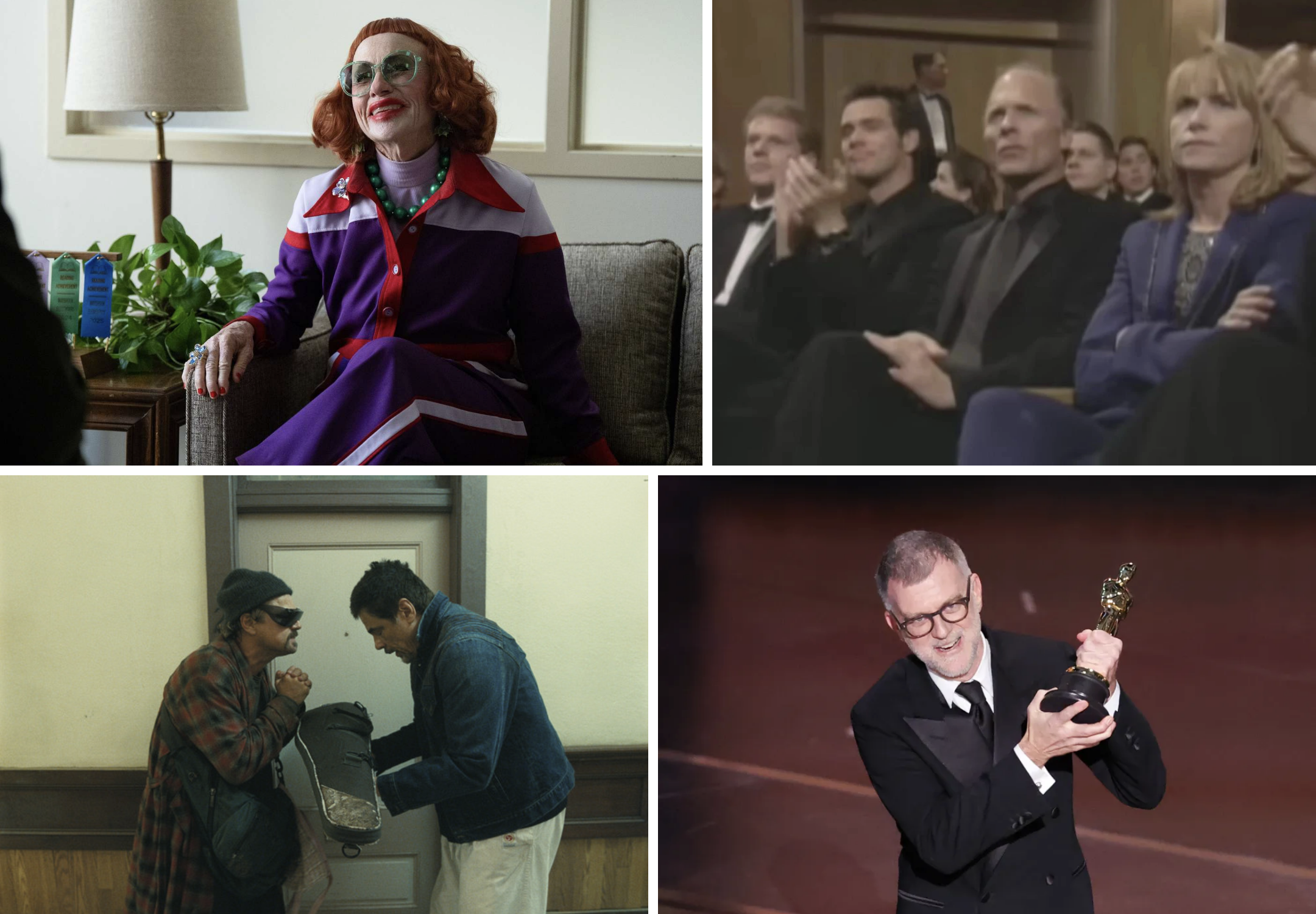
Amy Madigan, who won the Academy Award for Best Supporting Actress Sunday night, felt similarly about Kazan, but unlike Welles, she didn’t bellow. She did almost the exact opposite. In 1999, Kazan, who’d be dead in four years, was presented with an honorary Academy Award by no less than Martin Scorsese. The theater gave him rapturous applause, a partial standing ovation, but in a widely-circulated image of Madigan and her husband, Ed Harris, they are stone-faced and not applauding. Madigan has her arms crossed.
Madigan’s career didn’t actively suffer for this moment like those of the people Kazan betrayed—she co-starred with Harris in his self-directed, Oscar-winning Jackson Pollock biopic the very next year. But it was a political stand in a time when those were particularly unfashionable in Hollywood. Not in the sense that they were dangerous, but more that they were kind of cringe.
That same Oscar telecast saw Best Picture awarded to Shakespeare in Love, widely remembered as one of the frothiest, safest movies ever to get the top prize, particularly considering the competition included Saving Private Ryan and the Italian Holocaust tragicomedy Life is Beautiful.
We were in the waning years of the presidency of Bill Clinton, a man who had repented his 60s radicalism to advance mature, serious ideas like welfare cuts and budget surpluses. Earlier that year, we’d been introduced to a gangster named Tony Soprano, whose life suggested that even hardened criminals suffered the anxieties and neuroses of suburban ennui and, even worse, had teenage daughters who came home from school thinking they were smarter than their parents. Very few people wanted to be a wet blanket in a moment honoring a legend of filmmaking. What the hell did that have to do with politics?
Like 1999, this year’s telecast was overwhelmingly apolitical, even as our government murders its own people in the streets at home and Iranian schoolgirls overseas.