The so-called sanity the world represents
Zack Budryk on The Testament of Ann Lee
by Zack Budryk
I’ve recommended my share of movies with the assurance that “it’s better than it sounds,” but in the case of The Testament of Ann Lee, you’ll probably know right away whether or not you have the patience for it from the log line. It’s a musical about the nearly-extinct Shaker sect.
Established in 18th century England as a Quaker offshoot, the Shakers settled in New York shortly thereafter. While they numbered in the thousands at their peak, they are today down to just three due to their practice of abstaining from fucking, which understandably complicates recruitment compared to, say, Catholics. Their name, shortened from “Shaking Quakers,” derives from their practice of dancing in religious ecstasy during rites.
Mona Fastvold’s film, as the title implies, focuses on “Mother” Ann Lee (a never-better Amanda Seyfried), the founder of the North American community. The racial- and gender-egalitarian sect viewed Ann as a messianic figure, reasoning that if all humans are made in God’s image, God was both male and female, and thus, a God who had already come to earth as a man would naturally return as a woman.
Seyfried plays Ann as an eccentric, often mystifying figure, and one who it’s easy to view as simply delusional. Her personal edict of celibacy derives from the compound traumas of stumbling on her parents in the act and losing multiple pregnancies. It all sounds like the sort of thing you would see in any streaming cult documentary, the mysterious, charismatic leader whose teachings about how we should all behave derive from her personal hangups and preferences.
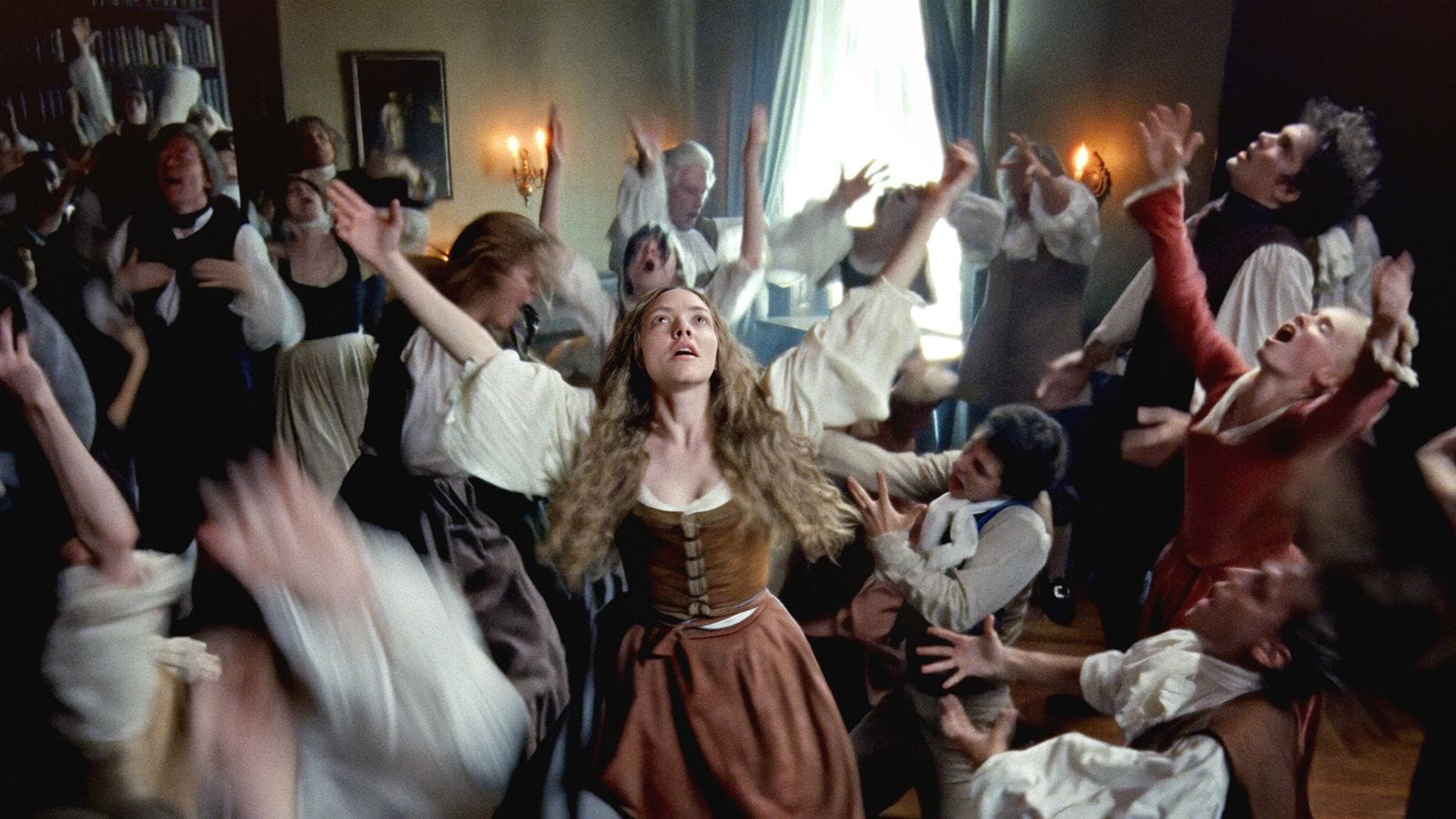
Fastvold’s direction leans into the fine line between divinity and madness. This comes through particularly in the beautifully choreographed ritual dances. They’re rhythmic and symmetrical and emphasize Seyfried’s angelic features, alternately serene and twisted into a rictus. Ann and her followers move not as though it’s self-directed but as if an unseen force is flinging them to and fro, which, according to their theology, is exactly what is happening. The movie depicts Ann sympathetically but it certainly doesn’t discount the idea that she isn’t all there.
And yet, the movie seems to suggest, if Ann is insane, perhaps that’s preferable to the so-called sanity that the world around her represents. Shortly after arriving in New York, Ann beholds a slave auction and breaks away from her followers to howl “Shame!” It’s the sort of behavior you’d cross the street to avoid, but it’s also the only moral reaction to one of the worst depravities in our country’s history of extensive depravities, and Ann is the only one on the thoroughfare doing it.
Much of the remainder of the movie after the Shakers make it to America takes place in the self-contained community, and so their other contacts with the external world are similarly jarring. During the American Revolution, Ann is briefly jailed by the Continental Army for directing the pacifist sect not to sign an oath of loyalty in the conflict. In an even more harrowing scene toward the film’s end, the leadership of the Shakers are attacked and beaten by residents of a village where they attempt to recruit, while Ann herself is sexually assaulted by villagers accusing her of disguising as a woman. While this is based on a real incident, it’s hard not to think of modern “transvestigators” obsessed with the idea of secret trans women trying to deceive them, a reminder that long after Ann’s death and the dwindling of her community, the base, animalistic violence of the world outside it persists in strikingly similar ways.
The movie’s portrayal of Ann is reminiscent of one of the best modern films about Christianity, Martin Scorsese’s The Last Temptation of Christ. Whitewashing aside, the casting of Willem Dafoe as Christ is its biggest single asset. Dafoe’s distinctive voice and facial muscles truly convey why an entire empire would view this man as a threat.
Dafoe’s performance has something of Charles Manson about him, a wild-eyed man from the wilderness elucidating visions only he can see of the toppling of society. When he emerges from his temptation in the desert with an axe in his hand, Dafoe’s Christ is genuinely frightening. And yet when he brings that same intense freneticism to his message of hope, it’s crystal clear why people follow him.
“If I was a woodcutter, I'd cut. If I was a fire, I'd burn. But I'm a heart and I love. That's the only thing I can do,” Dafoe’s Christ proclaims.
When they speak in private, Pontius Pilate (David Bowie, another stroke of casting genius) explains to Jesus that, much like Ann Lee, his holy madness is a threat to the sanity of the fallen world. “It's against Rome. It's against the way the world is. And killing or loving, it's all the same. It simply doesn't matter how you want to change things. We don't want them changed,” Pilate says.
Both Dafoe’s Christ and Seyfried’s Ann Lee also evoke a distinctly American figure in John Brown, a devout Christian whose fanatical devotion to the cause of abolition was indistinguishable from insanity in a society that had metabolized the ownership of human beings as business as usual. Today, of course, Brown stands as proof that whatever horrors were accepted as a fact of life throughout history, there were always those who knew that they were wrong and acted accordingly. It’s a reminder that we have no excuse to stand pat through similar injustices in our own time, and since then everyone from leftist revolutionaries to anti-abortion extremists have sought to claim that legacy. And yet Brown, like Christ or Ann Lee, was indeed kind of a weirdo, with his prophetic beard and entourage of large adult sons. Frederick Douglass, hardly a squish on abolition, correctly assessed Brown’s plans to raid Harper’s Ferry as doomed to failure. Today, however, none of his personal eccentricities matter next to the fact that he correctly identified the great evil of his time and the necessity of violent means to end it if peaceful means could not.
We’ve seen that same intersection of radical politics and spiritual fire wherever Americans have come together against the wrongs of the state, often in ways that the comfortable or elites would dub aberrant. People like the radical Jesuit Fr. Philip Berrigan, whose destruction of draft files during Vietnam with homemade explosives made him the first ever priest to make the FBI’s Most Wanted List. Berrigan and his conspirators, all current and former clergy or lay Catholics, indicted the religious establishment as an accomplice in the moral crimes of the secular world, saying in their manifesto “we are convinced that the religious bureaucracy in this country is racist, is an accomplice in this war, and is hostile to the poor.”
Just this month the hundreds of thousands of people who filled the streets of the Twin Cities in defense of democracy included about 100 clergy of various denominations who were arrested on January 23 at Minneapolis-St. Paul International Airport. In an interview with Episcopal News Service, the Rev. Jered Weber-Johnson described his motivation to take action in ways that evoke Ann Lee’s dances, something almost beyond his own control:
“I’ve been grieving viscerally. I’m also galvanized in my own faith to live my baptismal covenant; to reject Satan and all of his powers; to turn my life back over to Jesus and to follow him; and to do it with every fiber of my being,”he said.
The French New Wave icon Francois Truffaut opined in 1973 that the nature of the medium means that “Every film about war ends up being pro-war.” Perhaps a similar dynamic is at work with depicting faith on film: to depict the spirit that moves someone like Ann Lee, you must use the filmic language of delusion, of hallucination, of a break with reality. That’s what a religious experience is, after all, even for a believer: a piercing of human reality into something else entirely. The nature of faith means it’s something you have to see for yourself rather than second hand, but maybe the hallucinatory beauty of art is the next best thing.
Zack Budryk is a DC-area journalist and writer. His reporting and commentary have appeared in The Hill, The Washington Post, Teen Vogue and The Nation and his fiction has been published in Rock and a Hard Place Magazine.