A requiem for a Revere Beach dive bar
Change hovers on the horizon

by Sara Selevitch
Did you hear that they're closing down? Anyone who’s lived in an American city has heard a version of that question too many times. It could be about the neighborhood corner store, local rock club, or a dive bar down the street. They might have been open for six years or sixty. In any case the closure is likely due to a change in building ownership or raised rent. Soon they’ll be demolished and replaced with a new-build condo or mix-used development. One with a bleak grey facade, neon accents, and perhaps a street-level Cava.
I watched this sequence play out again and again over the ten years I lived in Los Angeles. After recently moving back to my hometown of Boston, I’ve found the same forces at work here, transforming the places I remembered with a speed I hadn’t anticipated.
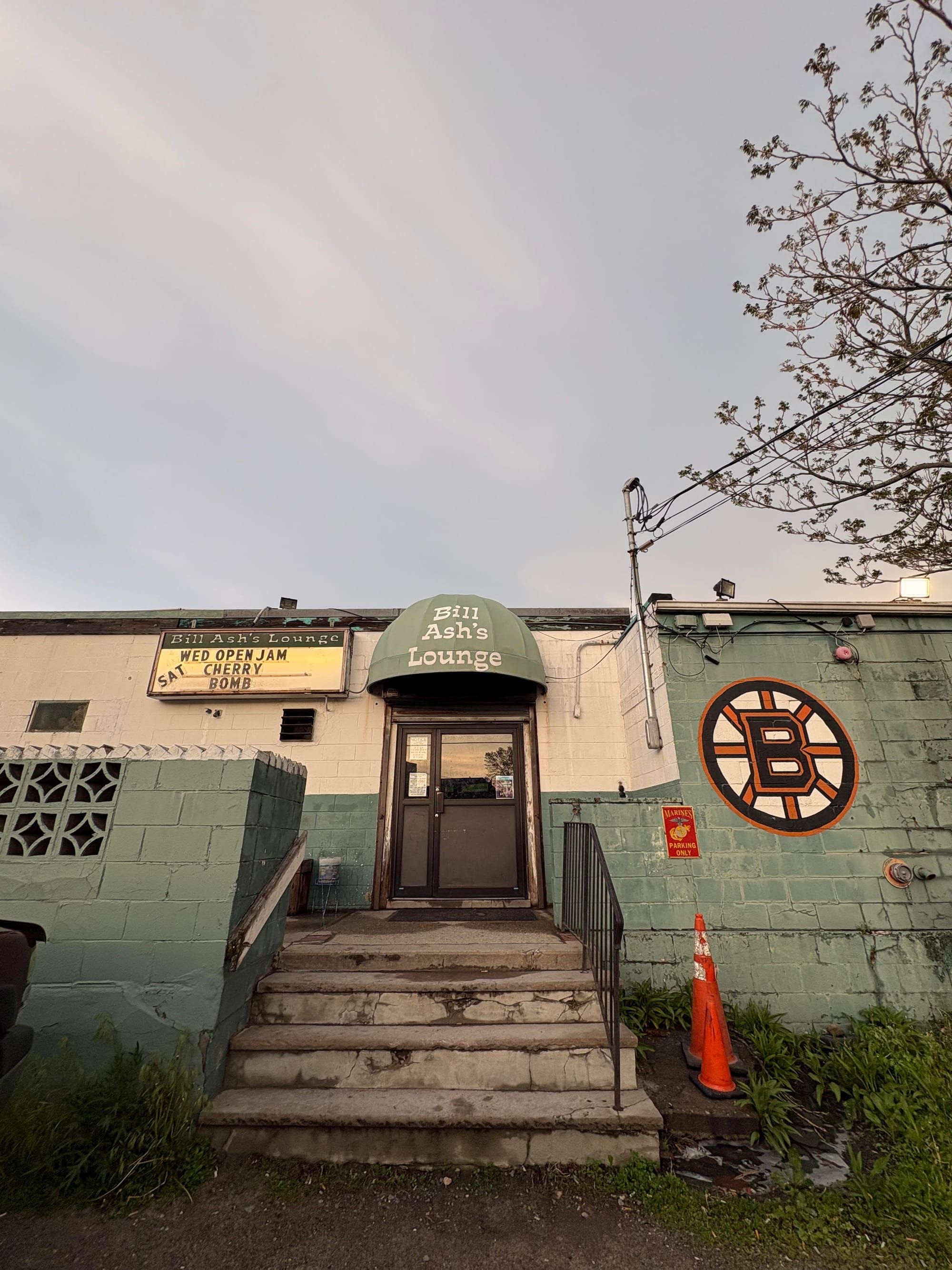
One of the most drastic transformations has taken place right where I grew up, where massive luxury condos have engulfed the once sparse, endearingly shitty Revere Beach. Each time I’ve visited home in the past few years, something else has been missing: the building that once housed my dad’s restaurant, Rob’s Kabobs, in the 90s; the ice cream shop where I got my first job as a teenager; the baseball diamond on the corner of Revere Street. And this upcoming Labor Day will mark the last day of business for Bill Ash’s Lounge, the iconic dive bar that’s been a fixture of the beach for over fifty years.
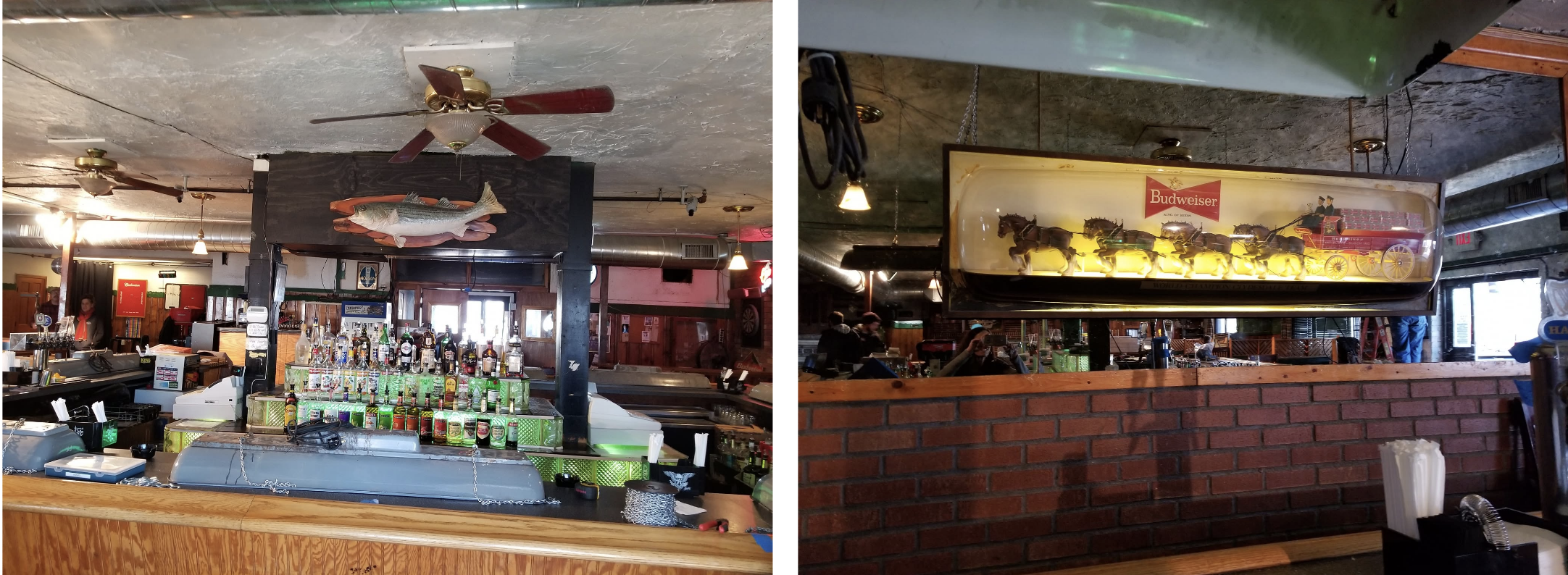
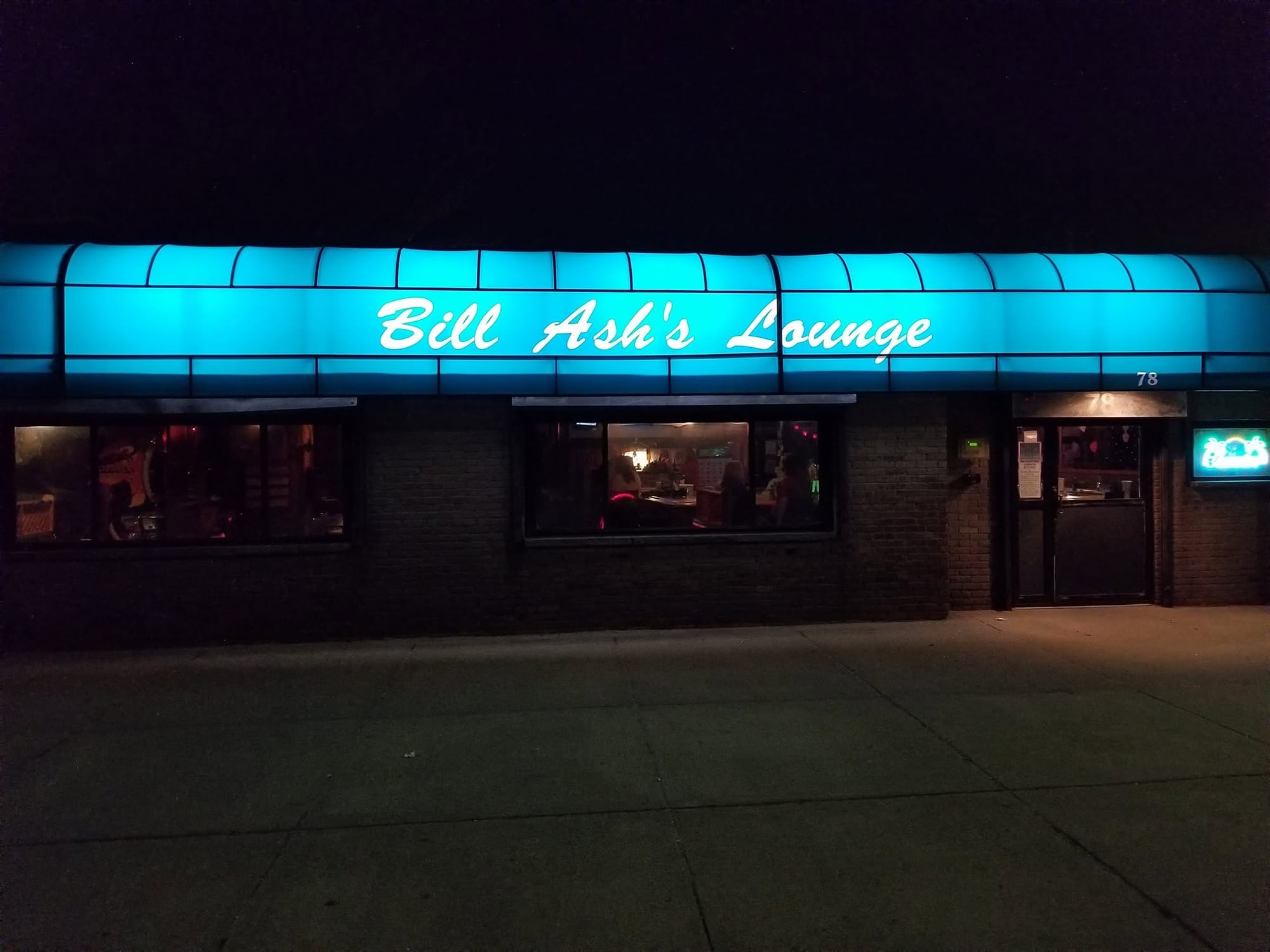
If the new Revere Beach has become increasingly generic, Bill Ash’s has remained the opposite. When I brought my boyfriend for the first time a few years ago, he said it redefined his idea of a dive bar. You can enter through the front door on the beachside or the back door to the parking lot. From either end you’re greeted by a U-shaped bar with a green laminate bar top. Mixed drinks are served in plastic cups, beers by the bottle or can. It’s cash-only, always. Prices went up this year for the first time in many, but a vodka soda and Bud Light will still run you just twelve bucks. There’s a stage in the corner where local rock bands used to clamor to play, and some cover bands still do. Keno loops on two small TVs overhead, and a robust smoking patio awaits out back. There’s a bench with a statue on it shoved in an aisle, inexplicably blocking several of the booths. A nonworking fireplace sits in the corner. Dusty gaming machines rest on some of the tables, and a fluorescent vestibule houses several others.
My dad refers to the bar as The Ashcan. He and one of the owners, Kerry Tunstall, used to split Patriots season tickets throughout my youth. I spoke with Kerry recently about his and the bar’s intertwined legacy.
“Let’s see how much I can remember,” he says when we sit down. “48 years and a lot of liquor makes it tough.”
We chat as the opening bartender comes in for the lunch shift. Kerry’s granddaughter, an adorable and precocious girl wearing a Bill Ash’s t-shirt, hangs out and entertains herself with a deck of cards nearby. She occasionally shows me a trick or starts singing a song. Kerry says she got to sing onstage during last year’s holiday party.
“The DJ didn’t want to give her the mic. I told him maybe he didn’t want to get paid either.”
Kerry is a character with an unmistakable deep voice. “I got a face like Brad Pitt, and a voice like Rodney Dangerfield,” he jokes. He met his first and second wife at the bar, both of whom were named Patty. That way he never got confused, he says.
Kerry started working at Bill Ash’s in 1978, when he was twenty years old. He spent his first few years behind the bar, until he discovered that one of the owners was stealing money from the register every night he says. After helping uncover the scheme, Kerry took his place as an acting partner in the business.
“I’m here every day,” he says. “People ask me what I do on my days off. I tell them I celebrate Thanksgiving and Christmas. I hate to say it, but I’m ready. I’m so ready to be done.”
Though the end for Bill Ash’s is imminent, plans for the building’s next life are still unclear. “Our last day was supposed to be this past New Year's Eve,” Kerry says. “And then I get a text in mid-November saying the developer changed his design, it’s gonna take a little…” He shakes his head. “People think I’m holding out on them, not telling them what’s going on, but I don’t know any more than they do.”
The buildings at 76-82 Revere Beach Blvd. will be demolished to make way for a new 80-unit luxury condo. Two of the other four businesses on the lot, Happy Garden and Twist N’ Shake, have already closed and relocated. The spot next to Bill Ash’s (which for many years was their own pizza output, now a jerk chicken restaurant) is still in operation for the time being. These businesses are and were some of the last long-term holdouts in a drastically changing neighborhood. I have many memories of driving down the beach to get Chinese food and ice cream and sitting on the wall with my dad, looking out at the waves. It’s hard to imagine the beach without these places. But then the beach has always been changing.
In the 1890s, architect Charles Eliot used eminent domain to clear all the properties along the beachside of Revere Beach Blvd. to transform it into a public reservation–earning Revere the designation of America’s First Public Beach. The site became a popular tourist destination, as the nearby train line provided easy access for families across the region. This led to the construction and development of numerous hotels and attractions. With its massive wooden rollercoasters, dance halls, bath houses, and amusements, Revere came to be known as “Coney Island of the East.” The archive at the Revere Historical Society offers a glimpse at the dizzying array of attractions, from diving ponies to a water ride that mimicked the River Styx to a show called “Fighting the Flames,” in which a mock city block was set on fire and extinguished by live stunt actors. (I even found a news clipping detailing a dance marathon that somehow lasted from June 24 to October 11. We seem to have gotten lazier with our leisure.)
The decline from the beach’s heyday was gradual. Pieces of the boardwalk closed due to financial decline or structural disrepair. The final death knell arrived when the Cyclone rollercoaster, once the largest in the country, caught fire during Boston’s infamous blizzard of 1978. Kerry recalls watching it burn out the window of the bar.
Throughout the 80s and 90s Revere Beach was gritty and largely empty, made up of vacant lots, local food stands, and dive bars. Although many locals at the time lamented that the beach’s glory days were over, Kerry maintains that “it was a lot more rocking then than it is now.” And it remained a leisure destination for working class people, whether Revere residents or folks taking the Blue Line in from other parts of the city. In an August 1986 WGBH news segment, one local summarized the appeal.
“There’s no other beach to go if you ain’t got a car.”
This particular news package is iconic, highlighting the various Revere Beach characters of the day: big haired women and leather-skinned men, all with their distinct Reveah accents. They speak of a place full of community and good times. “It’s like heaven,” one woman says. The segment ends in uncertainty, though, as it cuts to the construction of the beach’s first large-scale apartment project, the 303 units of Waters Edge. (These three Brutalist buildings were condemned in 2025 after a fire and unresolved structural issues, forcing all residents to evacuate late last year.)
“Change hovers on the horizon,” the voiceover announces, “and it’s not welcome. High rise and high price, decidedly not for natives, but for newcomers.”
One of the elder interviewees voices her fears. “I’m afraid [the beach] is gonna all be private, and I don’t like that. It’s gonna take away from the poor people.”
The vision outlined back in 1986 is finally coming to pass, with the completion of more than a dozen new luxury apartment and condo buildings. Ninety O, Revio, The Robinson, BLU Revere, Modera, BLVD, Beach House, Eliot on Ocean, Ryder, Ocean 650… the list of fatuous names goes on.
“You drive down the beach now, it feels like a canyon,” Kerry says. “These huge buildings on either side. You know, it used to be wide open.”
It’s difficult to find reliable statistics on the occupancy rates of the many new buildings. Kerry says the building inspector told him they’re all half empty. What’s clear is that the rents are comparable to, and in some cases higher than even those in Los Angeles. A studio can run close to $3,000 a month. Under Massachusetts law, 10% of new apartments must be designated as “affordable,” meaning they’re reserved for households earning no more than 80% of the area median income. But Revere’s affordable-housing threshold is tied to the much wealthier Boston-Cambridge-Newton metropolitan area, where the AMI is $120,800. Revere’s actual median household income is nearly half that, at $62,568. (Off the beach, rent in Revere is still cheaper than many other parts of Greater Boston. But if development extends beyond the beach, as it’s already begun to, it’s unclear how long that will remain true.)
Even if there’s an argument to be made that these buildings are “nicer” than the ones they’re replacing, it would seem most Revere residents can’t afford to live there. So who’s moving in?
“People say you must be getting so much business from all these new places,” Kerry tells me. “But they’re not coming in here, that’s for sure.”
With several Blue Line stops within walking distance, many of the new residents are commuters, using Revere primarily as a place to sleep between trips into Boston. On social media I’ve seen plenty of evidence that some of these newcomers see the city less as a place to live than as a (slightly) cheaper alternative to Boston. On Reddit one former 90 Ocean resident complained that the area was congested and filled with “not the best people.”
“The beach is atrocious too,” they said. “Not sure how desperate you need to be to consider this a beach.”
I’ve heard this stereotype all my life. That Revere is trashy and dangerous. We’ve always taken on that reputation with a sort of pride. It might not be beautiful, but it’s home.
Revere has always been a working-class, immigrant city. For a long time, those immigrants were mostly Irish and Italian. Then came families from Morocco, Brazil, Colombia, Cambodia, Haiti, and elsewhere. In 2025, 44% of Revere residents were foreign-born. When I went to Revere High School, 26 different languages were spoken. The diversity has of course brought unwanted attention from ICE in the past couple of years. In the most high profile case, a Brazilian woman with family ties to former White House Press Secretary Karoline Leavitt was arrested by the agency last year.
Revere’s long history of immigration doesn’t mean it’s always welcomed its newest arrivals. At Bill Ash’s, it’s common to hear longtime customers complain about the influx of “foreigners” on the beach, with their volleyball nets and loud music. The flip side of an insular, tight-knit community is, unfortunately, distrust and exclusivity. A BBC news segment from 2016 reported that Revere has the highest percentage of MAGA voters in the state.
On a recent Friday night at The Ashcan, my boyfriend and I watched with admiration as a lone bartender rushed around serving a room of about 100 people. The crowd was eclectic: older regulars, a matching-T-shirt birthday party, random twenty-somethings, and a group of Colombian soccer fans celebrating that day’s World Cup victory. One barfly trapped my boyfriend in a long-winded story that neither of us could quite hear or follow. A guy at the corner of the bar introduced himself as Vinny, then lifted his shirt to reveal a huge chest tattoo that said “Vinny the Bull.” I later winced as I heard him ask one of the Colombians whether he was an American citizen.
It’s such a shame because I’ve always loved the archetypical townie. The accents, the stories, the gossip and jokes. The evidence of a life lived deeply in one place. The intimacy that emerges between neighbors, between the places you go every day and the faces you encounter there.
“I tell people I was born at Revere Memorial Hospital,” Kelly told me. “They go, Revere has a hospital? Well they did. Now it's a nursing home. So I was born there, and I'll probably die in the nursing home, you know what I mean? I'll come full circle.”
We love the dive bar much for the same reasons. Both are intensely specific, born of a particular time and place. Their character is accumulated, not designed.
But authenticity is messy. Although we valorize townies for their specificity, we cringe at their datedness. The archetypical townie has strong opinions. He runs his mouth thinking he’s seen it all, verging on the cusp of too much, and sometimes too far. His context is complicated, and contemporary life has no bandwidth for that. Contemporary life favors frictionless thinking and frictionless spaces. Everything must be sleek, optimized, and legible. The new buildings going up where places like Bill Ash’s once stood are spaces of anonymity: polished lobbies, cookie-cutter apartments, carefully designed lounges. These drab non-places are the opposite of the dirty dive where everybody knows your name, where you can’t hide, and why would you want to? (Unless someone called something like Vinny the Bull is looking for you I suppose.)
Though immigrants and people of color are often scapegoated for Revere’s changing character, the forces actually reshaping the neighborhood are economic. It’s luxury housing, rising rents, and a new class of people wealthy enough to live in Revere without participating in it. They commute each morning, come home at night, and never stop by for a beer or a chat. They see the city as a commodity, not a community.
Hell World’s Luke O’Neil published a book about Boston’s Best Dive Bars in 2011. A few years later, nearly all of them had closed. In a 2016 Boston Globe article on the subject he blamed “rising rents, land values, and changing tastes and demographics,” as well as the exorbitantly expensive $400,000 liquor licenses (now up to a dizzying half million).
Boston knows it has a nightlife problem, and there’s been discussion in recent years of the need for a nightlife czar–to potentially reinstate happy hour and extend operating hours across the board. The problem is, Boston isn’t cool. It lacks the hipness and edge of other major cities like New York and San Francisco. What it does have is history and pride. People come here to experience a place and a people that have endured. But once these types of places are gone, and the people in them have been pushed out, what will it have left?
My boyfriend and I spend most of our days off in bars eating, drinking, reading, watching a ballgame, generally unwinding. I moved back to Boston so he could open a pub in Southie (another neighborhood that's been rapidly transformed in the time since I’ve been gone.) Maybe that’s why I’m so invested in what places like Bill Ash’s represent. A bar is one of the few third places we have left for people to gather and live their lives in public. You don’t need a reason, you just show up.
In an homage to the 2022 closing of Cambridge’s Courtsides pub, O’Neil wrote: “It's not necessarily the place itself that we mourn when it's gone, or its history, although it is often that too, but rather the encroaching, pulverizing anonymity of the homogenous.”
Kerry says he’s not sure where his customers will go when Bill Ash’s is no more. “That’s what they’re all asking me.”
Two guys knock on the window trying to enter the bar before noon, and Kerry waves them off. “That’s one thing that’s never changed.” He laughs. “I’m sure I’ll miss a lot of things about it… I’m real nostalgic. I hate change. I don’t know where I’ll see all these guys again. I don’t golf, you know what I mean?”
I squint into the sun as I leave the cool dark of Bill Ash’s. Construction of another nearby new build is underway. The smell of jerk chicken wafts from the shop next door. I get myself a cup of Richie’s Slush and take in the sights of the beach. Children squeal as they wash sand off their feet in the outdoor shower; women chat as they power walk in their exercise gear. And I smile at a familiar site: longtime beach dwellers setting up their chaise lounges, not on the sand but the concrete sidewalk next to it. They’re turned away from the ocean, often with headphones in and a cooler nearby, bodies supine. They breathe deeply with eyes closed, facing the wrong direction, before the shadow of the condo can steal their sun.
Sara Selevitch is a writer and waitress. Her work has been published in Longreads, Eater, Prolit, Leste, Peach Magazine, The Washington Post, and the Boston Institute for Nonprofit Journalism, among others. You can find her at hyacinthgirl.substack.com
I don't do much writing about dive bars these days but every now and again they pull me out of retirement to give a quote in the newspaper when another one closes. Most recently the Globe asked me about the end of the Dugout Cafe near BU. Here's what I said.
Luke O’Neil, a local journalist and author, wrote “Boston’s Best Dive Bars” 15 years ago, chronicling their slow disappearance. Back then, there were roughly 120 true dive bars, he estimated. Today, there may not be 20.
“It’s the same story as anything else about how the city has changed,” O’Neil said. “Overpriced and homogenized and designed now as a playground for the rich. With every beloved old bar or music venue that closes, usually because of greedy land hoarders, the city loses a piece of what makes it special.”
Places like the Dugout, he added, were “the reasons why so many people were proud to live here or wanted to move here in the first place.”
This piece I wrote about the closing of Great Scott in Allston a few years back is still a favorite of mine.
 Luke O’Neil