It took a surge in traffic deaths to change
How the Netherlands became the model for cycling infrastructure


Hey how's it going buddy?
Today Jessica Swearingen writes from the Netherlands on the differences between cycling culture there and where she grew up in the U.S.
"We all just spent the summer suffocating through soaring temperatures, choking on wildfire smoke, suffering from devastating floods, or withering in droughts. Everyone driving everywhere all the time is not, and has never been, sustainable for the environment. In fact, studies show that anywhere from 30 to 50 percent of trips in a car are shorter than 5 kilometers. If the infrastructure existed, many of these short drives could be replaced with cycling. Imagine if cities in the U.S. viewed cycling with the same fervor reserved for catering to the oil and gas industries."
Based on the fact that there are still Democrats coming out announcing that they are willing to sacrifice trans people in order to win their election it appears I did not get my wish from this one last week.

I suppose politicians always have a team of bloodless motherfuckers whispering in their ears about charts and shit but it's very funny to me that so many average people – not in a position in the media or politics – also feel the need to volunteer unprompted that they are willing to sacrifice the rights or lives of a particular group of people in order to serve the greater cause of Some Democrats. Thanks man. Thanks for letting us know.
You have to suffer so I don't. Sorry. Yeah I know. No I do know. But I don't want to suffer in the slightest so yeah.
The thing about using whatever measure of influence you may have to agitate for trans rights is 1) it's free 2) it's the right and moral thing to do 3) perhaps it will help in some small way 4) you get to tell bigots and bullies to eat shit which is among one of life's great pleasures. I highly recommend it.
Let's read about bikes now. After that a bunch of new writing from me. Thanks as always for being here.
Stop de Kindermoord
by Jessica Swearingen
My husband and I moved to the Netherlands from Milwaukee, Wisconsin in March of 2025. We had just completed an eight year quest to run a marathon in every state in the nation, so there was a sense of “we’ve seen what we need to see here,” that made me crave a new adventure. Trump 2.0 didn’t help, but I had long before known that I didn’t want to live my entire life in a place where I didn’t have access to healthcare, and people had to constantly worry about being the victim of a mass shooting. Since I’m forty five years old, it’s highly unlikely these problems are going to be solved during my lifetime.
The Netherlands offers a relatively accessible self-employment visa for U.S. citizens which comes with a path to permanent residency after five years. We sold everything we owned and took a giant leap to a place where we knew no one. Surprisingly, the most stunning culture shock we experienced wasn’t the access to affordable healthcare. It wasn’t walking around without fear of someone opening fire at the grocery store. It wasn’t even learning the basics of the Dutch language and easy to spell and pronounce words like verantwoordelijkheid. The greatest shift in our daily life was adjusting to the cycling culture in the Netherlands.
Living without a car was another one of our goals when we moved to Europe, and I knew cycling was important to the Dutch. But I don’t think anything could have prepared me for the sheer number of cyclists everywhere all the time. On my daily runs I see senior citizens pedaling to pick up morning groceries and nearly all of the children in our small city cycle to school every day. Differently abled people utilize mobility scooters, which are welcome in cycling lanes, and commuters bike to the train station where they either leave their ride in the cavernous bike parking building or take them on the train. We hop on our own bikes to visit friends, go to doctor’s appointments, and to grocery shop. The only thing we don’t use them for is taking our cats to the vet – they prefer if we walk.
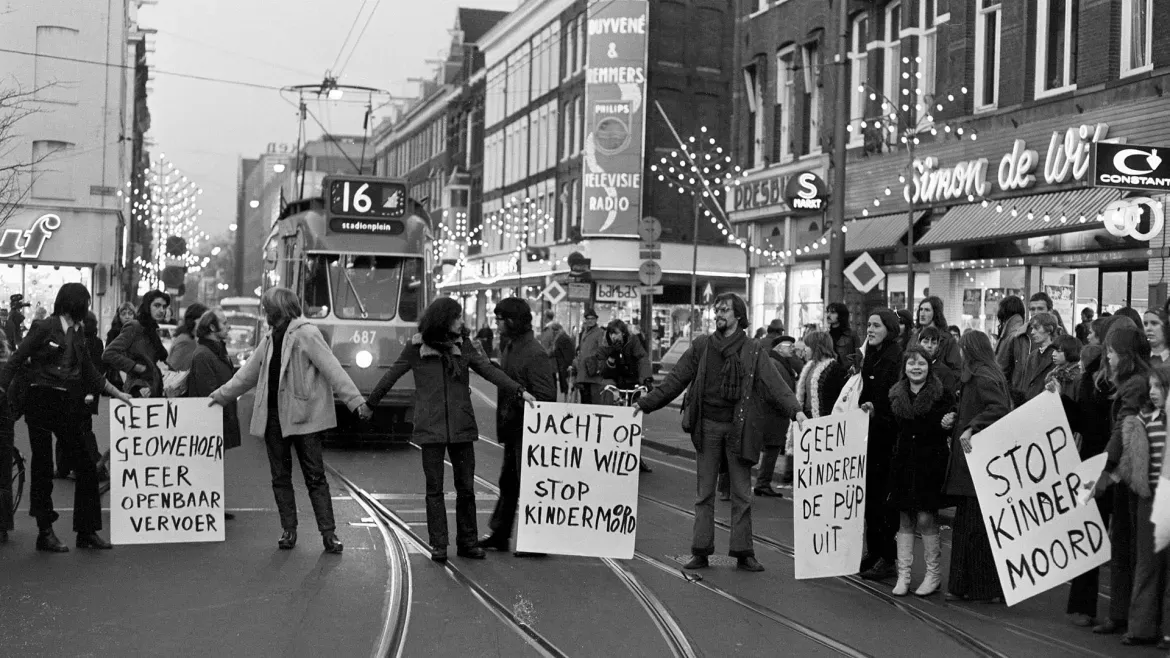
It’s easy to look around the Netherlands today and imagine that it’s a place that has always prioritized cycling accessibility. But decades ago the Netherlands was as susceptible to the siren call of the automobile as the United States and many other countries. It took a surge in traffic deaths, particularly among young children, to jumpstart the Stop the Kindermoord (stop the child murder) movement which ultimately led to improved Dutch cycling infrastructure.
Vic Lagenhoff lost his daughter, Simone, in 1971 when she was killed by a car while biking to school. Simone was one of over 450 children to die in traffic accidents that year. In 1972 Lagenhoff published an article in the newspaper De Tijd where he publicly called for changes to make streets safer for children. The article pushed angry Dutch parents and activists to form the Stop the Kindermoord movement which eventually resulted in protests and demonstrations across the country. At the core of the group’s argument was the idea that children should not be held solely responsible for their safety on the roads. Traffic should be organized in such a way that children could play and cycle without danger. Drivers should be considered guests on the roads in residential areas instead of making car traffic a priority.
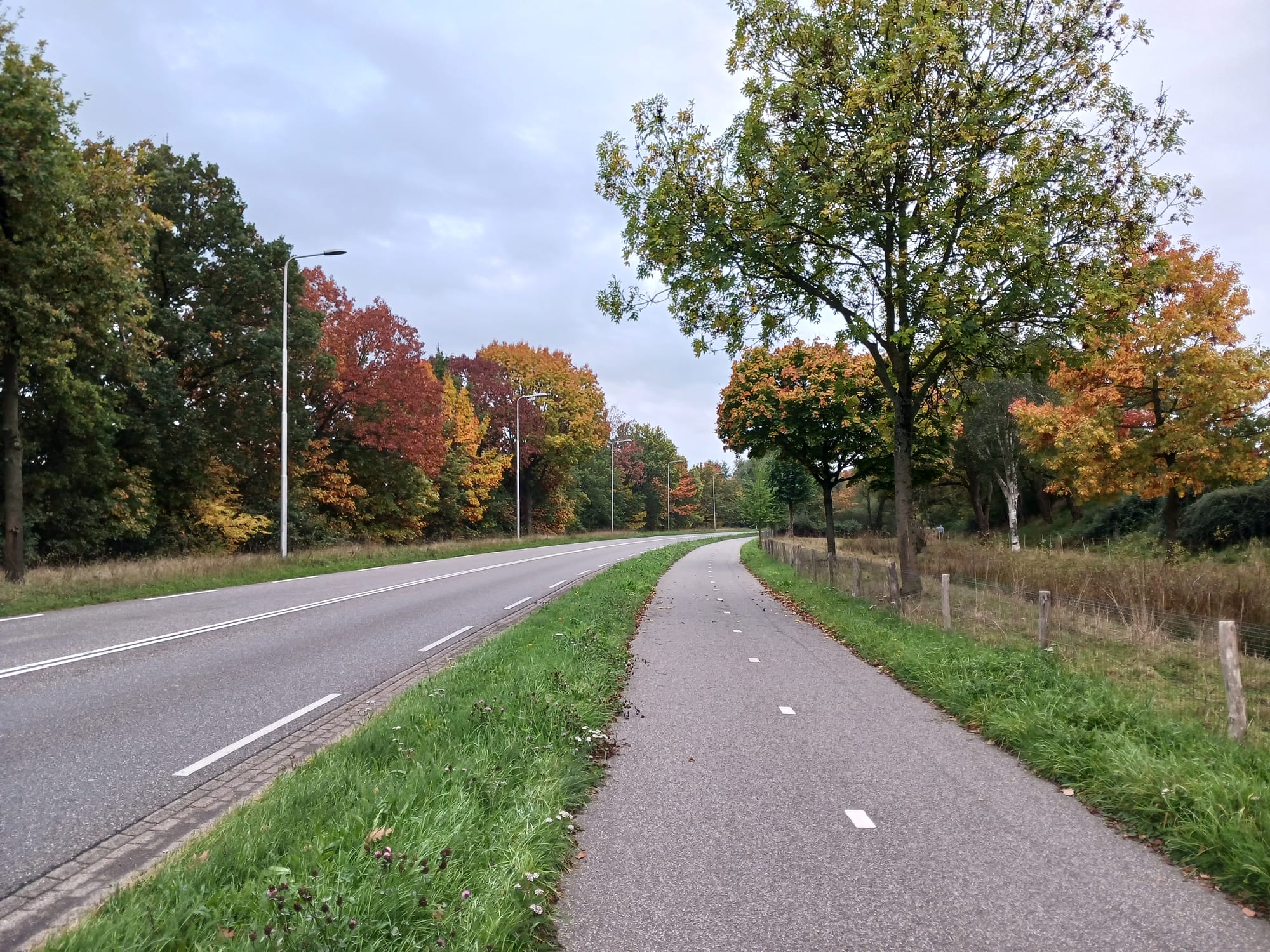
This attitude of cars as guests remains today and it’s apparent in how the streets are designed. The road in front of my house is residential. It’s paved with red bricks which signal to drivers that this is a “shared space” street. The speed limit on residentials streets like this is 15 kilometers per hour. From the table where I sit and work, I see people walking and biking throughout the day. The road is too narrow for two cars to pass at the same time, so everyone is forced to slow down. It’s sharply different from the residential street in our old Milwaukee neighborhood where cars constantly blew through the intersection in front of our house and sped down the street.
In 1974 the Dutch government began to listen to the Kindermoord group. The transportation minister outlined a plan that included bicycle lanes separated from vehicular traffic and reduced speed limits in residential neighborhoods. There was widespread support for the plan, not in small part due to the 1973 OAPEC oil embargo. The skyrocketing price of oil encouraged more people to search for alternative means of transportation – it’s always really about the oil. Nevertheless, cycling was suddenly more financially appealing on top of people wanting safer routes.
The vast cycling infrastructure present in the Netherlands today didn’t appear overnight. It took years for many of the proposed changes to be implemented. Cities such as Tilburg and Den Hague experimented with limited cycling paths in the 1970s. Delft was the first city to introduce a complete citywide cycling network in 1987. The network connected neighborhoods with shopping, public transportation, the university, and other city amenities. Cycling use grew in Delft as people were able to bike more easily on the newly constructed cycle paths.
Around the time the Delft cycling network was completed, the government took a step back from centralized funding for cycling. Once the funding was removed, the push to build more cycling networks fell apart. During this period without government support, automobile traffic and congestion climbed. So did traffic deaths. Vehicle emissions rose as more drivers filled the streets. Fortunately, the Dutch recognized the negative health and environmental impacts of increased automobile emissions. The national government returned to cycling as a solution to the worsening air quality problem. Policy changed to encourage municipalities to design safer cycling routes, connected cycling networks, bicycle theft prevention measures, and ample, accessible bicycle parking. The government enticed cities to embrace cycling by offering financial subsidies to help municipalities build infrastructure. The result of years of hard work on the behalf of cycling lobbyists, activists, and the Fietsersbond (cyclist’s union) is a country that now has over 35,000 kilometers of cycling lanes and far more bikes than people.
I’ve lived in the Netherlands for a year and a half. I can’t think of a single time when I’ve missed owning a car. Our small city of about 50,000 people is easy to get around either by bike or on foot. The train station is a five-minute bike ride from our house. There are six grocery stores within a mile. Neighborhoods blend smoothly into retail areas, hospitals, schools, and parks. It’s something like the so-called “fifteen minute cities” you may have heard conservatives everywhere complaining about. In the U.S., a city this size would be a suburb with subdivisions segregated from everything else by two or four lane roads that are only safe to navigate by car. Furthermore, widely available and safe cycling lanes benefit everyone who commutes. When more people ride bikes, there are fewer cars on the roads. This means the roads are less congested and safer.
This isn’t to say that cycling in the Netherlands is perfect. There are still far too many cars here. About 70 percent of the total distance traveled in the Netherlands is traveled by car with only about 10 percent of the total distance traveled by bike. This shows that many people still choose cars when they must cover a longer distance, even though the cycling infrastructure exists to travel easily by bike. I don’t know what it would take to encourage more people to cycle longer distances. Cars are a difficult habit to shake. Teenagers speeding on fat bikes while staring at their phones are as much of a menace here as they are elsewhere. While the number of fatalities is far lower than it was when the Kindermoord movement began, in 2025, 18 children under the age of fourteen died in traffic accidents and 281 cyclists across all age groups were killed while cycling.
This is where the Dutch government soars above the American government. Instead of ignoring problems, the Dutch government and individual municipalities respond with policy solutions that evolve in response to the changing environment. For example, after an increase in serious accidents involving electric fat bikes, Amsterdam banned the bikes from the busy Vondelpark. The city of Enschede has also banned fat bikes in the city center. The speed limit for such bikes is 25 kilometers per hour, but some bikes are modified to go as fast as 60 kilometers an hour. I’ve experienced the jump scare of a speeding fat bike overtaking me on the cycling path many times and I’m always shocked by how fast they fly by. Amsterdam and other cities also plan to test a 20 kilometer per hour speed limit in some cycling lanes. Individuals who ride e-bikes, mopeds, and scooters have a higher likelihood of serious injury than those on regular bikes, thus the hope is that instituting a speed limit might help mitigate some of the risk to all who use the cycling lanes.
Even though I have a few complaints, the benefits of Dutch cycling far outweigh the risks. People in the Netherlands have a life expectancy that’s almost three years longer than the United States. Obviously, that isn’t just because people here bike more often (I’m sure access to healthcare is a critical factor), but the ability to safely remain physically active does play a role. This is purely based on observation, but it seems like older people are so much healthier here than they are in the U.S. I see people who look like they are in their eighties biking every day. The pensioners who volunteer at the Dutch language café we attend are spry, sharp, and active.
We all just spent the summer suffocating through soaring temperatures, choking on wildfire smoke, suffering from devastating floods, or withering in droughts. Everyone driving everywhere all the time is not, and has never been, sustainable for the environment. In fact, studies show that anywhere from 30 to 50 percent of trips in a car are shorter than 5 kilometers. If the infrastructure existed, many of these short drives could be replaced with cycling. Imagine if cities in the U.S. viewed cycling with the same fervor reserved for catering to the oil and gas industries. An Arizona State University study found that 17.6 percent of car owners would like to live car free. Another 40.5 percent say they would consider living without a car in the future. The interest is there, but the government must be willing to build the infrastructure that enables people to do so.
Cities that take climate change seriously have tried the Dutch approach to cycling with promising results. Paris instituted a two-part cycling plan between 2015-2026 which invested over €250 million in improvements such as creating cycling lanes and new parking spaces for bikes across the city. Copenhagen has made significant investment in cycling infrastructure, cutting the number of cars in the city and resulting in 43 percent of daily work and school journeys being completed by bicycle. Finally, for those who insist that businesses suffer when cycling lanes prevent cars from parking on city streets, Montreal conducted a study on restaurants in the city center. The results showed that restaurants there had significant growth in business in areas where cycling lanes were added. It turns out people like being able to walk and cycle safely in their cities.
The Netherlands only became the model for cycling infrastructure it is today because of years of sustained action to hold the government responsible for safer streets. It was the voices of the people that forced government action, even though it took a long time. This was able to happen because campaign financing is more heavily regulated here. No single industry or interest can have a stranglehold over every decision the government makes. There are also twenty-seven different political parties in the Netherlands, seventeen of which currently hold at least one seat in the House of Representatives. Unlike the two-party system in America, one group typically lacks the ability to dominate decision making. Not to say the Netherlands is perfect – Geert Wilders’ horrid PVV party holds nineteen seats in the current house of representatives. I feel more confident in the government here, though, because the sheer number of political parties provides some protection against far-right nonsense while also allowing elected representatives to work in the best interest of the people rather than big money industry donors.
Imagine if the problems that plague the U.S. such as lack of healthcare, guns, better public transportation, safer streets, poor resilience to climate change, and (again) guns had years of government action dedicated to solving them instead of caving to the NRA and the oil and gas industry. I was a high school senior in 1999 when Columbine happened. Since then, there have been 252 school shootings in the United States where at least one person has died. This number only includes school shootings, not the other mass shootings that happen with frightening frequency. Yet American federal gun laws have been weakened since 1999. There are groups demanding action against guns, just as the Stop the Kindermoord movement did in the Netherlands. The difference has been a government unwilling to act out of fear of wealthy and powerful donors and lobbyists. It’s now a government that exists only to make everyone’s lives worse.
When we moved here, I had only ridden a bike once or twice in the previous twenty years. It took me a few months to get comfortable with biking again. I’m still a little jumpy at some intersections and roundabouts where, even though they’re supposed to stop, I always fear cars are going to barrel through. I wear a helmet even though almost no one else in the Netherlands does. It makes me feel safer, even if that’s just an illusion. The anxiety I feel about biking is nothing compared to the cold sweat, fists clenched on the steering wheel anxiety that driving in the U.S. frequently caused. I hate driving, but I’ve grown to truly enjoy biking. It’s refreshing to pedal to meet friends for coffee or to pick up groceries instead of having to drive everywhere. As an unexpected bonus, cycling was a valuable alternative to running both when I was injured this spring and during the heatwave this summer when it was too hot to run safely.
Obviously plentiful cycling networks aren’t the cure for everything wrong in the world today. We aren’t going to fend off fascism with our bikes. But cycling infrastructure gives people the thing fascism seeks to strip away – choice. Bikes give us a choice to step away from cars, an opportunity to make small decisions about our actions that don’t contribute to worsening the climate crisis. Bikes might not fight fascism, but holding governments accountable to give us safer choices is a step in the right direction.
Jessica Swearingen is an expat freelance writer who lives in the Netherlands with her husband and two senior cats. She also writes the Pep Talk newsletter.
A reminder from the Hell World book why I am always so much harder on Democrats.

Did you know my most recent book We Had It Coming isn't even a year old yet? Hard to believe since I never shut the fuck up about it. Here are some people with good taste.

Paid readers can keep reading for a few new short pieces by me and some more thoughts on losing a loved one and the song of the week and some other stuff I think of and then write down.
I love you.
We finally all got together to say goodbye to my uncle earlier this week. I wrote about his passing in this one.
 Luke O’Neil
It was lovely seeing the whole big family and his old friends in one place but there were not 50,000 people there and that made me really angry. The kind of anger that I couldn't shake for a few days. The fucking world should stop for every death whoever it is.
Someone dies somewhere every few seconds but I don't care.
Don't quote me out of context with that sentence.