After decades of naked exploitation
A rare triumph for workers over capital

Luke DeCock reports from Indianapolis from the first NCAA Final Four where athletes are being paid directly by their schools. This will go out in the next edition of the newsletter. Subscribe to help pay our reporters if you can.
by Luke DeCock
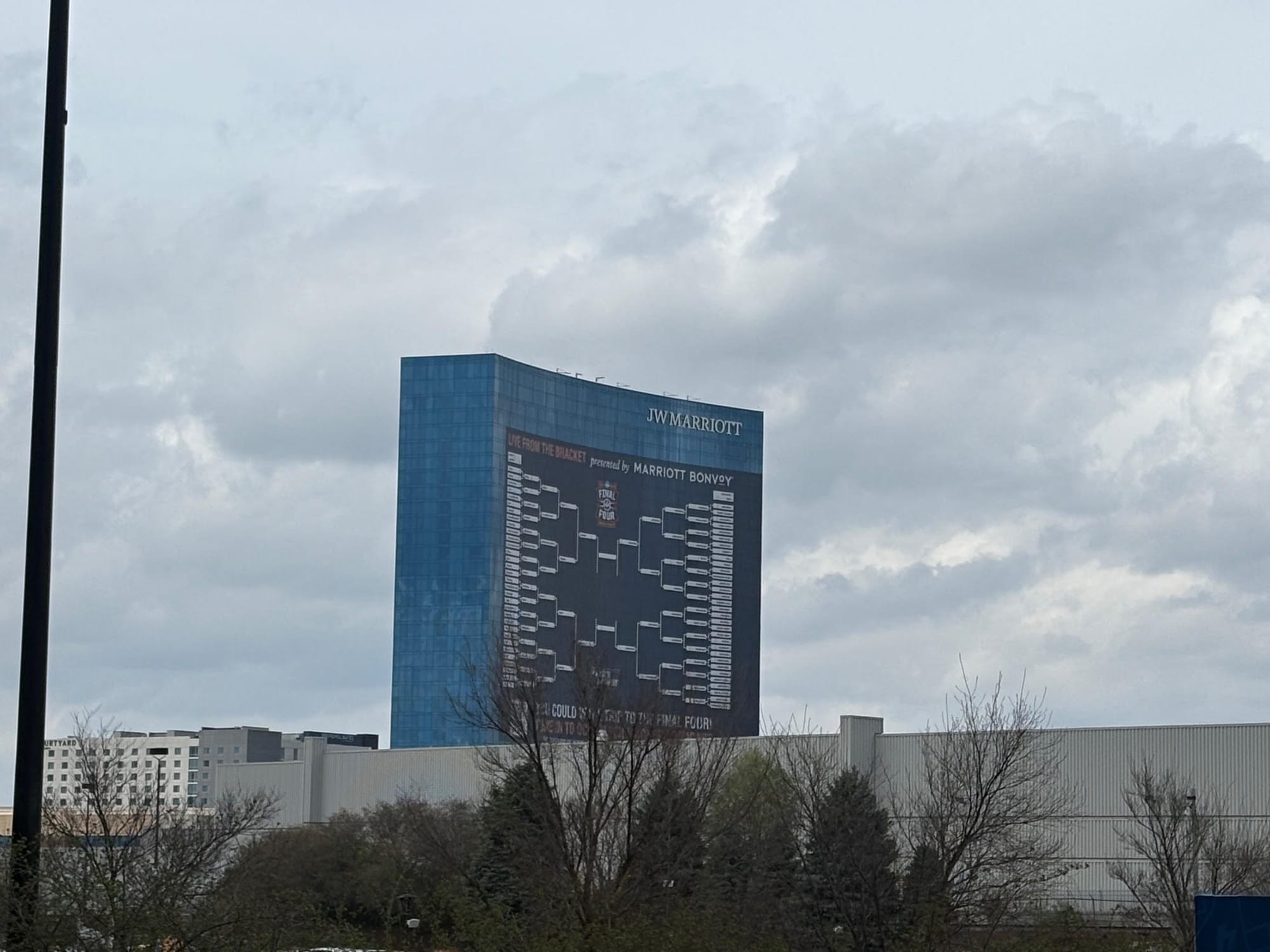
A giant NCAA basketball Tournament bracket looms over downtown Indianapolis, 34 stories high on the facade of the JW Marriott hotel. If you weren’t already aware the Final Four was in town, it would be impossible to avoid it. The bracket is, of course, prominently sponsored by Marriott Bonvoy.
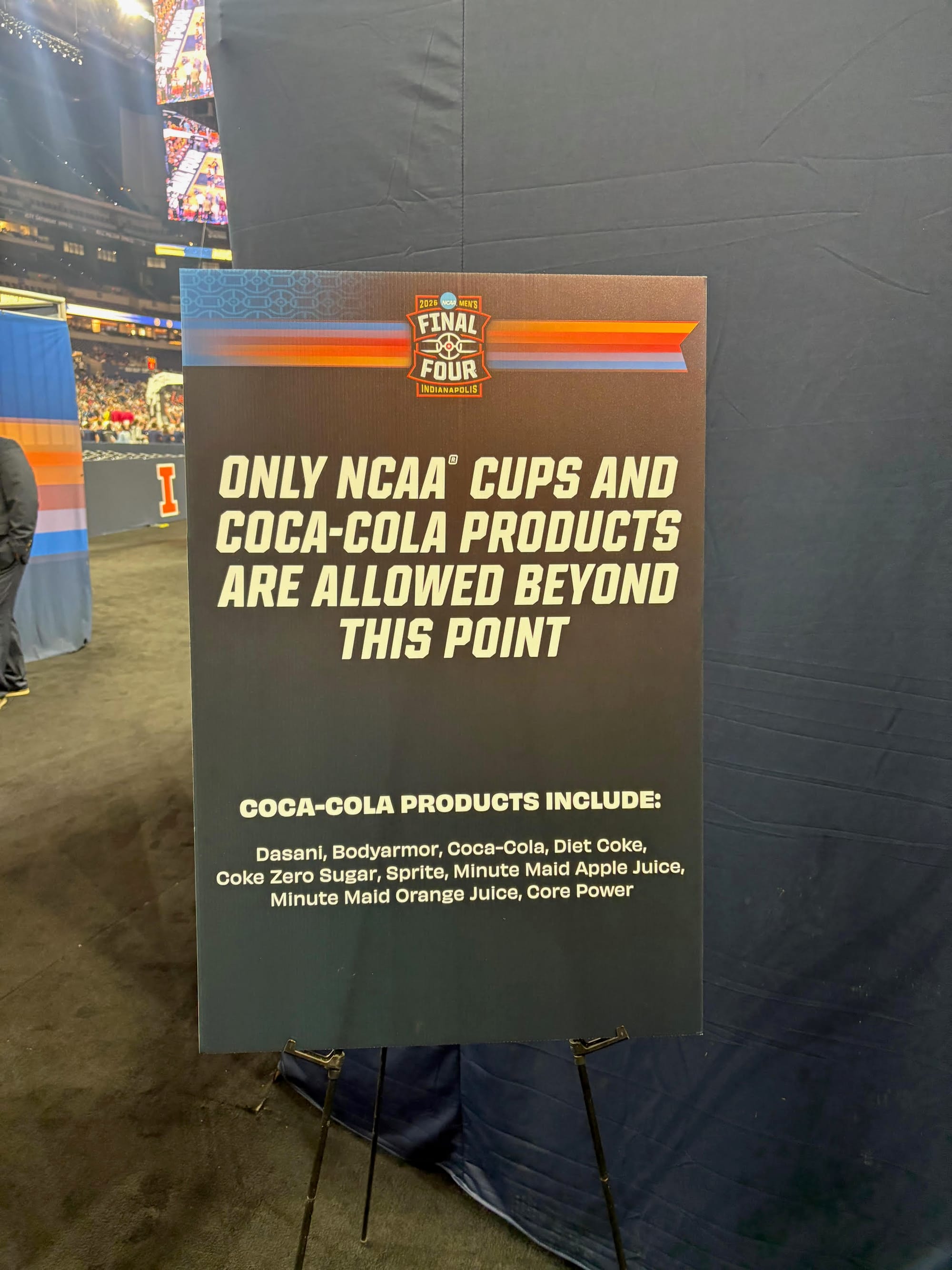
One of four basketball teams — Arizona, Connecticut, Illinois, Michigan — is going to be a national champion Monday night, but the brands are always the big winners at the Final Four. On television it looks like any other major sporting event, with the same commercials from the same sponsors over and over again. In person those sponsors are even more omnipresent, more so than at the Super Bowl even. The logos are everywhere. You cannot escape them.
And yet amid this supernova of hypersponsored apex capitalism labor can claim a massive victory.
After decades of naked exploitation, this is the first Final Four to be played by athletes paid directly by their schools. The entire men’s basketball tournament has been generating billions of dollars for the NCAA for years, money that goes to conferences and then the individual schools. Some of the money has finally filtered all the way down to the players who actually generate it. The reason any of us pay attention to the sport in the first place.
“I tell our younger guys they’re very blessed,” Michigan player Roddy Gayle Jr. told me. “Even my freshman and sophomore years, it wasn’t very much a thing. Just kind of seeing the money people are allowed to make and benefit their families. I know a lot of these guys come from literally nothing. So being able to support their communities, their families, even these past two years being able to support my family, it just means so much to me personally. I know how much it means for other people as well, just the ability to earn exactly what you work for. It’s been a really good element for us, my family, my community as well.”
It’s a stunning change from decades of a commitment to “amateurism” that outlasted even the Olympics and made generations of coaches and administrators rich on the backs of unpaid labor. There was a time when the finances involved in college sports were modest enough that a scholarship was fair compensation, but those days ended when television contracts hit 10 digits and players started to notice how much money was flowing through the system. Eleven years ago there were rumors of a player walkout or boycott at the Final Four led by a polymath Wisconsin player named Nigel Hayes. It never came to that.
After years of legal battles, including getting spanked in a concurrence by Brett Kavanaugh, of all people, in a 2021 case that reached the Supreme Court, the NCAA settled a pivotal lawsuit last spring and finally allowed schools to make direct payments to athletes. It’s not much to start, $20.5 million a year under the guise of “revenue sharing,” but it’s a fundamental change to the economics of college sports. (The NCAA loves that kind of verbiage. Its sponsors are “corporate champions” just as the players are “student-athletes.” It trademarked the phrase “March Madness” in 1988.)
Most of that $20.5 million goes to football players, but men’s basketball players typically get the next biggest chunk. Throw in what players have been allowed to generate since 2021 via endorsements and influencer deals by capitalizing on their name, image and likeness — they were previously prohibited by the NCAA from any use of their so-called “NIL” rights, even in ways totally unrelated to sports like recording an album or acting in a TV show — and a lot of athletes are sticking around college longer instead of turning pro early because they can make more on campus than they can playing in the Uzbekistan league. Women athletes in particular have benefitted from NIL, with many converting massive social-media followings into considerable income.
Turns out that letting a quarterback sign autographs at a cell-phone store or having a burrito named after a basketball star didn’t bring about the end of the world. The NCAA spent years claiming under oath that unpaid players were the reason for college sports’ popularity, but fans haven’t stopped watching. Ratings for college football and college basketball, men and women alike, have never been higher. Lucas Oil Stadium, the home of the NFL’s Indianapolis Colts, holds more than 70,000 people for basketball. Every seat will be filled Saturday night.
The veteran Tennessee coach Rick Barnes jokes that NIL means “Now It’s Legal” but he also, at age 71, has adapted to his new world. You don’t need to spend millions on a locker room with a barber shop or a football facility with a flight simulator and lazy river to land a recruit — the money always had to go somewhere! — let alone make sure a new car shows up in his uncle’s driveway or any of those old gambits. You just … pay him what he’s worth instead.
“It’s easy,” Barnes told me. “You can recruit a guy now for a week and get him. You know what I mean? ‘Hey, what’s the number?’”
For Michigan’s Yaxel Lendeborg, the biggest star at the Final Four, that’s reported to be about $5 million in revenue-sharing and school-arranged NIL deals for his lone season in Ann Arbor after transferring from Alabama-Birmingham. That’s around $2 million less than Kentucky offered. Connecticut’s Alex Karaban, playing in his third Final Four, makes more than $2 million per season. Arizona freshman Koa Peat, represented by LeBron James’ agency, has endorsement deals with CVS and Turbo Tax.
It’s a rare triumph for workers over capital as the free market does its thing, finally placing appropriate value on the economic benefits college athletes have always generated for others: St. Bonaventure even just announced it was going to pay its new head men’s basketball coach less so it could allocate more money to its players. Still, schools routinely complain about their ability to pay actual salaries. The former commissioner of the Big Ten once testified that if a minor provision allowing schools to pay players for books and living expenses was approved, his league would drop scholarship sports entirely. (The Big Ten has its own cable network and deals with Fox, CBS and NBC worth $1 billion a year.)
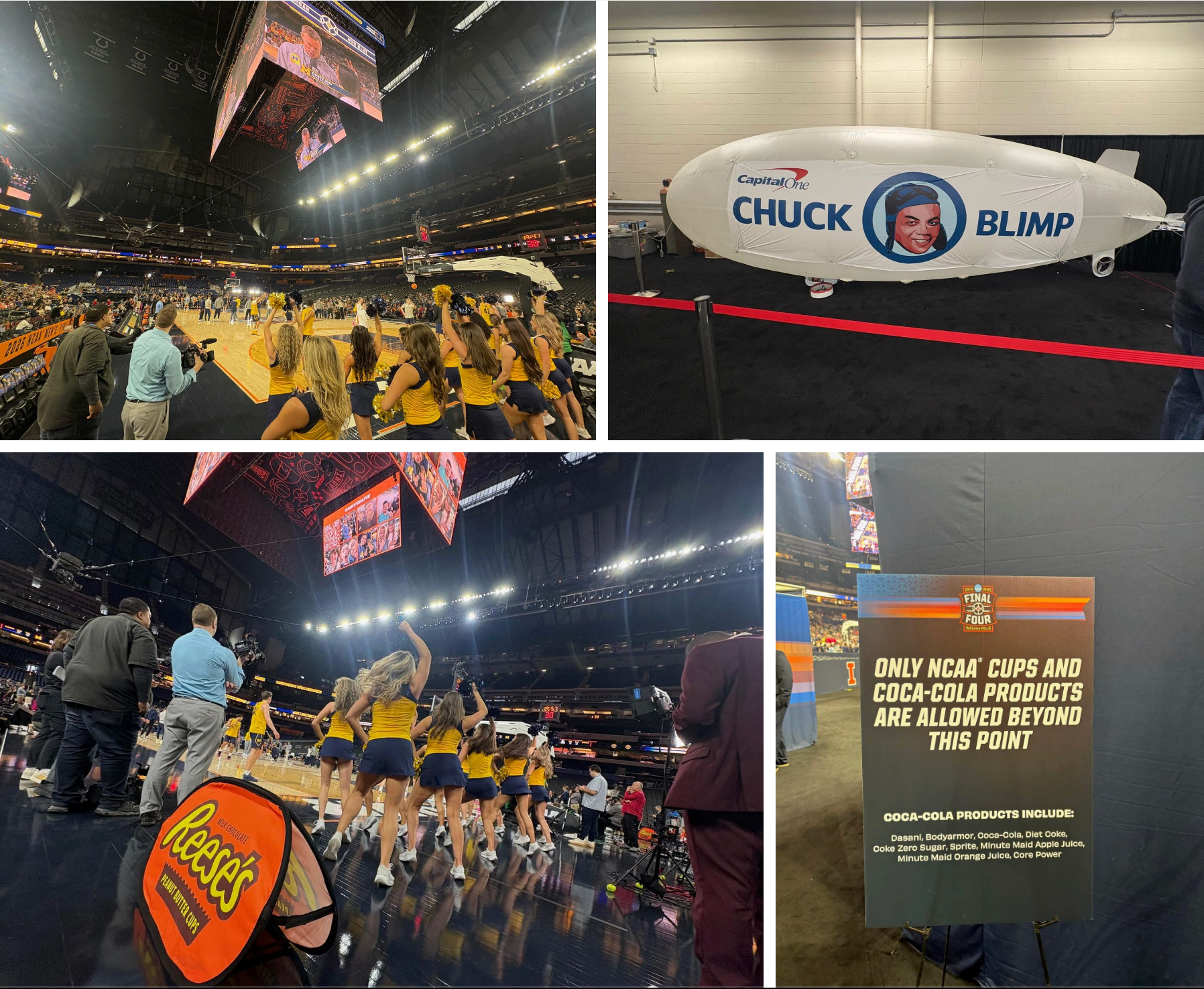
Here in Indianapolis, the home city of the NCAA, the ubiquitous branding of those corporate champions tends to mock those kind of concerns. A lot of the money comes from the NCAA’s own billion-dollar broadcast deal with CBS and Turner, but if there’s a logo to be slapped on something, a logo will be slapped on it. These are the only college basketball games all season played in giant NFL domes, because the NCAA can and does sell those 70,000 tickets at extravagant prices. It’s always a weird atmosphere for the games themselves, with the court propped on an elevated stage at the 50-yard line in a building big enough to fly a blimp inside, provided it’s a modestly sized blimp. There are two of them staged in a hallway under the stands, emblazoned with Charles Barkley’s smiling face and the Capital One logo, both familiar sights here.
The Men’s Final Four Fan Fest is sponsored by Capital One. The March Madness Music festival is sponsored by AT&T, Capital One and Coke. Friday’s College All-Star game is sponsored by Reese’s. The Men’s Final Four Dribble, whatever that is, is sponsored by Geico. Requests to discuss the Official Gummy of the NCAA Tournament, Shaq-A-Licious SLAMS, with Shaquille O’Neill “are available and will be approved on a case by case basis.” The Men’s Final Four Tip-Off Tailgate stands out for its sponsor-less logo. Your name here.
At last weekend’s Midwest Regional in Chicago, members of the Communication Workers of America handed out flyers to fans entering the arena pointing out that AT&T spends millions sponsoring the NCAA “while the workers that make the company billions get boxed out at the bargaining table.” AT&T sponsors everything, the flyers read, except its employees. Here everyone sponsors everything.
For years a selection of Unilever brands — Degree deodorant, Dove body wash, etc. — was prominently displayed in every player’s locker, to be visible in the background of television interviews and photographs. Many players would discreetly throw them into their backpacks after their final game, along with the signs and other paraphernalia that decorates the locker rooms.
“I guess I don’t know if anything’s different from previous years,” Illinois’ Jake Davis said when I asked. “They bless us with a whole bunch of gear and stuff and countless things. They’re going to let us take all of this Final Four stuff home.”
Even that’s a change; in 2019, an Iowa player took a “March Madness” floor mat home, then held it hostage when the NCAA demanded it back. “Give us the ability to make money off our own name and we’ll give you your rug back,” Jordan Bohannon tweeted at the NCAA. “You have 24 hours.” It took a couple years, but Bohannon won.
Reminders of this new world are everywhere now. In the Illinois locker room on Thursday, two players were battling in NCAA Football 25 on a big-screen TV, an amenity provided by the NCAA. The names of the players in the game were the names of the actual Washington and Toledo players, their fellow college athletes, thanks to NIL.
EA Sports originally made the popular game with faux rosters using only jersey numbers that clearly represented real players, until a group of former athletes sued and won. After a nine-year hiatus, EA Sports brought the game back last year. The football players who signed the contract each received $600 and a free copy of the game; the next version of the game will pay each $1,500.
“Just being a part of something like this, it’s game-changing,” Gayle, the Michigan player, said. “Kind of laying down the foundation and also living our lives through the people before us. We know how hard those guys worked, everything that has happened in the past and us finally being able to benefit from that, I’m just very thankful for those guys who came before me.”
The rosters of these final four teams playing this weekend were expensively assembled through “revenue-sharing” payments negotiated directly with the players, their value defined not by arbitrary rules but the free market for basketball talent. A lot of people are still getting rich because of the game they play. But now they are too.
Luke DeCock spent 20 years writing about college basketball as a newspaper columnist in Raleigh, NC. He’s a three-time North Carolina Sportswriter of the Year and a member of the US Basketball Writers Association Hall of Fame.