It’s what makes us human

David Roth on a Rob Zombie painting exhibit
It’s what makes us human

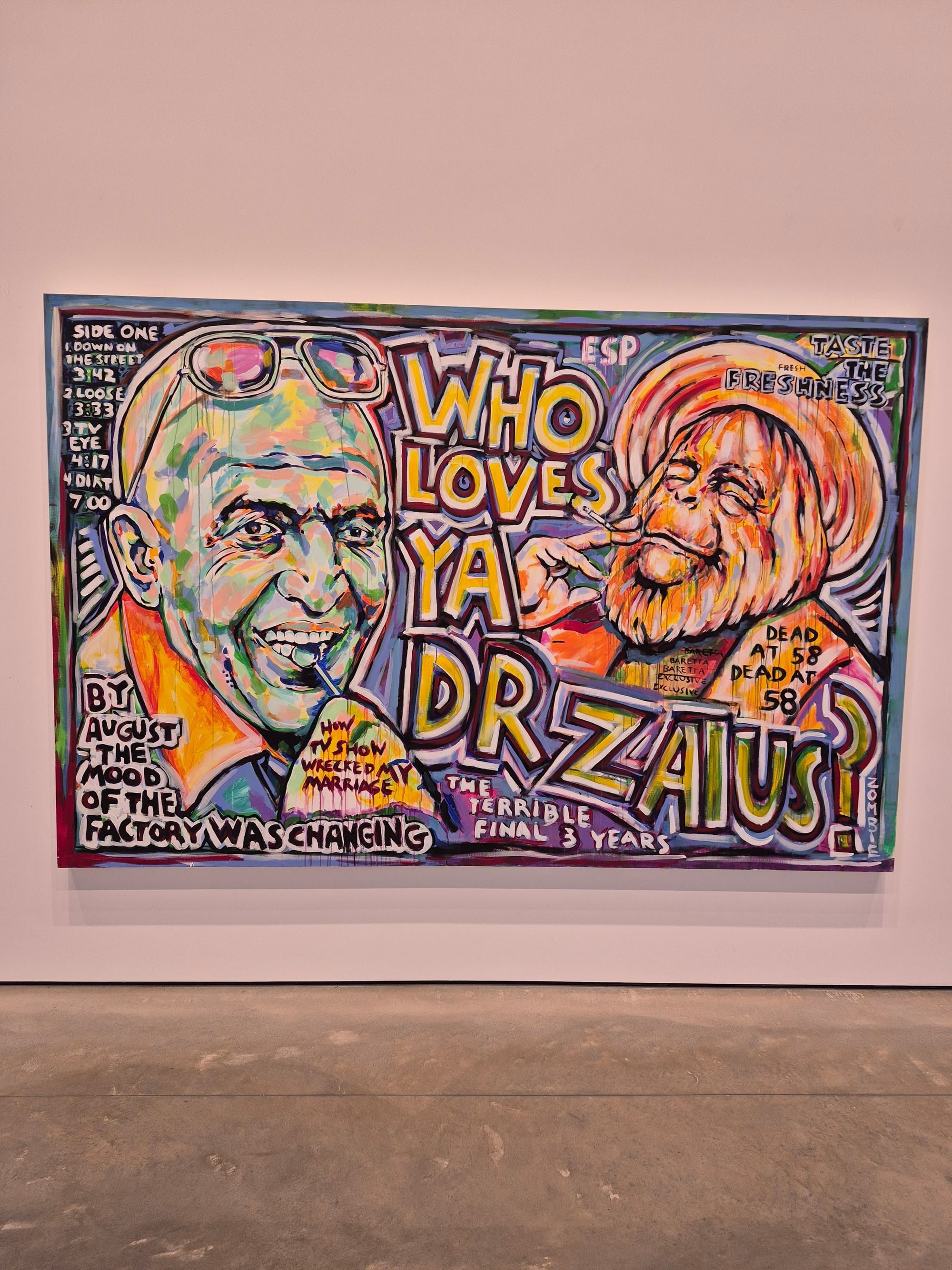
Last week David Roth texted from a weekend away in Connecticut that he had just walked by what looked like a Rob Zombie painting exhibit. Please go in and write about it I said instantly. He did. Unsurprisingly he nailed it. I'm excited for you to read it.

This to me is what it's all about by the way. Being able to publish writers you admire greatly writing about whatever happens to catch their attention. Even if – or especially if – it's not about all of this.


This was originally for paid subscribers only but I'm opening it for anyone. Please consider a subscription to support our work here.


I felt similarly about this piece by Parker Molloy from the other day. It's a must read I would say.
I've got a piece up today at @lukeoneil47.bsky.social's Welcome to Hell World. Check it out: www.welcometohellworld.com/a-coordinate...

Parker Molloy (@parkermolloy.com) 2025-12-02T19:03:50.730Z

Here's an all too predictable follow up:


David Roth as you probably know is one of the people behind Defector – the last good website. The last time he turned up in Hell World was right after he and the gang had up and quit Deadspin. We talked about it here. It's interesting to go back and look at how different things are now. And how they are nevertheless the same.
We chose not to continue to eat shit

So too with this interview I did with a bunch of the other Defector folks right before they were about to launch the site in July of 2020. July 2020 man. What a concept.


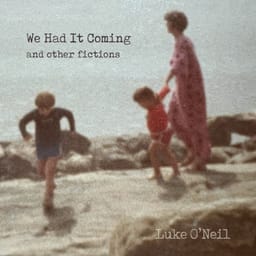
Speaking of R0b Zombie he also has a cameo in a short story from my new book We Had It Coming. It's the one about Pete Buttigieg eating a shredded up Cinnabon like a buffalo wing.
I’m not saying you shouldn’t try to help
This story appears in my new book We Had It Coming available now. I was looking at my phone on the couch when D___ looked up from her phone on the couch and she goes please don’t ever open the door for a strange woman if she arrives asking

It goes in part like so:

Our niece had slept over a few nights before and she’s at that age where she’s starting to watch horror movies and loves to talk about them almost to scare herself on purpose in the daylight when it's safer. To poke her feelers out into what the frightening world can sometimes be in the way that kids do. She asked me what my favorite horror movie ever was and I thought about it for a minute or two and couldn’t decide on just one like I was worried about insufficiently impressing this child with my refined taste and I said well I will tell you one horror movie that has stuck with me because of how abject and mean it was and that is House of 1000 Corpses. It was made by Haverhill Massachusetts’ own Robert Bartleh Cummings I said and she said she hadn’t heard of it. I thought about pulling up More Human Than Human for her on YouTube to illustrate what the nineties were like for me and her parents more than anything but instead I said have you ever heard of the band Wet Leg and she said what and I said have you ever heard of the band Wet Leg and she said yeah. She said that she had heard of them. D___ said what band are you talking about and I sang a little of Chaise Longue with the cute accent and everything and she said oh right. 

I don’t think I’ve ever spent any real time in Haverhill despite having a degree in Massachusetts Studies (unaccredited) although I know it’s a decently large river milltown that has probably seen better days even though it was founded something like four hundred years ago. To be frank I imagine the days were worse then no matter what it’s like there now. No one ever says a town has seen worse days it’s always the other way around.

Here's Roth. Then a bit more from me after that.
It’s what makes us human

by David Roth

It’s one of the little games a person plays while going through the Becoming Washed years—is it upsetting that this person, who mattered to you in your youth or was just ambiently present for it, is now old? For instance: Kenyon Martin, who I pretended to be while dunking on a subway station beam while waiting for the train on the way to my first adult job, has a son who is also a professional basketball player. That’s fine, I guess; people start families, and it has been a long time since I did a chin-up in a subway station. Now consider that the kid is currently playing in China, and quite possibly done as a NBA player after several years spent bouncing around various benches. Well that I don’t care for. I actually think that’s rude. It’s a delicate balance, and an entirely arbitrary one. 

It was initially surprising to me that I found it fairly easy to process the fact that Rob Zombie is 60 years old, and painting. There was never a public version of Rob Zombie that seemed young, exactly; the look he cultivated was closer to “previously dead” than anything traditionally youthful. There was too much stagecraft and artifice and makeup and hair involved in the version of Robert Cummings (that’s his name) that became famous to get an accurate reading re: when the very gnarly man howling at the center of all that strobing light and noise—a man who had very consciously styled himself like one of the feral desert weirdos from the 1977 version of The Hills Have Eyes—might have graduated from high school. You wouldn’t think to worry about how old that dreadlocked dead guy in a big weird hat is. You would be more concerned with how recklessly he is driving his overstated steampunk car

Zombie became extremely famous and successful making arch, theatrical, glossy heavy music during what now looks like the last period in which anyone could do that. In the interest of disclosure, I should note that I never really vibed with the music Zombie made in his platinum-plus era, first with the mid-’90s iteration of White Zombie and then as a solo artist; the hits, which were all I really heard, all sounded too shiny for my taste, and while I appreciated that there was an elaborate joke embedded in all of it, I never quite felt like I was in on that joke. (I was happy to discover, while preparing to write this, that White Zombie’s significantly skankier late-’80s stuff, which the Numero Group remastered and released as a deluxe box set in 2016, is excellent; when I was in middle school and Zombie really was young, the band sounded kind of like The Stooges.) (I am also old.)

But if I never exactly liked Zombie’s work as a musician or as a filmmaker, I have always respected him as a Type Of Guy. A proud TV super-consumer, Zombie started directing his own music videos during the ‘90s—they’re derivative and of their moment, but you can generally see that there’s something there—and has since directed a number of startlingly cruel horror films, with his 2007 reboot of the Halloween franchise the most lucrative and 2003’s House Of 1000 Corpses probably the most unsettling. Zombie churned fairly quickly out of the big studios after two profitable but not critically well-received Halloween movies, but has continued to make extremely brutal, extremely stylish, formally accomplished and luridly vile movies ever since. That these films, in which his stock company of lumpy-menacing ‘70s and ‘80s character actors (and his wife, Sheri Moon Zombie) mostly do terrible things to other people, are tasteless and ugly is something like the point. Zombie is not trying to elevate or update the nasty canon of ‘70s horror films that did so much to shape his aesthetic so much as he is trying to replicate them, and credit where it is due: he really is good at that.

As with his music, I have absorbed a decent amount of Zombie’s film work without ever quite liking any of it. There’s a vision that runs through all of it, and I don’t have to like The Devil’s Rejects to appreciate that the Hollywood Vampire rock star types who were once Zombie’s cultural peers couldn’t and more crucially wouldn’t have wanted to make it. It’s a weird thing to respect an artist this much without actually liking any of their art. Maybe I just needed to be in Connecticut, looking at a massive canvas onto which Zombie had painted the faces of both Dr. Zaius from The Planet Of The Apes and Telly Savalas in Kojak, for it all to fall into place. Or maybe I just needed him to be 60.


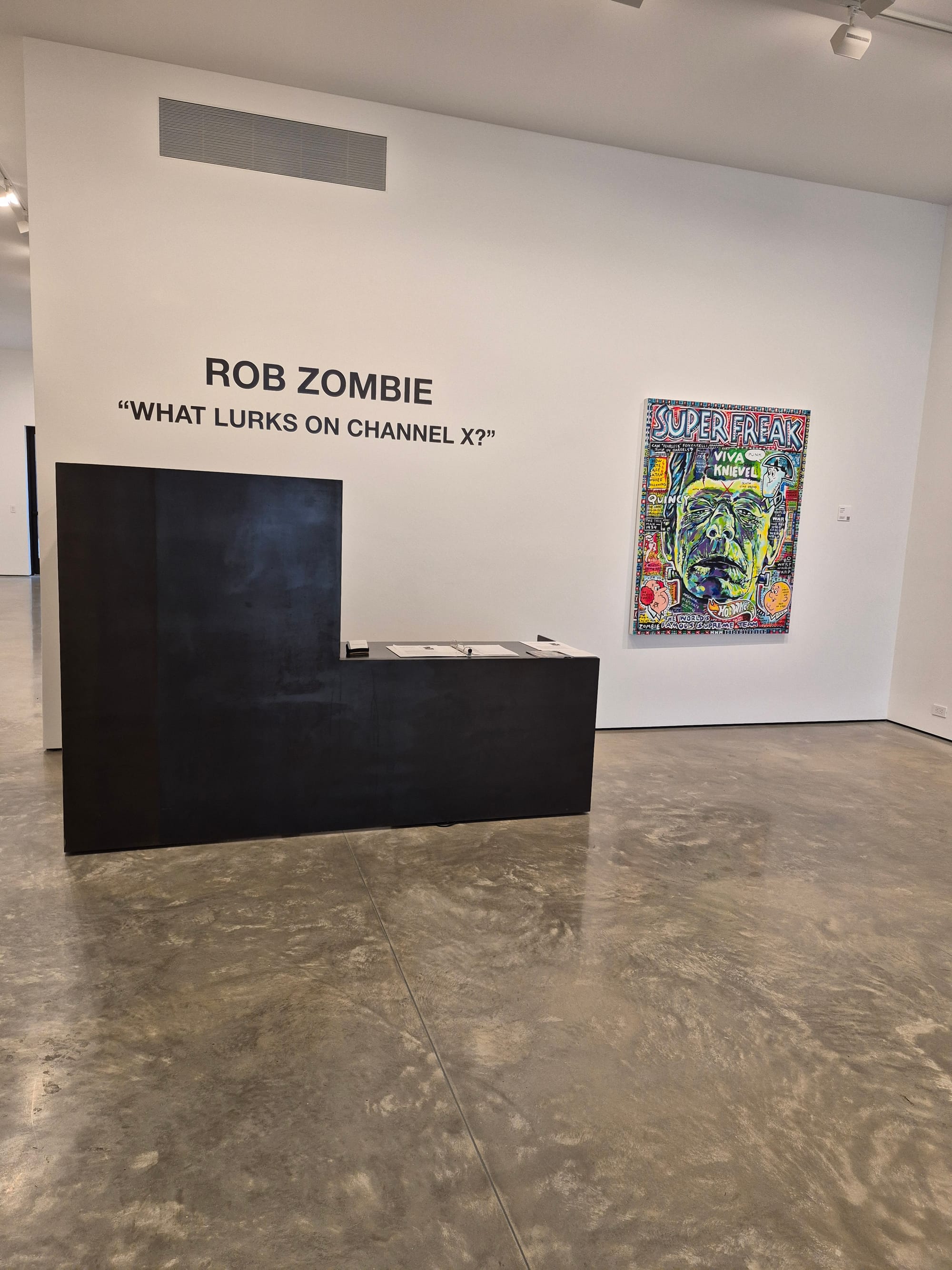
What Lurks On Planet X, Zombie’s first gallery show, has been open at the Morrison Gallery in Kent, Connecticut since October 25, and will close this weekend. I did not see this show on purpose. My wife and I were in Kent, a small town where I once went to summer camp and where both Ted Danson and Lana Del Rey attended private school, to eat a fancy dinner and stay in a nice inn and mostly just not be in New York City for a little while. Despite having spent five summers there, I had no real sense of what the town was like, and beyond the fact that the places where the counselors used to go to drink beers—Kent Pizza and The Fife & Drum—were still there, every bit of it was a surprise to me. The bookstore was very good. The cheese shop was expensive, but cheese shops tend to be like that; the discounted misfit chunk of local gouda we got was delicious. The fancy dinner was very good, and the pizzas we ate in a different dining room in the same building the next night were also good. Spending some time with Rob Zombie’s visual art was not part of that plan.

But the Morrison Gallery was more or less right next to where we stayed, and a look at the work on the gallery’s website—enormous canvases crowded with references to the ‘70s junk and carnage that shaped Zombie’s worldview, all of them glowing an unholy yellow that were less the ambient piss notes of AI art and more an irradiated shade of Gatorade —suggested that it was worth a visit. To me, anyway. While I was staring at an enormous cartoon visage of Frank Zappa surrounded by the names of character actors and creature features and whatever else was on Rob Zombie’s mind at that moment, my wife was in our room, reading a book.

Zombie has been telling pretty much the same story about himself since people started asking him in earnest in the 1990’s. He grew up in Haverhill, Mass., which is one of the bleaker post-industrial burgs in Massachusetts, and watched TV obsessively, because he loved it and because there was nothing else to do. 

“I’d watch everything,” Zombie told Rolling Stone in 1999, “starting with the crop reports at 5:30 in the morning. My saddest moment was when that flag came up at the end of the night, right before the station signed off. Oh, how the tears would flow!” He estimated that he watched somewhere between eight and nine hours of television per day, and has cited that figure in interviews for three decades now. 

He has brought it up because it has remained the answer to the sort of questions that interviewers ask him, which tend to be about where he gets his inspiration. When Robert Cummings was becoming Rob Zombie, he watched a lot of monster movies and Gilligan’s Island and whatever else he could watch; watching the TV is, he told the art historian David Ebony when his show opened, still part of his process, to the point where he sets up a TV near the canvas so that he can watch old sitcoms and old cop shows and old movies while he paints characters from them. “Like Warhol,” Ebony said. Zombie wasn’t quite willing to take the comparison. Later in the interview, when Ebony asks if painting is a “meditative state” for him, away from the necessarily more collaborative work he does in music and film, Zombie is more decisive. “Probably not for me,” he says. “Because like I said I’m watching a movie and playing music at the same time.”

It might be that more extreme exposures—your eight to nine hours a day kind—lead to more gnarled expressions, but the extent to which the cultural shit that washes over our brains changes them in the process is overwhelmingly present in Zombie’s canvases. I walked around the show making notes on all the things that were referenced on them, sometimes visually but often just by Zombie scrawling a name or address or movie title or logo on there. You’ve got Kool Moe Dee and Lee Van Cleef and Hollywood Squares and Lee Marvin and John Belushi (dying) and Charles Manson and the Fonz (wearing a Misfits t-shirt) and Betty from the Archie comics with the words “political piggy” written across her decolletage. It’s crowded to the point of becoming claustrophobic, but it’s familiar. “Another side of him,” the woman behind the desk at the gallery said, and I replied “eh, I think this is pretty much the side I’m familiar with” before I was able to stop myself. 

There is a version of these paintings that I could do with the stuff that crowds my own brain—an endless parade of Mets grounding out to second base while the Night Court theme blares and the cast of Homicide: Life On The Street looks on—and you could surely do one with the stuff in yours. Like in a hoarder’s house, little pathways emerge between the wobbling stacks of stuff that you’ve decided to keep, or just been unable to throw out. You will still need to move around in there, but the pathways get narrower as the things pile up.

“Sometimes I think back on stuff and confuse my own life with, like, TV kids’ lives,” Zombie told Conan O’Brien in 2005. He is wry and funny in that interview, the look is turned down about 95 percent, and his voice and affect is very much that of the ardently nerdy, readily bullied kid that he once was. It is a very Rob Zombie answer, although the voice in which it’s given is unfamiliar. Instead of being buried under effects or bassed up for performance, it is just someone making a confession that many people could make—to losing the thread, at times, between the rush of the references that shape us and our own still presence within that current. It erodes and it adds at once; it’s what makes us human, no more and no less.

David Roth is a co-owner of and editor at Defector.


Here's Portugal The Man with Weird Al and Jorma Taccone covering Killing in the Name just like we all imagined happening one day.

I know I said the other day that I don't give a shit about what happens on college campuses but that doesn't apply if they're teaching my work. That to me is good.


"Nobody in First Day Back was alive in the ’90s, but that doesn’t stop the Santa Cruz five-piece from sounding like one of the decade’s foundational emo bands," Nina Corcoran writes in Pitchfork today about their immediately arresting and raw debut Forward. I don't know what else to tell you except that this is, to me, the Real Shit.

Forward, by First Day Back
9 track album

So too is this 2020 Brazilian film Bacurau I finally got around to seeing this week. What a picture! Don't read anything about it just watch it.

Not that I'm exactly watching high quality cinema lately. I just got caught watching Star Wars Rebels in the dark and I said don't make fun of me and she said I won't but I didn't realize your thing looks so bad. I said it's fairly accurate in tone and spirit to A New Hope by the way and she said I feel like I just came down and caught you watching a puppet show.

Time to go. It's so cold.

This came to me in a dream

Jeff Betten (@jeffbetten.bsky.social) 2025-12-05T12:24:28.625Z